

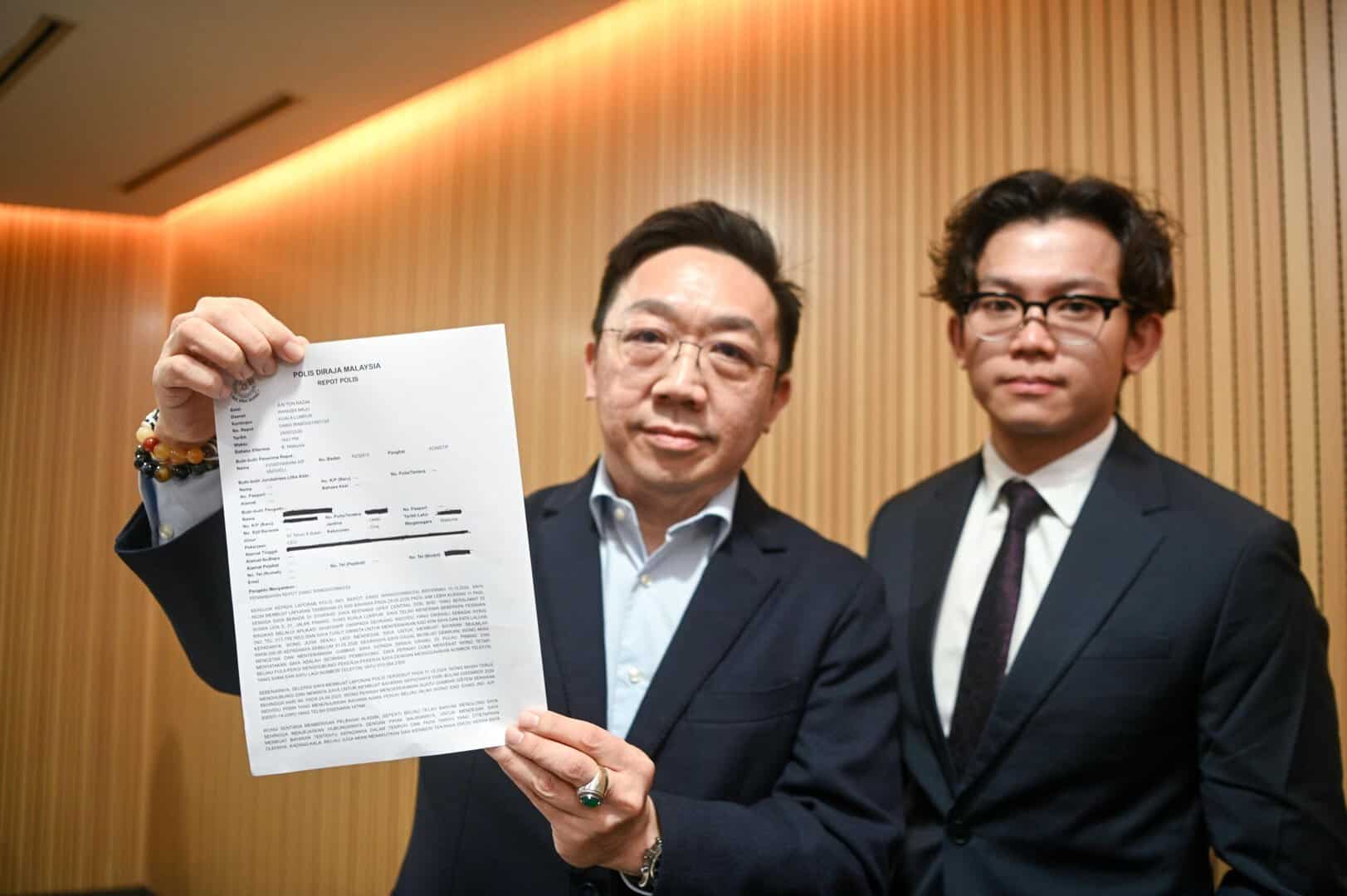

A BUSINESSMAN who fell victim to an online “fast loan” scam has come forward to share his experience, hoping to raise public awareness about the risks and the importance of verifying information before making financial decisions.
Bryan Teow, an education entrepreneur managing businesses in Malaysia and Hong Kong, said he borrowed RM20,000 in September 2024, but the scam ultimately cost him close to RM400,000 after making payments to as many as eight different accounts.
He lodged a police report on May 29 this year after seeking advice from a lawyer, as well as the Democratic Action Party Socialist Youth (DAPSY) Penang and the Penang Chinese Entrepreneurs Association (CEA).

Speaking at a press conference called by state Infrastructure, Transport and Digital Committee chairman Zairil Khir Johari at Komtar today, Teow recounted how he came across a Facebook advertisement in August 2024 and clicked on what appeared to be a legitimate fast loan application from a bank.
At the time, he was facing cash flow difficulties due to legal challenges arising from a matter in Hong Kong. Soon after, he was contacted via WhatsApp by an individual posing as a bank officer.
“Unfortunately, I did not verify the information carefully and chose to trust what he told me. That single click marked the beginning of one of the most difficult periods of my life. What followed was a long stretch of pressure, intimidation, threats, and repeated demands for money,” Teow said.
“Like many victims, I initially believed that if I complied with the demands, the situation would eventually come to an end. Unfortunately, it did not. The scammer showed me photographs and disclosed details about my company, which led me to believe he had connections within government agencies. He also threatened to disrupt my business operations and personal life.
“Throughout these 20 months, I chose to remain silent because I hoped the problem would disappear if I continued to cooperate. Looking back today, I realise that silence was not the solution. The turning point came when I realised that the right thing to do was not to continue living in fear, but to seek help through the proper legal channels. Therefore, I have lodged police reports and engaged legal counsel to assist me in protecting my rights and ensuring that the matter is handled through the proper legal process.”
Also present at the press conference were Teow’s lawyer, Dixon Eng Yuh Pei, DAPSY Penang secretary Benji Ang and CEA president Dr Lee Eng Wah.

Zairil commended Teow for his courage in coming forward to share his story, noting that “many victims prefer to keep quiet, while he wants others not to suffer the same fate.”
He said the scam industry is a major global operation, estimated to be worth about US$1 trillion, with many victims in Malaysia losing billions of ringgit.
“Many of the victims are from vulnerable groups, but not always. Professionals have also been cheated,” Zairil said.
In Teow’s case, Zairil said it is no longer merely a conventional financial fraud, but has escalated into a series of criminal harassment, intimidation, and extortion that affect the safety and emotional well-being of victims, their families, and their business communities.
He added that to coerce the victim into complying with demands, the suspects employed a highly aggressive modus operandi. They claimed to have extensive connections within government enforcement agencies, including the Royal Malaysia Police (PDRM), and even presented documents resembling confidential government databases to intimidate the victim.
In addition, Zairil said the syndicate targeted the victim’s workplace by contacting company management and staff directly, threatening to circulate the victim’s personal photographs around the office and across Penang in an attempt to defame him as a fraudster.
In pursuit of justice and personal safety, the victim lodged an official police report, requesting a thorough criminal investigation into the suspects, the freezing of bank accounts involved in the transactions, and appropriate legal protection.
“The government takes online scams seriously. To curb this issue and help the public avoid falling victim, the Malaysian Communications and Multimedia Commission (MCMC) has organised a Safe Internet Campaign, while Digital Penang conducts regular monthly public awareness programmes focusing on online financial fraud,” he said.
Zairil advised victims to report immediately to the National Scam Response Centre (NSRC) via hotline 997 (within 24 hours if funds have been transferred), the PDRM Commercial Crime Investigation Department Scam Response Centre at 03-26101559 or 03-26101599, the MCMC Complaint Portal at https://aduan.skmm.gov.my or via email at [email protected], or the MCMC WhatsApp hotline at 016-2206262.

Eng, Teow’s lawyer, said that regardless of whether the identity of the scammers can be established, police should thoroughly investigate all bank accounts involved in the transactions.
“We hope this will serve as a lesson that account holders should not lend or allow others to use their bank accounts in exchange for any form of benefit. Those who do so may expose themselves to serious legal consequences,” he said.
He added that online fast loan scams are similar in nature to Ah Long schemes. Typically, scammers first transfer money into a victim’s account before using intimidation tactics, including threats, public shaming on social media, contacting employers, and even reaching out to family members to pressure repayment.

DAPSY Penang Public Complaints Bureau secretary Benji Ang said this marked the fifth case received by the bureau.
Since its establishment, the bureau has assisted with various cases including sexual harassment, fake account fraud, vehicle registration number theft, issues related to higher education institutions, and other consumer and public welfare complaints.
“We urge individuals who have experienced similar situations to come forward. Many victims remain silent due to fear, embarrassment, or uncertainty about where to seek help. However, every voice can help prevent others from becoming victims,” he said.
He added that all information and identities of complainants would be handled with strict confidentiality and professionalism.

Dr Lee said that although cybercrime cases are rising, this was the first such case received by the Penang Chinese Entrepreneurs Association.
“When Bryan Teow came to see me two weeks ago, I advised him to immediately stop making payments to the scammer and lodge a police report,” Dr Lee said.
Story by K.H. Ong
Pix by Siew Chia En