

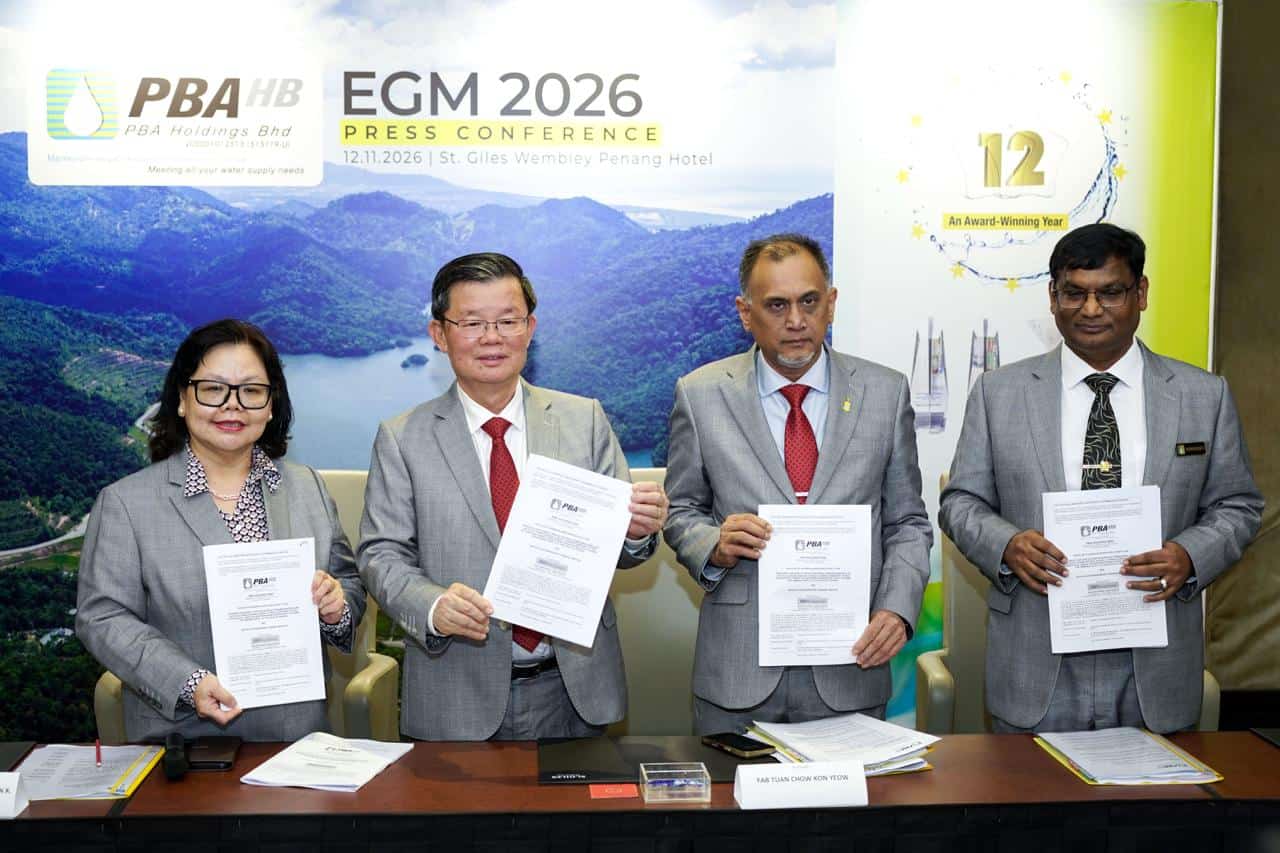

PENANG has secured a major step towards strengthening its long-term water security after the majority shareholders of PBA Holdings Bhd (PBAHB) approved the proposed purchase of between 300 and 500 million litres per day (MLD) of treated water from Perak, beginning March 31, 2032.
The approval was obtained at an extraordinary general meeting (EGM) held at St Giles Wembley Hotel here today, paving the way for the proposed Penang-Perak Water Project (P-PWP) to proceed, subject to the necessary regulatory and official approvals.
Chief Minister Chow Kon Yeow, who is also PBAHB chairman, said the approval fulfilled one of the key conditions under the agreement between the two parties.
He said Perak would now be responsible for undertaking the necessary steps to ensure the project is completed and treated water can be delivered to Penang by the agreed deadline.
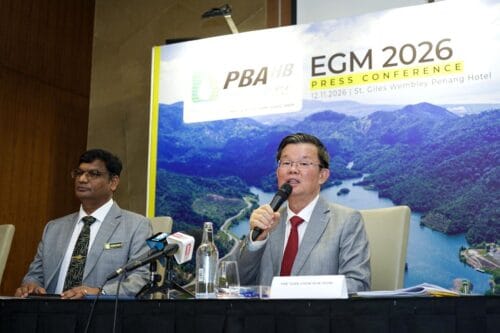
“March 31, 2032 is the date stipulated in the agreement for the project to be completed and treated water to be delivered to Penang, up to the Perak-Penang border.
“Beyond that point, it will be PBAHB’s responsibility to distribute the treated water received from Perak,” he told a press conference after the EGM.
The proposed purchase involves the Penang Water Supply Corporation (PBAPP), PBAHB’s principal subsidiary, purchasing treated water from Prasarana Air dan Irigasi Perak Sdn Bhd, subject to the relevant regulatory and official approvals.
Under the proposed agreement, the bulk water supply arrangement will run for 40 years, from 2032 to 2072, with an estimated overall supply charge of RM24.6 billion, averaging RM615 million annually.

The estimated cost of treated water for an initial supply of 300 MLD is RM3.62 per 1,000 litres, or RM0.00362 per litre.
Chow said the decision followed about a year of discussions at board level, during which the agreement’s terms, conditions and potential risks were examined.
He acknowledged that several directors had raised concerns over the potential financial burden and risks, while questions from minority shareholders were also addressed during the EGM.
On the conditions required for the agreement to take effect, Chow said Penang had fulfilled its obligation through today’s shareholders’ approval, while Perak must obtain approval from the National Water Services Commission (SPAN) for the agreed water tariffs.
He said Perak has until 2035 to secure the regulatory approval, failing which Penang could withdraw from the agreement.
“Under the agreement, there are two conditions that must be fulfilled. Penang has met its requirement through the EGM approval, while Perak must obtain SPAN’s approval for the proposed tariff,” he said.
PBAPP chief executive officer Datuk K. Pathmanathan said the agreement was conditional, with PBAPP not required to make any payment if the proposed tariff failed to obtain regulatory approval.
He added that the project would be funded by the Perak side, with no capital expenditure (CAPEX) required from PBAPP.
Under the agreement, Perak will be responsible for sourcing raw water from Sungai Perak, constructing a dedicated 500 MLD water treatment plant, and bearing the infrastructure, equipment and operational costs involved in delivering treated water to Penang throughout the 40 years.
Pathmanathan also described the proposed 300 MLD purchase as a conservative estimate, noting that Penang’s future water requirements could be higher as the state continues to attract new investments and expand its industrial activities.
Chow said the project was part of Penang’s long-term strategy to ensure adequate water supply as demand continues to grow.
Penang’s water consumption stood at 865 MLD in 2025 and is projected to exceed 1,100 MLD by 2032. The state is also expected to have fully utilised its viable raw water resources by 2030.
He said securing an additional treated water source would help diversify Penang’s supply and reduce its reliance on Sungai Muda, particularly amid increasingly unpredictable rainfall patterns caused by climate change.
“Penang cannot afford to run out of water. Our primary objective is to ensure sufficient water supply in the 2030s and avoid a foreseeable water shortage or crisis that could affect people’s lives and cripple the State’s economy,” he said.
Also present earlier were Penang State Secretary Datuk Dr Jafri Abdul Jalil and PBA Holdings Berhad (PBAHB) chief financial officer Dr Mary Ann Harris.
Story by Kevin Vimal
Pix by Siew Chia En
Video by Alissala Thian