

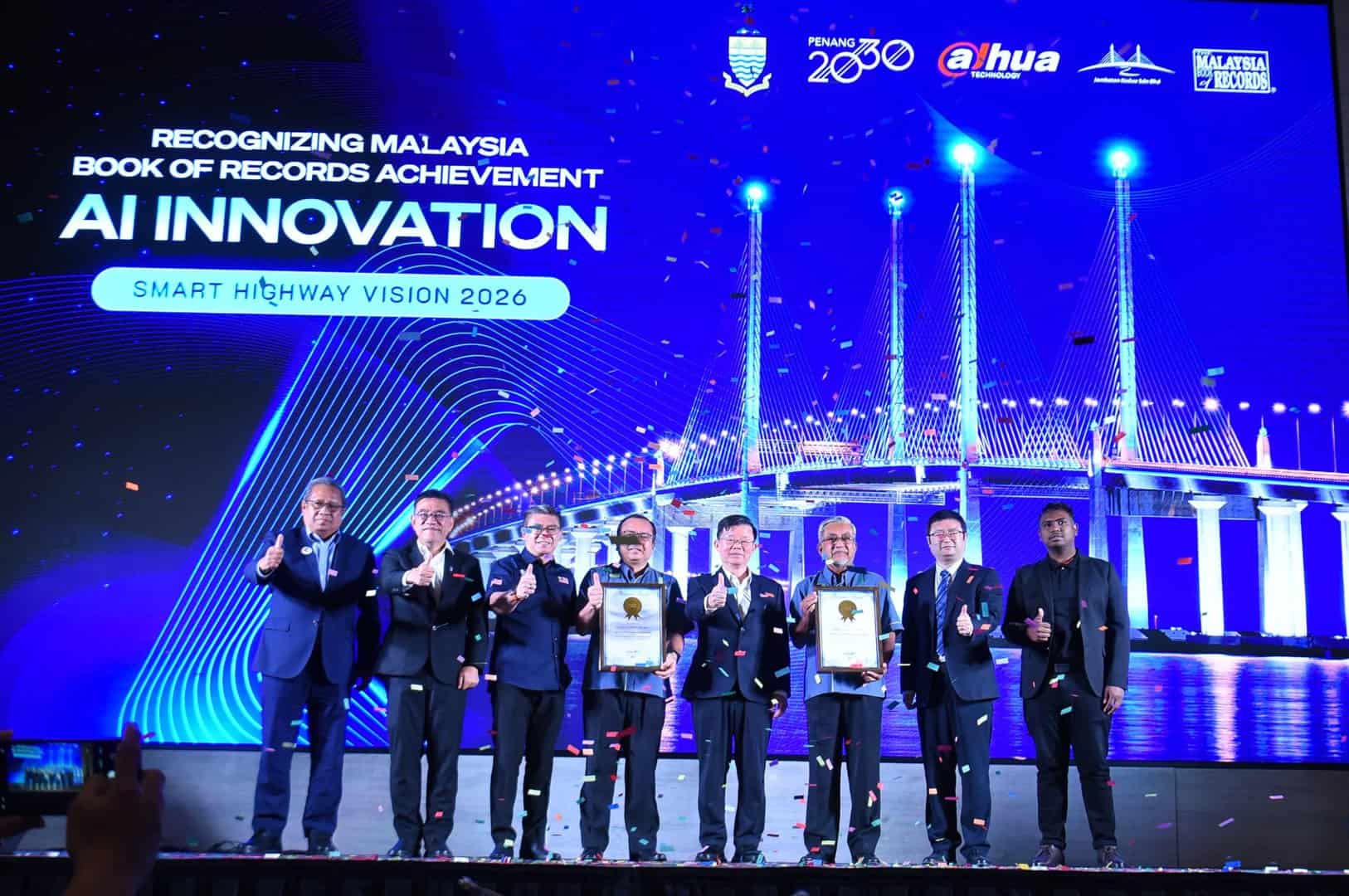

THE Sultan Abdul Halim Mu’adzam Shah Bridge has achieved a national milestone after its operator, Jambatan Kedua Sdn Bhd (JKSB), was awarded two prestigious recognitions from the Malaysia Book of Records (MBR) today.
JKSB was recognised for Most AI Technology Implemented on an Expressway Bridge and First Expressway Bridge to Implement AI Technology for Highway Operations, marking a significant milestone in the adoption of artificial intelligence within Malaysia’s expressway and bridge infrastructure sector.
The recognitions were presented at the Iconic Marjorie Hotel in Bayan Lepas, in the presence of Chief Minister Chow Kon Yeow.
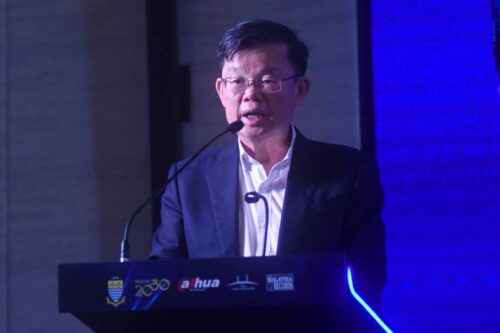
Chow said the achievement reflects JKSB’s commitment to progressive, technology-driven infrastructure that supports both public safety and economic growth.
“I would like to thank JKSB for bearing the cost of implementing this system to ensure that the Sultan Abdul Halim Mu’adzam Shah Bridge is safe for users,” he said.
He added that the deployment of smart AI systems enables better traffic management and allows the bridge operator to respond more efficiently to incidents detected along the bridge.
“This recognition demonstrates how strategic investments in intelligent infrastructure can deliver tangible benefits to the people.
“By embracing smart traffic management systems, we are strengthening road safety, improving mobility and reinforcing Penang’s position as a competitive, future-ready state in line with the Penang2030 vision,” he added.
Chow said such technology should not be limited to a single bridge, adding that the Penang Bridge should also consider adopting similar systems to enhance road safety, improve response times, and manage traffic flow more effectively.
“This includes the use of information boards and systems connected to platforms like Google or Waze, which allow road users to receive real-time traffic updates so they can plan their journeys better.
“Many highways already have such systems, and the use of AI technology should lead to a safer, more efficient, and more comfortable driving experience for all road users,” he said.
Chow also noted that the Second Penang Bridge continues to play a critical role in supporting the state’s economic ecosystem, particularly with Batu Kawan’s growth as a major industrial and logistics hub.
He stressed, however, that enforcement matters on highways remain under the jurisdiction of federal authorities such as the Ministry of Transport.
“This is beyond the authority of JKSB, but the company’s decision to instal the system reflects the vision of a concessionaire committed to managing its facilities efficiently, effectively and safely,” he said.
Earlier, JKSB chief executive officer Datuk Faisal Shahbudin said a total of 32 high-definition closed-circuit television (CCTV) cameras have been installed along the bridge as part of the Smart AI Traffic Management Systems.
He said the cameras are strategically positioned to provide comprehensive coverage of the bridge.
“The system enables real-time monitoring and improves JKSB’s ability to detect incidents, unusual behaviour and potential safety risks along the bridge,” he said.
He added that there have been instances where motorists stopped to take photographs and were instructed to move on.
“If individuals fail to comply, then JKSB will dispatch auxiliary police personnel or response teams to the location,” he said.
Under operational requirements, JKSB is required to respond to incidents within 10 minutes or less.
“The bridge is very long, so response time may vary depending on location, but in most cases it is under 10 minutes,” he said.
On system limitations, Faisal said excessive vehicle window tinting that does not comply with Road Transport Department specifications could affect detection accuracy.
He added that while the system is capable of detecting behaviours such as mobile phone usage and seatbelt non-compliance, it is currently function is used for monitoring rather than enforcement.
“At this stage, it is not used for enforcement, but we are open to upgrading the system if authorities wish to utilise it for enforcement purposes,” he said.
He added that the system is also capable of detecting vehicle speed and could be used for speed control if approved by the relevant authorities.
JKSB chairman Datuk Abdul Malik Abul Kassim said the recognition underscores the company’s responsibility as custodian of a strategic national asset and its commitment to innovation and operational excellence.
As traffic volumes on the bridge continue to rise, he said the implementation of intelligent traffic management systems supports smoother traffic flow, improved safety outcomes and a more balanced distribution of traffic between the island and the mainland.
The Smart AI Traffic Management Systems were implemented in 2023 and fully completed by the end of 2024 through collaboration with Dahua Technology Malaysia Sdn Bhd, with YCS Technology Solution (M) Sdn Bhd as system integrator, and in close coordination with JKSB’s operations team.
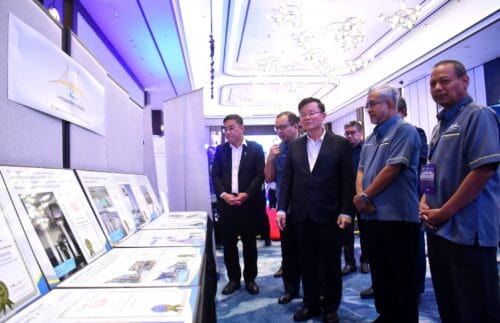
Also present at the ceremony were state Tourism and Creative Economy Committee chairman Wong Hon Wai, Malaysian Highway Authority director general Sazali Harun, Malaysia Book of Records chief executive officer Christopher Wong, and Dahua Technology Malaysia managing director Levi Wen.
Wen said Dahua Technology was honoured to be part of JKSB’s smart highway initiative, adding that intelligent technologies can be translated into practical solutions that enhance safety, efficiency and operational resilience.
Story by Edmund Lee
Pix by Muhammad Iqbal Hamdan
Video by Noor Siti Nabilah Noorazis