

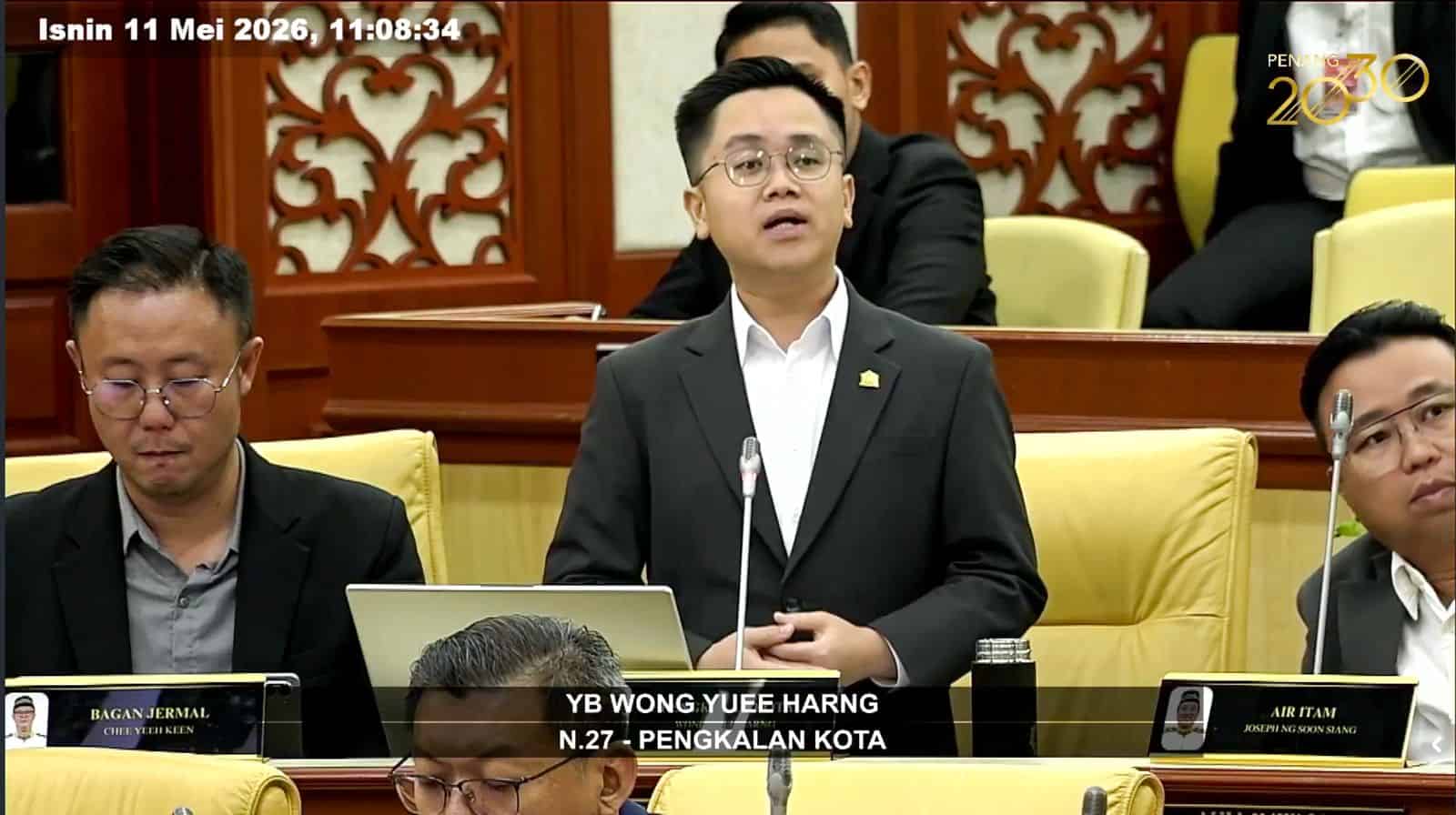

Penang has the strategic location, talent pool and industrial foundation to position itself as a regional financial hub, amid shifting global capital flows towards more stable and transparent jurisdictions, a state assemblyman said.
Raising the matter during his motion of thanks to the Yang di-Pertua Negeri during State Legislative Assembly, Wong Yuee Harng (PH-Pengkalan Kota) said the state should take advantage of evolving geopolitical and economic trends to attract international capital and expand its financial services sector.
“Penang has the advantage of strategic location in the Asia-Pacific region, a highly skilled workforce, and a strong track record as a manufacturing and technology hub,” he said.
He added that global investors have been reallocating funds from certain regions to established financial centres such as Hong Kong and Singapore, creating an opportunity for Penang to position itself as an alternative destination.
“If we can attract even a small portion of this global capital flow, it will have a significant impact on the state economy,” he said.
Wong said strengthening the financial services sector, including Islamic finance, could further enhance Penang’s competitiveness and attractiveness to Middle Eastern and international investors.
He also expressed support for the proposal to establish an international special financial hub in the state.
Beyond finance, Wong highlighted Penang’s broader economic positioning, noting its role within the Strait of Malacca—one of the world’s busiest maritime trade routes handling nearly 50% of global trade.
“The Strait of Malacca can be regarded as a thermometer of global economic and geopolitical stability—and Penang sits directly at that reading point,” he said.
He urged the state to strengthen port security, logistics capabilities and maritime-related investments to ensure Penang remains an active player in global supply chains rather than a passive observer.
On economic diversification, Wong said Penang should also capitalise on the growing Meetings, Incentives, Conferences and Exhibitions (MICE) sector, as geopolitical instability in other regions pushes international events to seek safer destinations.
He noted that large-scale events have demonstrated significant economic impact, benefiting industries from hospitality to small businesses.
“Such events are tourism products and should be treated as economic catalysts,” he said.
Wong also pointed to the Penang South Islands (PSI) project as a potential catalyst for developing a dedicated international event zone, supported by the upcoming Mutiara LRT line under Transit-Oriented Development (TOD) planning.
He said this would help reduce congestion in existing urban areas while enabling Penang to host large-scale global events.
Meanwhile, he also touched on energy transition and infrastructure risks, warning that rising fossil fuel costs could impact mega projects such as the Penang LRT.
“What mitigation measures have been planned to address this energy price uncertainty? Is there a contingency plan to ensure the LRT project will not face delays or excessive cost escalation?” he asked.
Wong urged the state to accelerate renewable energy adoption, including microgrid systems and smart energy solutions in industrial zones such as Bayan Lepas.
He also highlighted the Penang Green Industry Programme (PGIP), describing ESG compliance as a key requirement in global supply chains, not merely a policy option.
In addition, Wong raised concerns over heritage building safety following the Lebuh King fire incident, calling for a review of conservation guidelines to better balance preservation and fire safety requirements.
“Heritage should not become a museum that freezes risk. It must remain alive and safe for occupation,” he said.
On social development, he called for a shift towards active ageing policies, proposing community-based centres, volunteerism programmes and improved elderly-friendly infrastructure.
“Ageing is a success. But longer life must be matched with quality of life,” he said, urging the state to develop a comprehensive elderly master plan.
Story by Edmund Lee