



TRADITIONAL wood carving may be a fading trade, but for artisan Lee Chee Cheng, it remains a lifelong commitment to preserving heritage and culture.
The 60-year-old craftsman has been involved in the industry for about two decades after taking over the business from his uncle, who passed the skills and trade to him before his death.
Unlike many traditional artisans, Lee did not inherit the craft through generations.
“My father was not involved in this business. It was my uncle who taught me and eventually handed it over to me when I was in my 40s,” he said during an interview at his workshop at Sung Dynasty Wood Carving in George Town.
Before entering the trade, Lee worked as a salesman, travelling across Malaysia for work.
His interest in wood carving grew from an appreciation for traditional craftsmanship, particularly carvings found in clan houses, temples and heritage buildings.
Today, much of his work involves producing and restoring “Tang Hao” plaques, decorative signboards that represent the ancestral origins of Chinese surnames and clan associations.
According to Lee, about 90% of his projects are linked to clan associations, temples and heritage properties in Penang.
He said Penang and Melaka remain the two main centres where traditional wood carving is still actively practised due to their strong focus on heritage conservation.
“Many of these old buildings need restoration work. If there are no local craftsmen, the carvings would have to be imported from China, which is costly,” he said.
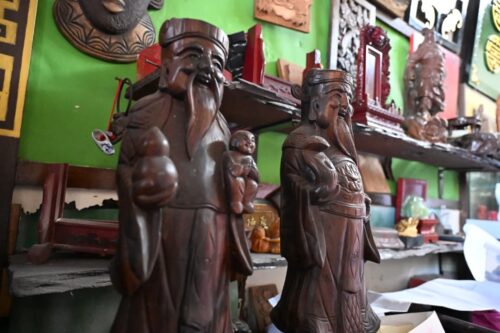
Lee explained that many heritage buildings contain wooden carvings that have deteriorated due to age, weather and termite damage.
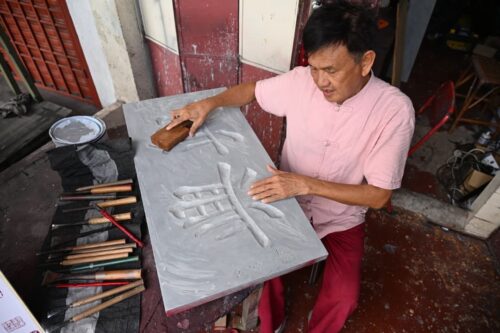
Part of his work involves restoring damaged pieces or producing replacements that match the original design.
Besides commercial projects, Lee is actively involved in passing down the craft to younger generations.
Educational institutions such as Universiti Sains Malaysia (USM) and Equator Academy of Art regularly send students to his workshop for training sessions and demonstrations.
He also conducts workshops through a Cantonese association in Penang, where participants are introduced to traditional carving techniques.
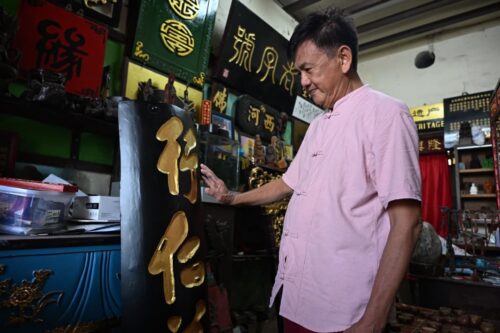
His contributions to heritage preservation have earned recognition from George Town World Heritage Incorporated (GTWHI), which selected him as one of its supported artisans under a heritage preservation programme.
The value of wood carvings varies depending on size, complexity and artistic significance.
Lee said a standard carved plaque can cost between RM2,000 and RM5,000, while larger artistic pieces can fetch significantly higher prices.
He recalled a carving based on artwork by renowned street artist Ernest Zacharevic that was eventually sold overseas for about RM108,000.
“The value was mainly due to the artist’s reputation, but it showed that traditional carving can also be appreciated as art,” he said.
Apart from restoring heritage buildings, Lee founded the Penang Carving and Preservation Association two years ago to promote the craft and create greater awareness of traditional wood carving.

He believes stronger support from both state and federal governments is needed to ensure the survival of heritage trades.
“Financial assistance is important, but there must also be efforts to promote and recognise traditional craftsmen. If young people are not exposed to these skills, they may eventually disappear,” he said.
Despite the challenges, Lee remains optimistic about the future of the industry.
As one of the few remaining traditional wood carvers in Penang, he hopes his efforts in restoration, education and advocacy will help keep the centuries-old craft alive for future generations.
Story by Edmund Lee
Pix by Muhammad Iqbal Hamdan