
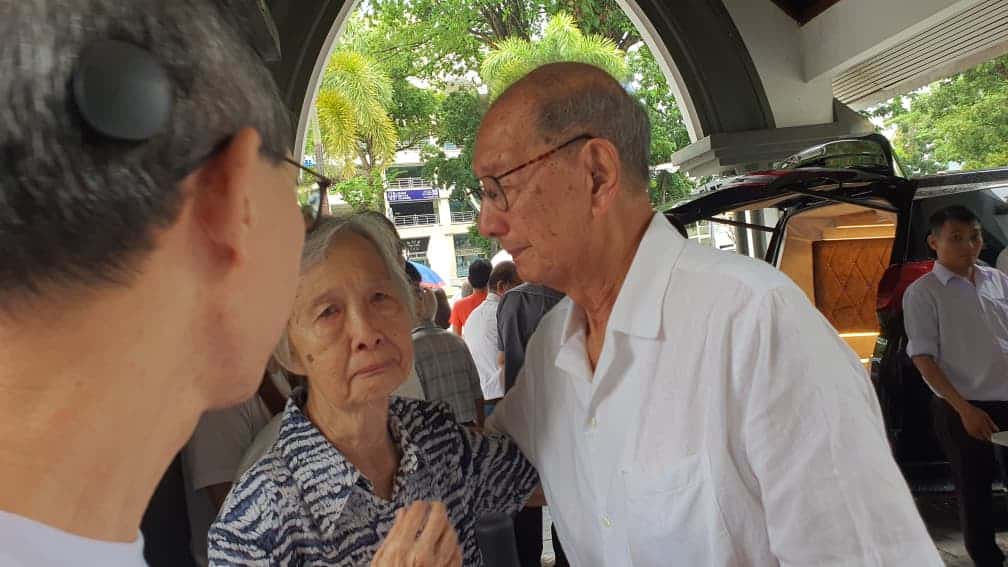

Story and pix by K.H. Ong
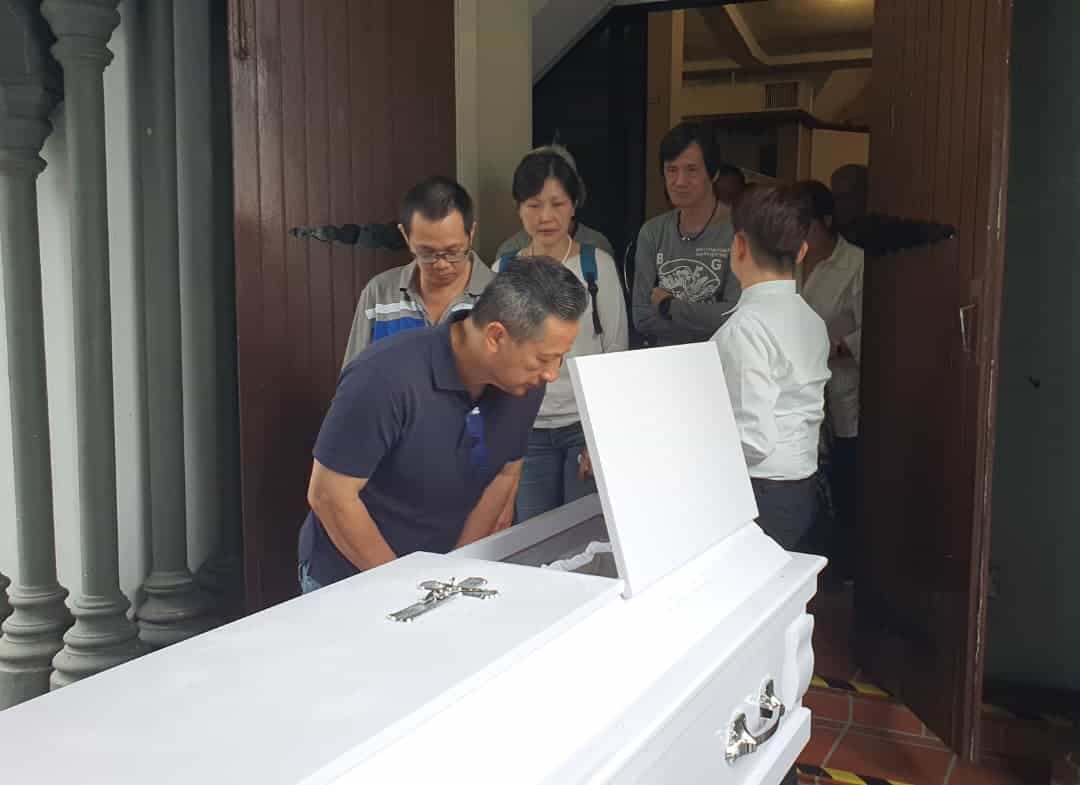
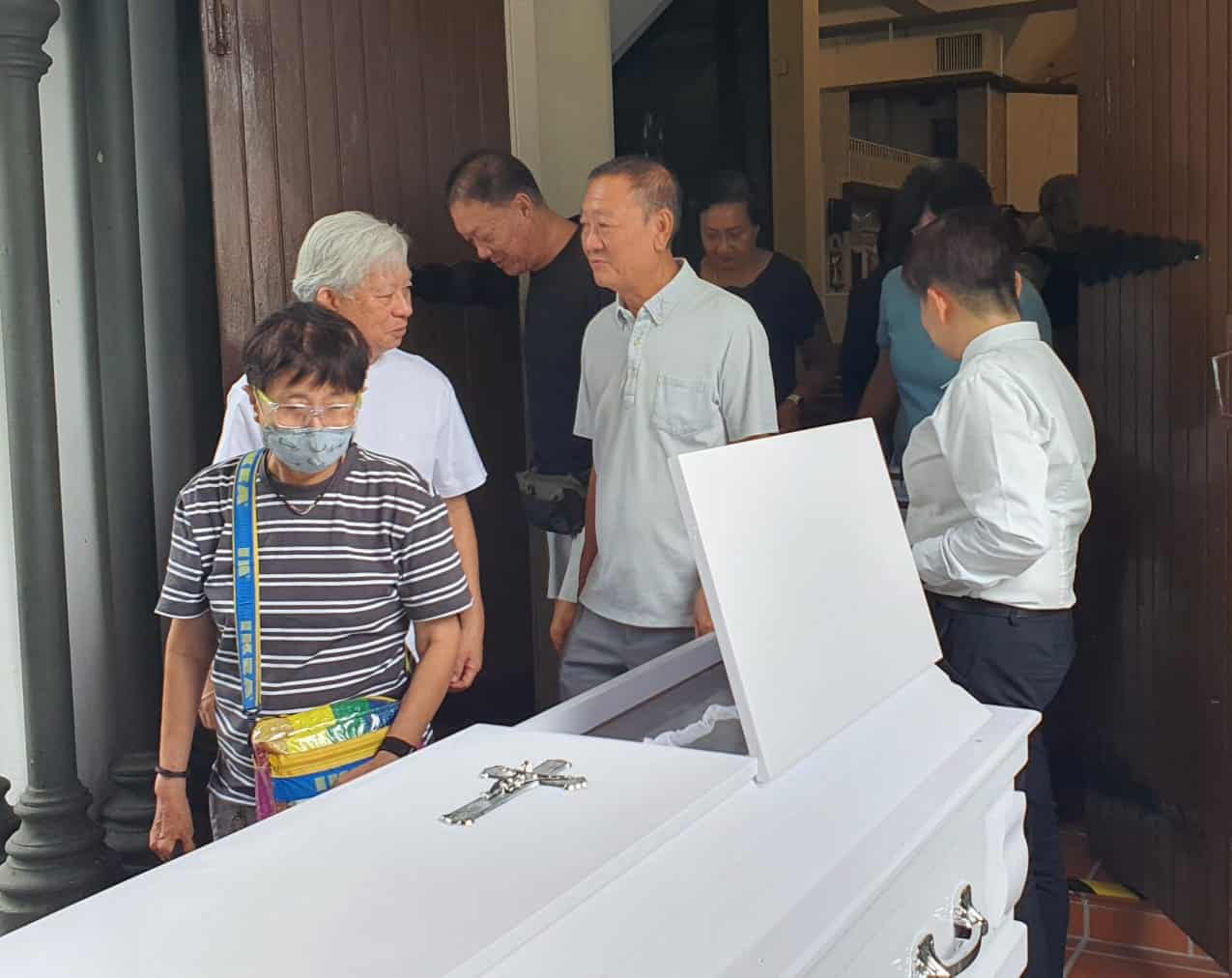
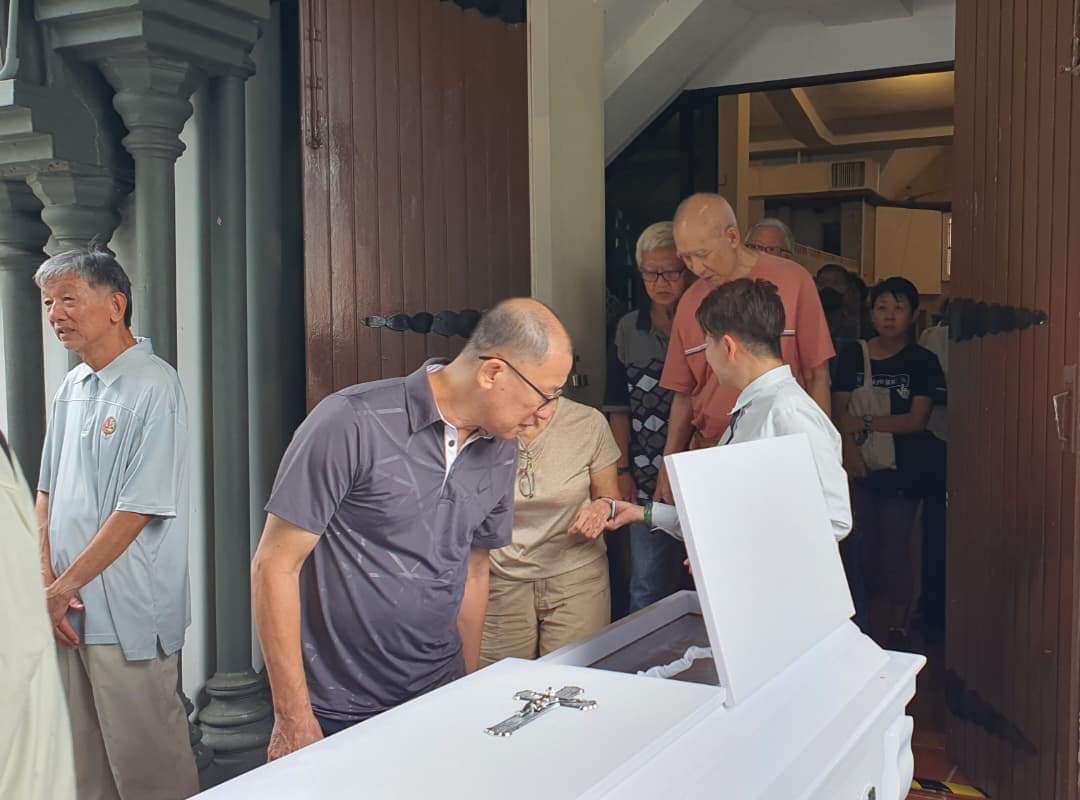
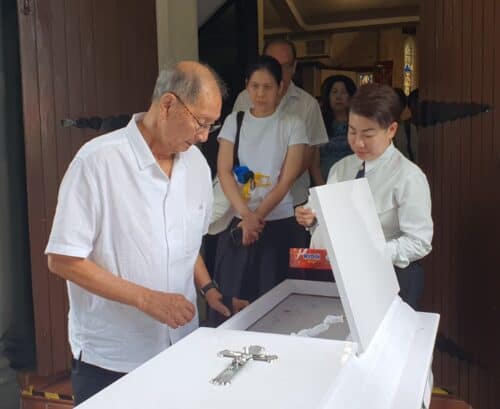
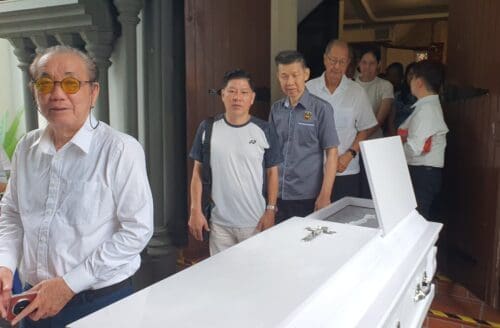
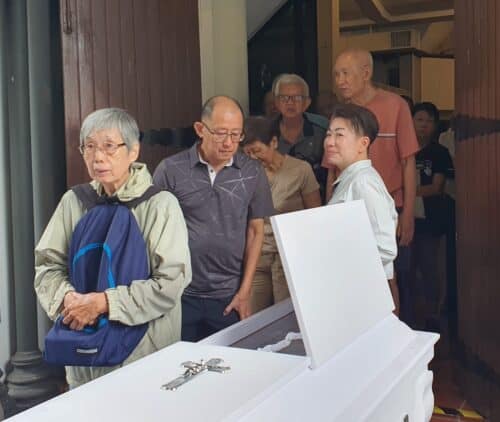
AS I watched Datuk Teh Kew San’s casket being rolled out of the Church of the Immaculate Conception this morning, bound for cremation at the Mt Erskine crematorium, my mind drifted back to a visit my friend Khoo Tiang Oon and I had paid to his home in Lorong Mt Erskine just ten days ago.
Lying in bed, the frail 91-year-old former Thomas Cup captain greeted us with a wide smile, called our names, and shook our hands firmly with his left — so strong a grip that it belied the fact that his life was quietly ebbing away.
Whether it was premonition or not, he told us that his time was up — “eight-something” that day on May 6 — yet to some of his other friends, he cryptically mentioned the numbers 513 and 318. Many interpreted 513 as May 13, but Kew San ultimately passed away on May 14 at about 10am at his home. In the days leading up to his death, he had lost his appetite after suffering urinary complications.
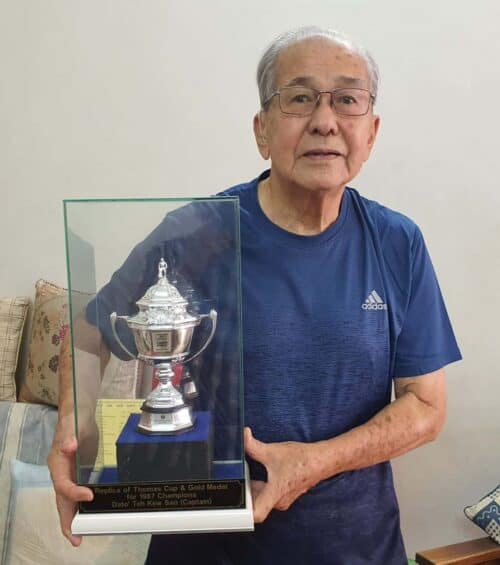
Fondly known as “Ah Pek”, Kew San was a household name in the 1960s and 70s, an era when Malaya — and later Malaysia — produced many champions who could match the finest players from Indonesia, Denmark, Japan, Thailand, India, and China.
Beyond his long list of titles, his life was a story of blood, sweat, and tears.
Perhaps the most painful of all was the loss of his week-old son, Michael, shortly after he had played in an exhibition match between Malaysia and Thailand in Mentakab, Pahang, in 1966. He had rushed home as soon as he was informed by the police.
Equally heartbreaking was the ordeal faced by his wife, Datin Ng Mei Ling, whom he had married just a year earlier. Mei Ling was a champion in her own right, having represented Malaysia in the Asian Games and SEAP Games.
“It was a normal birth, with the baby weighing 6.8 pounds. Because the child had jaundice, he was kept in the hospital while I was discharged. After a week in the incubator, I was shocked to receive news that my boy had passed away. The certificate, which I still keep to this day, stated that he died of ‘multiple haemorrhage’ — with three question marks,” Mei Ling told Buletin Mutiara in an interview.
Joy returned in 1967 with the birth of another son, whom they named Thomas, after Kew San led the Malaysian team to victory over Indonesia in the controversial Thomas Cup final that same year. In 1969, the family grew again with the arrival of a daughter, Karen.
Kew San also endured two frightening experiences as a schoolboy.
On his way home from Li Tek School, he saw Japanese planes flying overhead and clapped in childish fascination, not knowing the peril that was coming. The next day, to his horror, bombs were dropped on Chulia Street as the Occupation began.
On another occasion, while selling kuih to neighbours, he was spotted by a Japanese soldier who shouted and gave chase. Kew San ran for his life, so frightened that he urinated on his shorts in the process.
Of all his adventures, the 1967 Thomas Cup battle in Jakarta was the most harrowing, coming shortly after the Indonesian Confrontation.
Malaysia was leading 4-3 in the best-of-nine matches when crowd disturbances forced the eighth match — between Ng Boon Bee and Tan Yee Khan against Muljadi and Agus Susanto — to be halted during the rubber game.
Kew San, Tan Aik Huang, and Abdul Rahman found themselves in a restroom outside the hall, fearful they could be lynched by the mob if the chaos escalated. At one point, a soldier even prevented Kew San from re-entering the hall.
“Anything could have happened on that final night. It was the longest three weeks of my life there,” Kew San said in a recent interview.
Eventually, the Malaysian team was escorted back to the hotel and later to the airport by armoured vehicles.
The International Badminton Federation ordered the remainder of the tie to be replayed at a neutral venue in New Zealand, but Indonesia refused. The IBF then declared Malaysia the 6-3 winner.
The following year, Kew San and the entire team — except for Billy Ng, one of the six players — travelled to the All England Championships to receive the Cup and also to compete. Kew San was saddened that Billy Ng was not included in the trip. Aside from the Cup, the team was awarded made-in-Malaysia medals, as the whereabouts of the original medals remain unknown.
Another frustration for Kew San was that the promised RM10 per day training allowance for the month of preparation for the New Zealand trip was never provided.
Despite this setback, his love for badminton never wavered.
Mei Ling once joked, “He loves badminton more than he loves his wife.”
Life as a national badminton player in Kew San’s era was extremely challenging. With a salary of RM105 in 1954 as a clerk with the Penang Island Municipal Council, he often had to take unpaid leave whenever he represented the country.
At the All-England Championships, Kew San and his fellow Malaysian players were given just two pounds each daily by the Badminton Association of Malaysia. They often had to forego the welcoming dinner for participants because they could not afford transport to the venue. Most days, their lunch consisted of nothing more than bread. Aware of his predicament, his colleagues at the office would sometimes pass the hat around to collect money for him.
On one occasion at the All-England tournament, Kew San developed painful blisters and had to undergo an operation at Middlesex Hospital in London. Despite the ordeal, he continued to play with grit and determination, cushioning his shoes with sponges to protect his feet.
Before another trip to England, the anaemic Kew San was taken by BAM president Datuk Loh Hoot Yeang to see his doctor, receiving four iron injections and seven liver extract injections every other day for two weeks.
After joining the 1967 Thomas Cup victory parade through Perak, Kedah, Kelantan, and Johor, Kew San did not continue the celebrations in Sabah and Sarawak — much to the chagrin of some BAM top brass. In addition to leave issues, he had suffered an injury during a cricket match against the Rubber Research Institute at the Chinese Recreation Club, when a ball struck his toe despite him wearing boots. The injury caused his toenail to take six months to grow back.
One disappointment that Kew San experienced was when the 1967 Thomas Cup team were invited to the 1992 Thomas Cup semi-finals in Kuala Lumpur. The tickets did not entitle them to seats, and they had to stand for hours to watch the semi-finals at Stadium Negara. Frustrated, he left for home without watching the final, in which Malaysia beat Indonesia 3-2 in an epic and historic match.
While the 1967 Thomas Cup victory was his most memorable achievement, another unforgettable performance came during the 1966 Penang Open, in which he partnered Yew Cheng Hoe to thrash Rudy Hartono and Muljadi 15-0, 15-0 in the men’s doubles final.
As some of the local women players were routed 11-0 by their Indonesian counterparts, the crowd cried for revenge, and Kew San and Cheng Hoe rose to the occasion to hand them nought too.
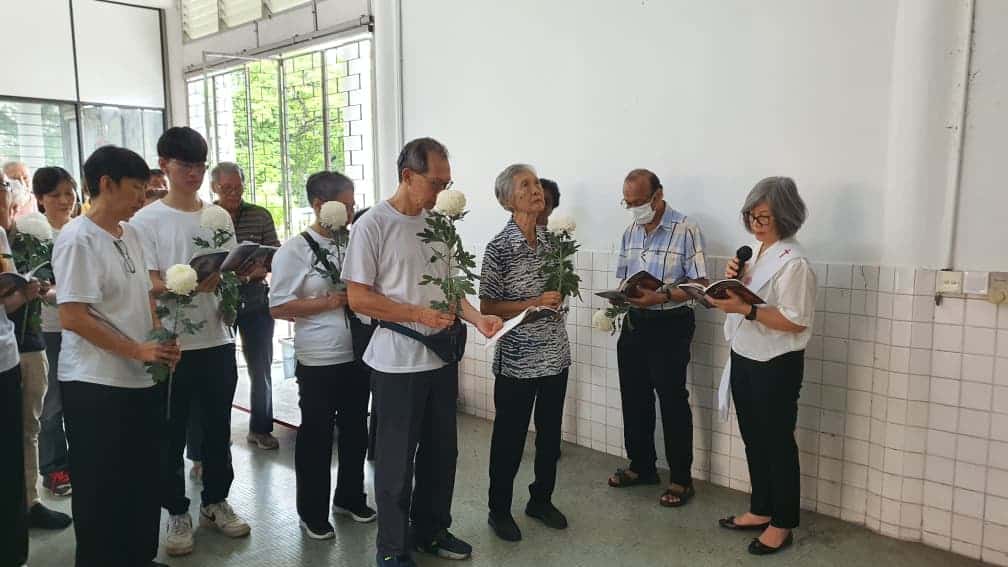
In his eulogy, Thomas said that last week, his father expressed his desire to be baptised, and his wish was fulfilled.
To many people, he said his father was a national sports hero, achieving many great things and representing the nation with pride.
“Behind the achievements and recognition was a very simple man – humble, steady, and deeply devoted to his family. He loved my mother faithfully, cared for us as his children, and led more by example than by words.
“As a sportsman, he believed in giving his best, playing with integrity, and carrying himself with honour. He taught us that true greatness is not only found in trophies or titles, but in character, humility, and how you treat people. For him, badminton was fun and also a serious business. When I was old enough to play with him and understand him, he would hit his own head with the edge of his racket when he made mistakes. There were occasions, too, when the racket landed on my head,” Thomas shared.
He added that what he would remember about his father is not just what Ah Pek accomplished, but who he was.
“He showed us commitment, perseverance, loyalty, and quiet strength. He was someone whom we could look up to – not only as a sportsman, but as a husband, father, grandfather and a human being,” Thomas said.
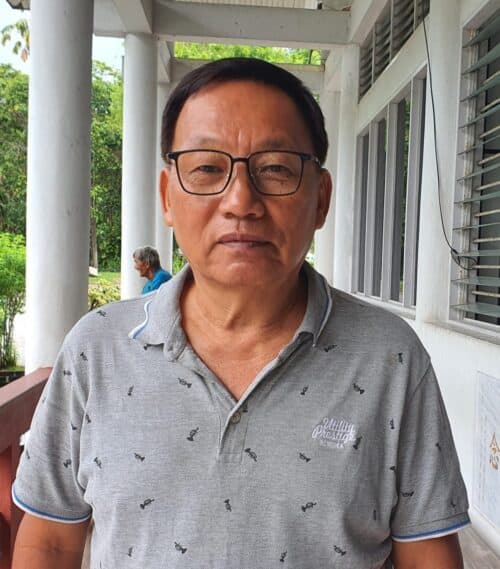
In 2007, Kew San was conferred the Datoship award by Yang di-Pertua Negeri Tun Abdul Rahman Abbas, borrowing a coat from state coach Khoo Kay Choo for the ceremony. It was former national player Lim Kean Guan who secured the support of then Chief Minister Tan Sri Dr Koh Tsu Koon for the award.
“He deserves the award even 40 years after winning the Thomas Cup. His character is as excellent as his outstanding badminton achievements,” said Kean Guan, who was at the funeral service today.
Also present was Datuk Yew Cheng Hoe, one of the three surviving members of the 1967 Thomas Cup-winning team. The other two are Datuk Tan Aik Huang and Datuk Billy Ng, while Datuk Ng Boon Bee and Datuk Tan Yee Khan had both passed away.
“To me, Kew San is Mr Badminton. He quietly guided many players to become champions.
“Now he is gone to a better place with God, having finished whatever he wanted. Now he is resting in peace with God. He was a good father, good husband, and good friend,” said Cheng Hoe, who was accompanied by his wife, Datin Girlie.
Penang BA president Datuk Kah Kau Kiak also came to pay his last respects, together with his vice-president Gary Poh and former treasurer Loh Eng Swee.
“He is a legend and has contributed immensely to Malaysian badminton. We, the Penang BA, are very proud of him,” Kah said.
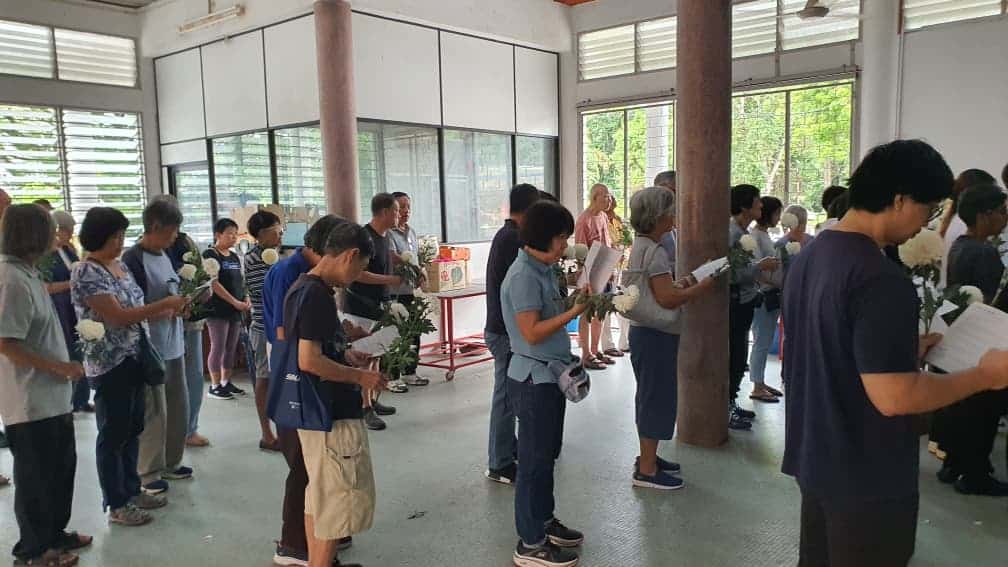
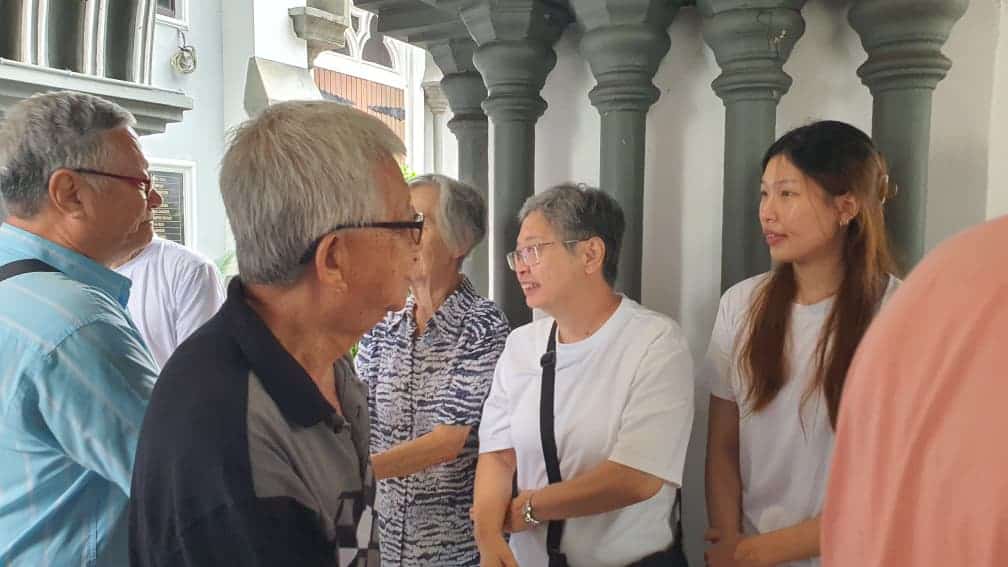
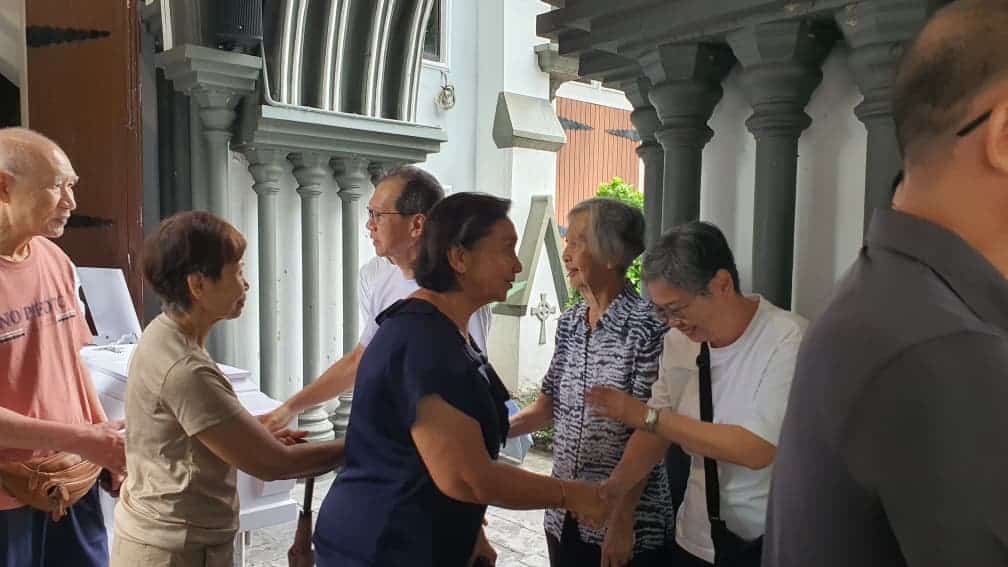
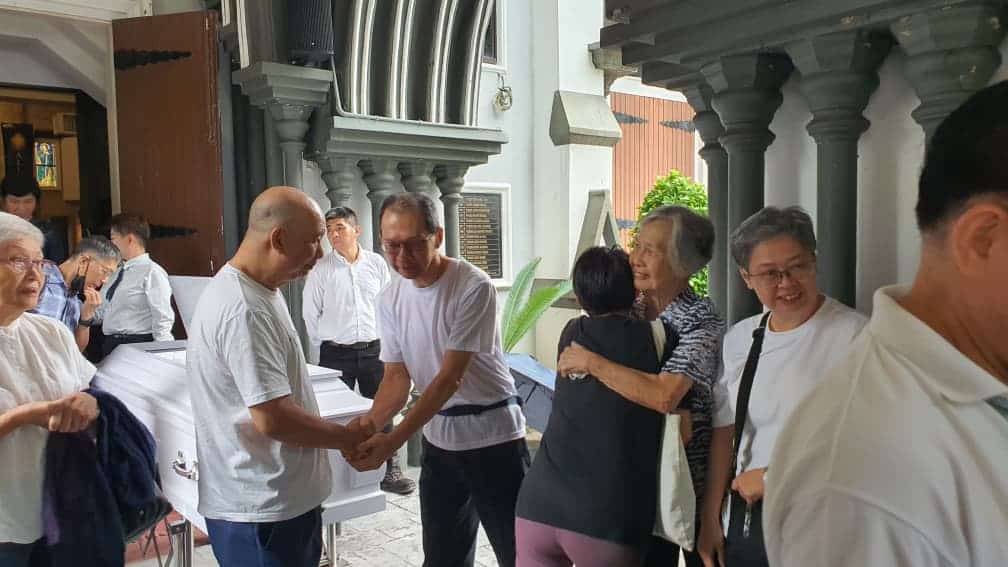
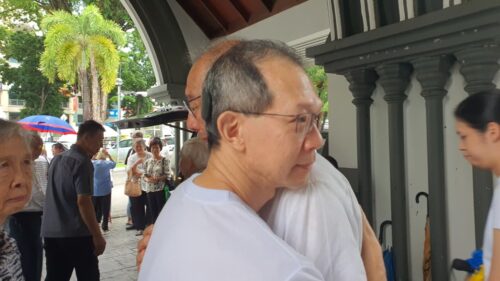
Just as the mass ended, the weather brightened with only a drizzle. Among the relatives, close friends, and former state and national players were Ho Khim Soon, Khaw Cheow Kheng, Chuah Han Khim, Yeap Eng Seng, Ho Khim Kooi, Yeong Wai Kheong, R. Karunathan, Ooi Gim Ewe, John Teh Chiang Jin, Teh Chiang Ghee, Yap Hei Ling and Betty See, Lam Joo Seang, Koay Kah Dip and Tan Kean Teong.
As the funeral drew to a close, the memory of that firm handshake lingered in my mind, and the words of the final hymn, “Sweet Bye and Bye, we shall meet on that beautiful shore,” echoed in my heart.