



PENANG has continued to record steady growth in international arrivals between 2023 and 2025, with Indonesia, China and Thailand showing the strongest increases.
State Tourism and Creative Economy Committee chairman Wong Hon Wai (PH–Paya Terubong) said arrivals through the Penang International Airport (PIA) improved consistently from January to September over the three years.
He noted that Indonesia remained Penang’s largest inbound market for three consecutive years.
“A total of 284,364 Indonesian tourists arrived in the first nine months of 2025, up from 253,307 in 2023, representing a 12.3% increase. China recorded the sharpest growth among all markets,” he said.
Wong added that only 26,056 Chinese tourists were recorded in 2023, but the number surged to 161,599 in the first nine months of 2025 following the resumption of flights and stronger travel demand. This represented a 520.2% jump, while Singapore remained Penang’s third-largest market.
However, arrivals from Singapore fell from 132,664 in 2023 to 116,442 in 2025, a drop of 12.2%.
Wong was replying on behalf of Chief Minister Chow Kon Yeow to Ong Ah Teong (PH–Batu Lanchang), who had asked for the top 10 countries contributing to international arrivals in 2025 and comparisons with 2023 and 2024.
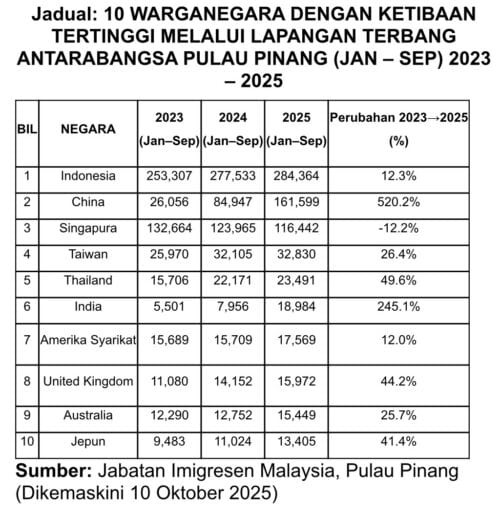
He said the steady recovery showed Penang had regained its position as a preferred regional destination.
Wong noted that the growth had also strengthened the performance of the hotel, food and beverage, and retail sectors.
He added that the state government would continue working with airlines to expand direct flights, charter services and regional routes.
He said Penang would also promote cultural, arts, food and festival activities to enhance its global appeal.
“Markets with further development potential include China, India, Southeast Asia, Australia, the Middle East, South Korea and Japan,” he said.
Wong highlighted ongoing efforts to strengthen Penang’s reputation as a key food destination in the region.
He said the Penang International Food Festival (PIFF) continues to be one of the state’s main platforms for showcasing its culinary heritage, bringing together hawkers, chefs, and food operators to highlight Penang’s diverse flavours to both local and foreign visitors.
Wong added that Penang’s representation in the MICHELIN Guide Malaysia has provided an additional boost, as the guide features several Penang eateries, including well-known hawker stalls.
He noted that international recognition of this kind helps raise Penang’s profile and encourages food operators to maintain high standards of taste, quality, and originality.
To protect traditional dishes, Wong said the state had proposed 10 iconic Penang foods to the National Heritage Department for heritage listing.
The dishes nominated are Nasi Kandar, Pasembur, Char Kue Kak, Hokkien Mee, Jawa Mee, Oh Chien, Prawn Mee, Mee Sotong, Kerabu Bihun and Roti Benggali.
He said the move aims to protect the state’s culinary identity and ensure that these traditional foods continue to be passed down to future generations.
Wong also highlighted Penang’s participation in the Osaka World Expo, where a “Flying Roti Canai” demonstration by Penang chefs was among the Malaysia Pavilion’s highlights.
He said the live performance gave international visitors a taste of Malaysian street food culture and showcased the skill and flair of Penang’s culinary talents.
According to Wong, the state has also expanded its food-promotion efforts through social media, digital storytelling and partnerships with airlines and international media outlets to reach wider audiences.
He added that Penang’s food scene continues to attract global attention, noting that TimeOut has ranked the state among the “10 Best Asian Cities for Street Food You Must Try,” while National Geographic has named Penang as one of Southeast Asia’s top islands for its distinctive local cuisine.
Story by Edmund Lee