

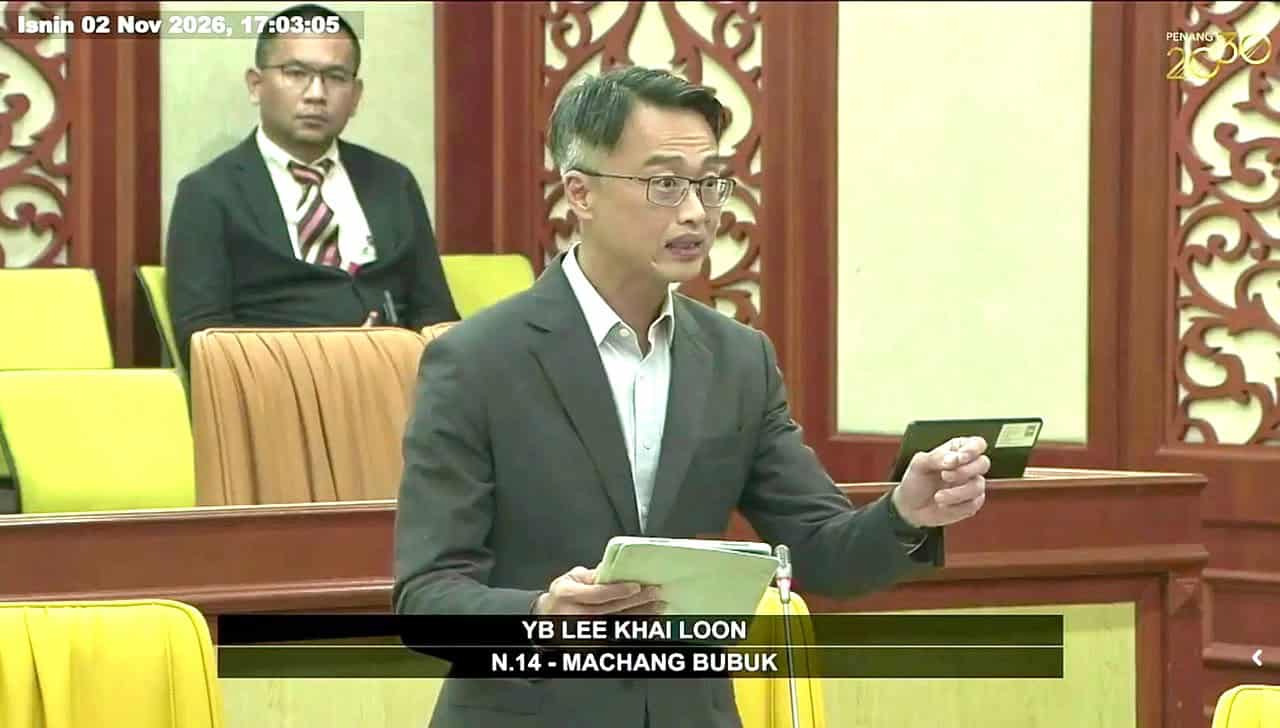

PENANG must move beyond economic growth by creating greater value for its people, strengthening its resilience against climate change and involving the public in policymaking, says Lee Khai Loon (PH-Machang Bubok).
Taking part in the Budget 2027 debate at the State Legislative Assembly, Lee said the state must look beyond its past achievements and prepare for challenges beyond the Penang2030 vision.
“Penang’s biggest challenge today is no longer simply how to continue developing, but how to ensure that our development creates greater value, is more equitable and sustainable,” he said.
He proposed a new approach, which he described as “Beyond Growth”, saying a developed state should not be measured solely by the wealth it creates.
On economic development, Lee called for a shift from “Made in Penang” to “Made by Penang”, with greater emphasis on developing and owning technology, capital and wealth.
He also questioned the economic benefits that the proposed Penang Technology Finance Centre (PTFC) would bring to the state, given its projected contribution of RM12.1bil to Malaysia’s gross domestic product over 15 years.
Lee said the state government should present the PTFC study to the State Legislative Assembly for scrutiny.
He also proposed setting up a legislative select committee to examine the initiative’s white paper, strategic plan and action plan.
On infrastructure financing, Lee called for a study into land value-sharing mechanisms to help fund public projects.
Citing the proposed widening of Jalan Kulim from two to four lanes and a new road linking Jalan Machang Bubuk 1, Taman Santuari and Jalan Seladang, he said the latter was estimated to cost RM76.44mil, including land acquisition.
He proposed a pilot study on Infrastructure Value Sharing for both corridors in 2027 to assess potential increases in land value, acquisition costs and traffic benefits.
“Do not just ask how we finance development. We must also ask how the value created through development can help finance the people’s future needs,” he said.
On climate resilience, Lee welcomed the Penang Resilience Strategy 2025 but said the state needed to measure its effectiveness through specific assessments.
He proposed a Critical Infrastructure Resilience Audit to identify high-risk hospitals, schools, major roads, drainage systems and evacuation centres.
He also called for a Penang Urban Heat Action Plan to identify urban hotspots, increase shaded areas and protect vulnerable groups.
Lee further suggested setting mobilisation targets and conducting regular emergency simulations for the Humanitarian Disaster Logistics Centre at Bukit DO.
On people-centred development, he proposed introducing a Penang Solution Lab to bring together government agencies, universities, the private sector, civil society groups and residents to address persistent community problems.
He suggested identifying 10 major issues and giving the teams 12 months to test solutions, assess their effectiveness and report the findings to the public.
Lee also called for the Women and Family Development Committee (JPWK) to play a greater role in policymaking, rather than focusing mainly on organising community programmes.
He proposed increasing its annual allocation from RM10,000 to RM12,000 for each state constituency, with greater emphasis on measurable outcomes in women’s leadership, family well-being and community development.
“Meaningful innovation is not simply about using new technology to introduce old policies. Meaningful innovation means changing the way the government works together with the people,” he said.
Story by Edmund Lee