

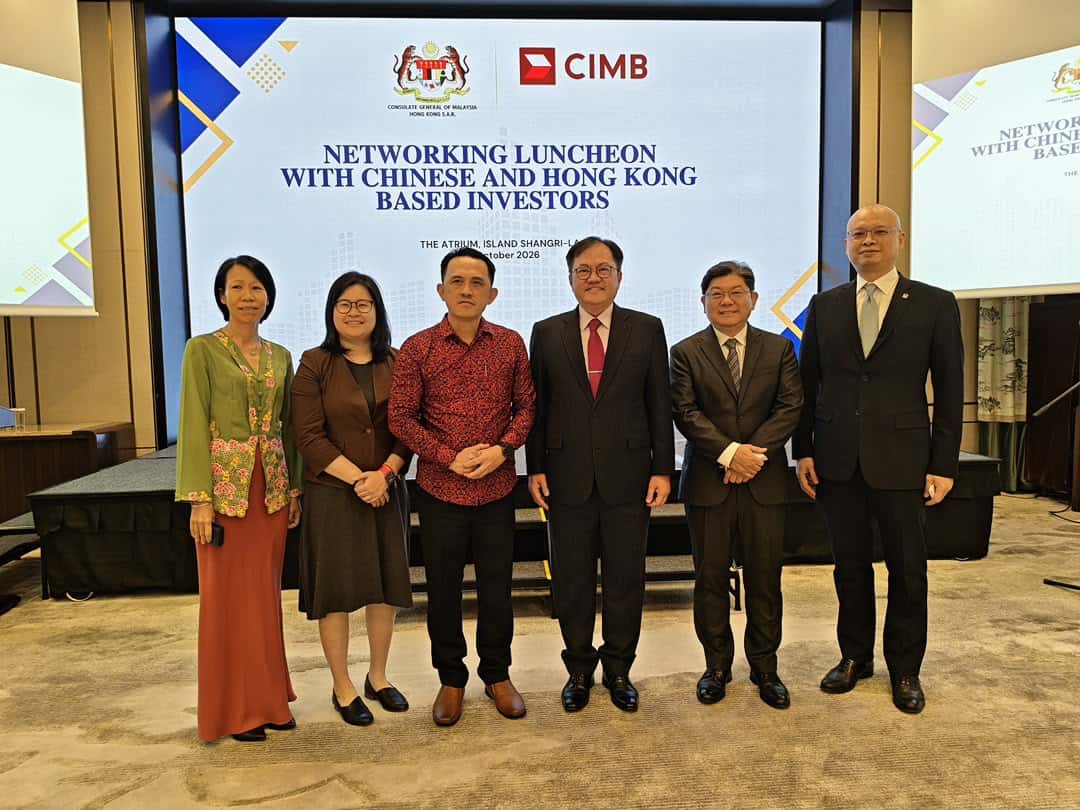

HONG KONG: Penang is stepping up efforts to attract high-value investments from Hong Kong and mainland China as it strengthens its position as a regional hub for high-tech manufacturing, innovation and global partnerships.
Penang state executive councillor for Trade and National Unity Goh Choon Aik said the state’s established industrial ecosystem, skilled workforce and strategic infrastructure provide a strong foundation for its next phase of economic growth.
With a population of about 1.8 million and a workforce exceeding 931,000, Penang is home to more than 350 multinational companies, particularly in the electrical and electronics (E&E), semiconductor and medical technology sectors.
“Penang’s industrial ecosystem has developed over more than five decades, covering the value chain from integrated circuit design and wafer fabrication to advanced semiconductor packaging and precision equipment manufacturing,” he said.
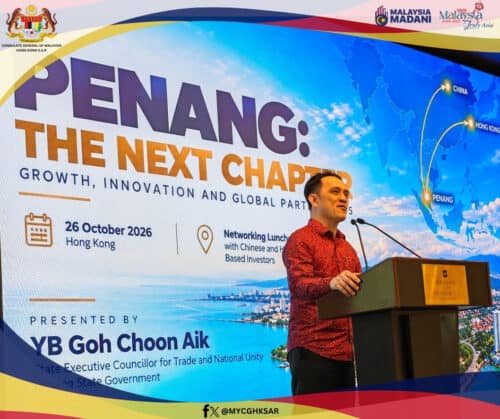
Goh was speaking at a networking luncheon with Chinese and Hong Kong investors organised by Muzambli Markam, Consul General of Malaysia in Hong Kong & Macao, where he delivered a keynote address titled “Penang: The Next Chapter – Growth, Innovation and Global Partnerships”.
Global companies operating within Penang’s E&E ecosystem include Intel, Micron, Broadcom and TF AMD, while B. Braun, Boston Scientific, Abbott and Dexcom are among those supporting the state’s ambitions in medical technology.
Penang recorded RM22.4 billion in approved manufacturing investments in 2025, while exports reached RM574 billion, accounting for about 36% of Malaysia’s total exports and 68% of national E&E exports.
For January to August 2026, the state’s exports reportedly totalled RM605.86 billion.
Goh said approved investments from Hong Kong in 2026 amounted to RM3.2 billion across 13 projects, with the potential to create more than 2,000 jobs. Approved foreign investments from China exceeded RM2.02 billion.
To accommodate further industrial expansion, the state is highlighting strategic developments including Penang Science Park South, Batu Kawan Industrial Park 3 and Bandar Cassia Technology Park. Privately developed freehold options include Penang Technology Park @ Bertam and Northern TechValley @ BKE.
“These locations offer industrial facilities and access to highway networks and Penang Port, supporting manufacturing and distribution operations,” said Goh, who is also the Bukit Tambun assemblyman.
In the business services sector, GBS Technoplex in Bayan Lepas is planned to provide 400,000 square feet of Grade A office space by 2029, catering to international companies seeking regional hubs and shared services centres.
Meanwhile, the RM1 billion Penang International Logistics Aeropark (Pila) is expected to begin Phase 1 operations by 2029, with a long-term target of handling 500,000 tonnes of air cargo annually by 2050.
Another key development is Silicon Island, a 2,300-acre master-planned project envisioned as a smart industrial hub incorporating climate resilience and environmental, social and governance (ESG) principles.
Phase 1 land reclamation has reached 500 acres, while 554 acres are earmarked for advanced manufacturing.
Goh said the project would help attract high-value investments, expand advanced technology industries and support the Penang2030 vision.
“Penang aims to be more than an investment destination. We want to be a long-term strategic partner for companies from Hong Kong and China seeking growth opportunities across Asia,” he said.
He added that the state’s combination of industrial expertise, strategic infrastructure and openness to global collaboration would help generate investment, create jobs and support sustainable prosperity.
Pic courtesy of YB Goh’s office