


THE first factory at Silicon Island’s 700-acre Green Tech Park is expected to begin operations in 2028, with the sale of its first industrial plots scheduled to start as early as the first quarter of 2027.
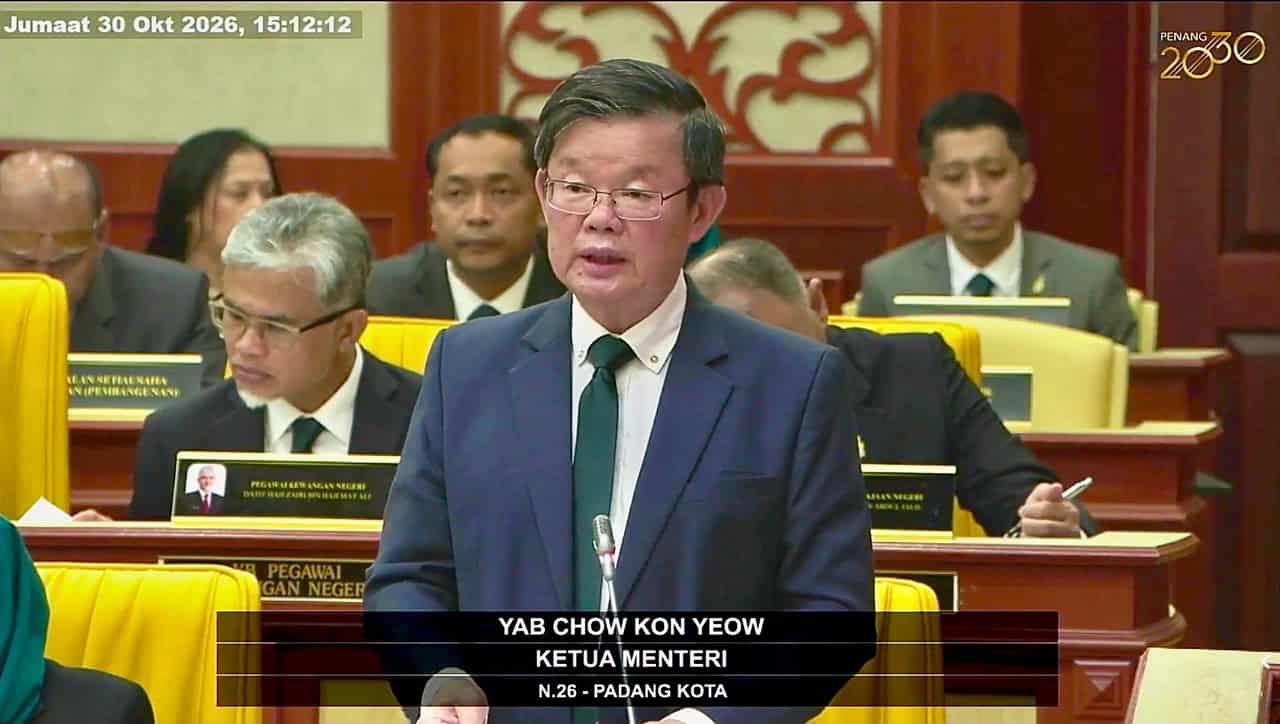
Chief Minister Chow Kon Yeow said the development would focus on attracting high-value investments in semiconductors, automated test equipment, integrated circuit (IC) design and medical devices, positioning Penang as a leading green, smart and sustainable technology hub.
He said reclamation works on Silicon Island had reached 500 acres as of October 2026, representing 39.4% of the 1,270-acre Phase One development.
A 64.85-acre site had also been prepared in May this year for the Mutiara Line Light Rail Transit (LRT) depot.
“Silicon Island is not merely about providing new industrial land, but represents a long-term investment that will generate economic benefits for the local economy.
“As of Sept 30, 2026, a total of 4,531 contracts worth RM1.92 billion had been awarded to local contractors and businesses,” he said when tabling the Penang Budget 2027 at the State Legislative Assembly today.
Chow said the state would continue strengthening its high-value industries, particularly electrical and electronics, semiconductors, IC design, automation, digital technology, medical devices and innovation-driven sectors.
Among the initiatives is the Malaysia Automation, Test and Equipment (ATE) Campus in Batu Kawan, led by InvestPenang in collaboration with the Economy Ministry.
The Federal Government has allocated RM25 million for the project, while the state is contributing 10 acres of industrial land worth approximately RM40 million to develop skilled talent and strengthen local companies’ participation in the global semiconductor supply chain.
Through Penang Silicon Design @5KM+, seven local companies have been approved for incubation incentives, while the state’s chip design ecosystem has grown from approximately 25 to more than 50 companies.
Meanwhile, the NCER Technology Innovation Centre (NTIC) in Bayan Lepas has trained 180 Penang participants as of September 2026, with eight companies involved in its Centre of Excellence initiative and six others matched within the industrial value chain.
Chow also highlighted the proposed Penang Technology Finance Centre (PTFC), supported by a RM100 million strategic investment partnership between the Federal and state governments through Khazanah Nasional and InvestPenang.
Following the submission of its White Paper to the Finance Ministry on Sept 23, the state will submit its strategic and action plans by November 2026. It has also requested the Prime Minister to expedite a joint Federal-State Government working committee to coordinate policies, financing, incentives and investment facilitation.
He stressed that the success of PTFC should extend beyond investment figures to include quality employment, higher incomes and suitable housing for skilled workers.
“The success of PTFC must also translate into opportunities for young Malaysians to build their future in their own country, ensuring that local talent has reasons and opportunities to remain, work and grow in Malaysia,” he said.
In this regard, Rumah Bakat Madani developments in Bandar Cassia, Batu Kawan, and Lorong Tenggiri, Seberang Jaya, will provide suitable accommodation for professionals and skilled industrial workers.
The Penang Development Corporation (PDC) will also drive several strategic developments, including Penang International Logistics Aeropark (PILA), the 1,578-acre Seberang Perai Tengah New Corridor, Batu Kawan Industrial Park 3 and Bandar Cassia Technology Park. Batu Kawan Industrial Park 2 in Byram is also being planned.
These projects will be complemented by Medi-City, Cassia Gardens workers’ accommodation and the Bandar Cassia Reservoir Project.
On digitalisation, Chow announced an allocation of RM4.5 million for 2027 through Digital Penang to implement the Penang Digital Economy Master Plan 2025–2030.
Some 8,646 micro, small and medium enterprises (MSMEs) have benefited from its capacity-building programmes, while 330 startups recorded estimated revenue of RM118 million and created approximately 1,720 jobs as of the third quarter of 2026.
The allocation will support startup incubation, hardtech product development, market access, MSME digitalisation and artificial intelligence (AI) adoption, alongside programmes such as DahDigital and MyKADUN.
Penang’s 4G coverage in populated areas reached 100% as of October 2026, while 5G coverage stood at 91.9%.
On tourism, Penang International Airport recorded 5,427,535 passenger movements from January to August 2026, an increase of 208,982 or 4% compared with the corresponding period last year.
The state currently has 278 domestic flights weekly connecting it to seven destinations, while international services link Penang to 21 cities. New routes to Batam and Haikou are expected to further improve connectivity.
The RM1.55 billion airport expansion project aims to increase annual capacity to 12 million passengers. Its first package has been completed, the second is underway, while the third, involving the main terminal, is at the pre-tender stage.
Penang’s business events industry is expected to generate RM1.9 billion in economic impact this year, rising to RM2.2 billion in 2027. Meanwhile, the Penang Hill Cable Car project, which has reached 32% completion, is scheduled for completion in August 2027 and full operations in the fourth quarter.
A total of RM14.5 million has been allocated for 2027 to support tourism-related state agencies and companies, including George Town World Heritage Incorporated, Penang Global Tourism and the Penang Convention & Exhibition Bureau.
In the halal sector, Penang has 1,191 MSMEs with active Malaysian Halal Certification, placing it third nationally after Johor and Selangor.
Penang Halal International and PDC have developed the Penang Halal Industrial Park at Penang Science Park and Penang Science Park (North), Bukit Minyak.
The state is also preparing its Penang Halal Industry Master Plan 2026–2030 and strengthening the Penang Halal Training Centre through industry and educational partnerships.
Chow announced RM1.5 million for 2027 to promote the halal industry and attract domestic and international investments, particularly in high-value products such as pharmaceuticals, cosmetics and medical devices, with the aim of increasing exports and creating quality jobs.
Story by Kevin Vimal