

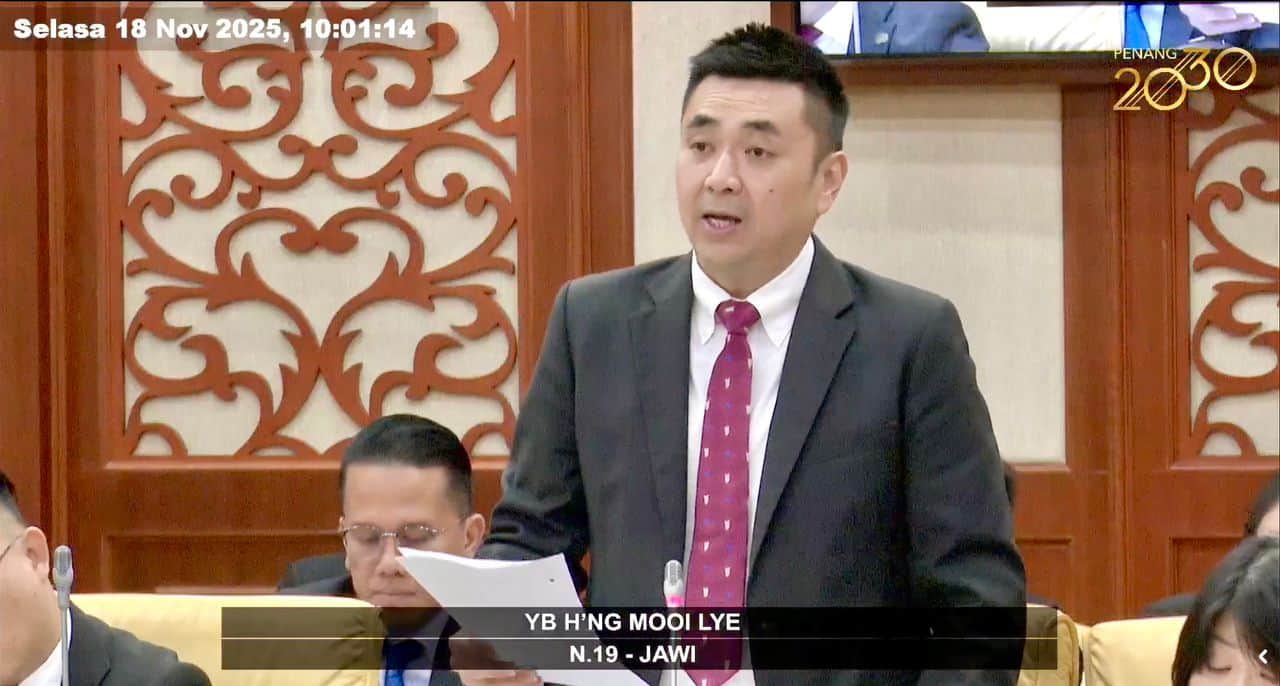

THE Penang government is reviewing several technical proposals from qualified companies on integrating smart elements into both new and existing bus stops.
Penang Local Government, Town and Country Planning Committee chairman Jason H’ng Mooi Lye said each proposal is being evaluated based on real-time functionality, long-term maintainability, city data integration and cost efficiency.
“This rigorous filtering process aims to determine a practical, high-impact smart bus stop model that can be adopted as the state standard for the benefit of public transport users.
“The evaluation will also take into account the overall cost of developing each smart bus stop,” H’ng (PH–Jawi) said during his winding-up speech at the Penang State Legislative Assembly in Light Street.
H’ng added that the state government, through both local councils, namely Seberang Perai City Council (MBSP) and Penang Island City Council (MBPP), has also established comprehensive guidelines incorporating requirements from the Immigration Department.
“These guidelines aim to regulate the involvement of foreign nationals in business activities and ensure that only eligible individuals who comply with Malaysian laws are allowed to work or assist in business operations.
“The guidelines have also been embedded as licensing conditions for business premises in the state,” he said.
MBPP and MBSP, he added, continue to take proactive steps to review and update these guidelines in line with current needs to ensure more effective enforcement and to reduce unlawful foreign involvement in Penang’s business sector.
On the proposal to increase closed-circuit television (CCTV) coverage for enhanced security, H’ng said MBPP already has plans to instal more CCTV units on the island beginning in 2026.
“A detailed study, to be carried out in collaboration with the police, will identify suitable hotspots for the installation of the new units to strengthen surveillance and public safety,” he said.
H’ng also highlighted MBPP’s intensified efforts to promote the disposal of abandoned and end-of-life vehicles through its ‘strata bebas kenderaan usang’ programme, along with wider public awareness campaigns.
“To support this initiative, MBPP provides regular briefings, digital information kits, promotional materials and engagement sessions with stakeholders to ensure that residents on the island clearly understand how to dispose of derelict vehicles independently via the online system (e-Deregistration).
“This method is extremely convenient. The process takes less than five minutes, requires no physical presence at the Road Transport Department (JPJ), incurs minimal cost and is far more user-friendly,” he explained.
He added that vehicle owners also stand to receive incentives and rewards when they surrender their vehicles to licensed Authorised Automotive Treatment Facility (AATF) operators.
“This encourages legal disposal and helps reduce the accumulation of abandoned vehicles in residential areas,” he explained.
H’ng reaffirmed MBPP’s commitment to actively promoting this initiative so that the public fully understands, trusts and is motivated to dispose of their vehicles responsibly.
On tree maintenance, H’ng said the state government, through MBSP, has implemented structured and scheduled arboriculture management to ensure public safety and the upkeep of orderly urban landscapes in Seberang Perai.
Story by Riadz Akmal