



A BALANCED two-way trade between Malaysia-Penang and China should be strengthened to ensure mutual economic benefits, said state Trade and National Unity Committee chairman Goh Choon Aik.
Goh shared this when he officiated the ‘International Export Empowerment & Global Entrepreneurship Programme (GLOBEX) Series 2: China’ at Holiday Inn & Suites Penang, Prai on April 21.
The programme, organised by the Federal Agricultural Marketing Authority (Fama) in collaboration with Penang Halal International (PHI), served as a strategic platform to equip entrepreneurs with the necessary knowledge and tools to penetrate international markets, particularly China. A total of 50 entrepreneurs participated.
Citing data from the Department of Statistics Malaysia (DOSM) as of April 20 (12 pm), Goh said Malaysia’s exports to China in March amounted to RM17.25 billion, representing 11.6% of total exports valued at RM148.75 billion.
“Meanwhile, China, which is Malaysia’s largest source of imports, recorded imports totalling RM31.79 billion in March, accounting for 25.6% of total imports of RM124.2 billion.
“This resulted in a trade deficit of RM14.54 billion between Malaysia and China in March, indicating that Malaysia, especially Penang, still has significant room to expand exports of ‘Made in Malaysia’ products and move towards a more balanced trade relationship,” he said.

Goh stressed that in an increasingly challenging global environment, reliance on the domestic market alone is insufficient for sustained business growth, underscoring the need to strengthen exports and expand global market reach.
“With the increasingly competitive global landscape, expanding beyond domestic markets is no longer optional but essential for long-term business sustainability. China, as one of the world’s largest economies, offers vast opportunities due to its large population and strong purchasing power.
“However, entering the Chinese market requires a deep understanding of consumer preferences, regulatory compliance, and culturally aligned marketing strategies,” he added.
He also highlighted the need for Fama to address the significant price disparity between farmers and supermarkets, which often results in lower earnings for farmers while consumers continue to face high retail prices.
On the halal sector, Goh noted that Penang’s halal product exports recorded a significant increase, rising from RM11.5 billion (23.4%) in 2023 to RM20.5 billion (36.4%) in 2024.
“A report by the Ministry of Investment, Trade and Industry (Miti) further showed that halal exports from Penang reached RM18.31 billion between January and June 2025, reflecting continued strong momentum in the sector,” he said.
To ensure the sustainability of the halal industry, Goh said the state government, through PHI — established in 2009 — continues to play a key role in promoting, developing and strengthening the local halal ecosystem.
He added that PHI is set to organise the Penang International Halal Expo (PIHEX) 2026 from July 2 to July 5 at Seberang Perai Polytechnic in Permatang Pauh.
.
“The event, now in its 14th edition since its introduction in 2010, is expected to be officiated by Prime Minister Datuk Seri Anwar Ibrahim and will bring together halal industry players from Malaysia and abroad,” he said.
Goh also noted that, in line with efforts to increase the number of Malaysian Halal Certification (SPHM) holders, the state government has implemented several initiatives. These include holding Halal Certification Committee meetings twice monthly and establishing the Penang Halal Industry Development Council (MPIHPP) in May 2025.
“Additionally, a special programme to support halal certification for cottage industry entrepreneurs will commence in January 2026, alongside the development of the Penang Halal Incubation Centre (PHIC), focusing on sectors such as pharmaceuticals, cosmetics and medical devices.
“The state has also developed the Penang Halal Industrial Park (TPHPP), which has received HALMAS accreditation across three locations — Penang Science Park and Penang Science Park (North) in Bukit Minyak, as well as PERDA Food Park in Kubang Menerong — covering a total of 198.62 acres.
“It is home to 14 multinational companies with SPHM certification,” said Goh, who is also the Bukit Tambun assemblyman.
Meanwhile, Fama senior international marketing director Noorsham Ramli said that in response to global challenges such as rising fuel prices and broader economic uncertainties, the Federal Government has established a task force to monitor the situation.
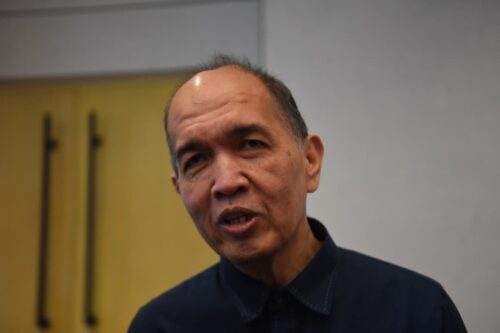
He said Fama’s role is primarily advisory, focusing on supporting the agricultural marketing sector. Farmers and entrepreneurs, he added, are encouraged to manage production costs more efficiently at the farm level to strengthen resilience against global uncertainties.
“Fama will continue to support industry players in expanding into alternative markets and reducing reliance on a single export destination through various initiatives, including participation in international trade platforms such as the recent Foodex exhibition in Japan,” Noorsham said.
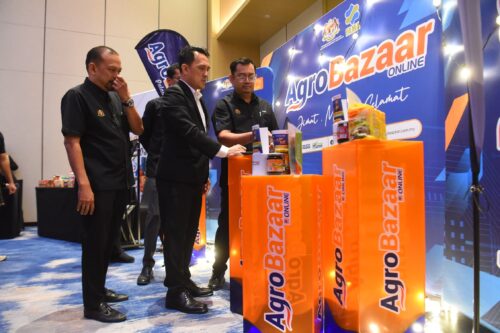
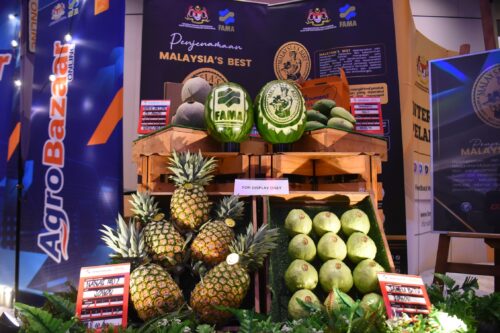
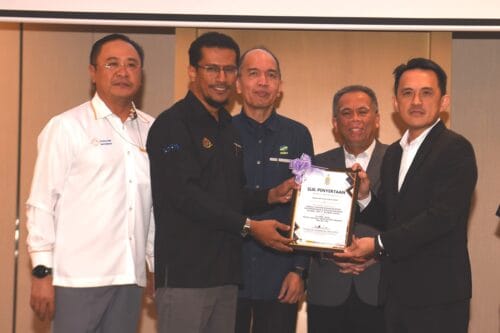
Pictures taken during the ceremony:-
Story by Tanushalini Moroter
Pix by Muhammad Iqbal Hamdan