

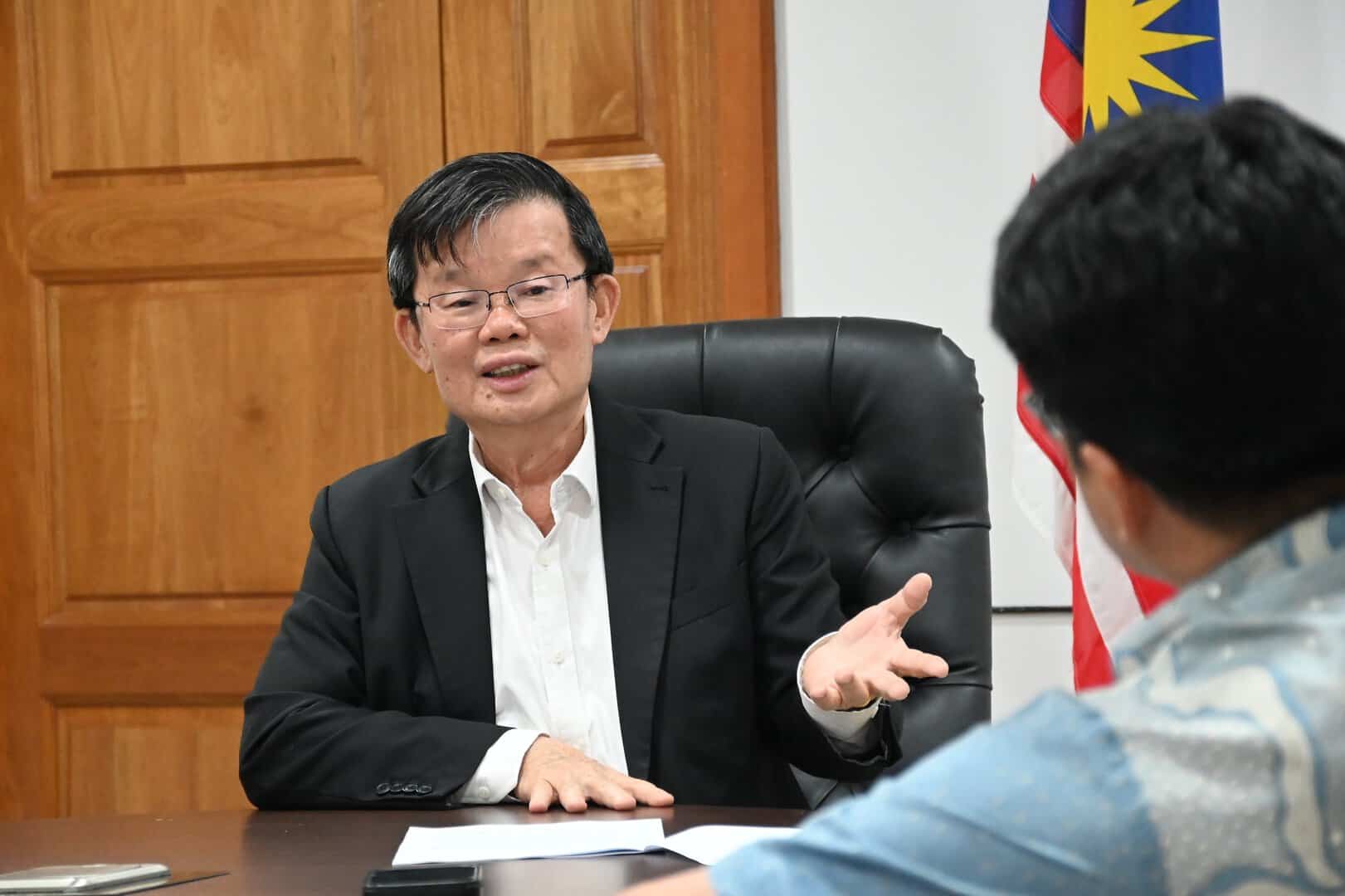

CHIEF Minister Chow Kon Yeow says leadership succession in Penang must be managed carefully and systematically to ensure political stability, investor confidence and continuity in the state’s long-term development agenda.
Reflecting on his final term in office during an exclusive interview with The Straits Times in Komtar on April 6, Chow stressed that discussions on succession should not be viewed as a single decision, but rather as an ongoing process involving leadership grooming, evaluation and consensus-building within the party.
“We have a constitutional amendment since 2018 which limits the chief minister to two terms. So legally and constitutionally, I have slightly more than two years left.
“That is why there is a need to look at who will come after me and to make the leadership transition, which is inevitable, as smooth as possible,” he said.
Chow noted that Penang, often regarded as the “crown jewel” of the party, could not afford internal instability or prolonged speculation over future leadership.
“If there is a lot of speculation and internal dissension, it would be bad for the party and Penang. There must be clarity.
“The succession is not a single decision. It is a process involving grooming, identifying, evaluating and readiness,” he added.
The chief minister acknowledged that politics can sometimes produce unexpected outcomes, citing his own rise to the top post following the change of the Federal Government in 2018.
Nevertheless, he said leadership preparation remains crucial, especially for a state like Penang where governance, economic management and coalition stability are closely scrutinised.
Touching on the qualities needed in a future chief minister, Chow emphasised the importance of delivery, fiscal discipline and long-term policymaking.
“Ability to deliver, execute and translate policies into real outcomes for the people is important.
“Politicians may want to be popular, but we must not sacrifice long-term policy impact. Cash handouts may be popular, but the state also needs sustainable revenue and development,” he said.
Chow pointed out that Penang remains among the few states with strong financial discipline and minimal outstanding federal loans, despite operating within the constraints faced by most state governments.
He also highlighted the importance of integrity and political stability, especially within a coalition administration.
“Integrity, public trust and credibility are the foundation for effective leadership,” he said.
On his administration’s legacy, Chow said several major infrastructure initiatives would likely define his tenure, particularly the Penang transport agenda and long-term water security plans.
Among the projects he singled out were the Penang Light Rail Transit (LRT) Mutiara Line project, Silicon Island reclamation works and the proposed Perak-Penang water supply scheme.
“Water supply is the lifeline of life and the economy. Without water, what can you do?
“If the Perak-Penang water scheme can be achieved, that would be one of the biggest things during my tenure,” he said.
Chow added that the LRT project and Silicon Island initiative were also closely tied to Penang’s future economic expansion and transport sustainability.
“The island is already taking shape now. In future, it could significantly change Penang in terms of available land and economic activities,” he said.
At the same time, Chow credited the Penang2030 vision as one of his administration’s most structured long-term policy frameworks.
Launched in 2018, the initiative continues to be monitored quarterly through dedicated steering committees, champion officers and performance tracking mechanisms.
“We have maintained the commitment to Penang2030 for eight years. It is not easy because civil servants come and go, but the system continues.
“Some projects have already exceeded their original targets, while others are still ongoing. Overall, it remains a work in progress, but it is continuously monitored,” he said.
On Penang’s economic performance, Chow said attracting quality investments while strengthening local industry ecosystems had been among his administration’s key priorities.
He noted that Penang had consistently remained among the country’s top investment destinations during his tenure, particularly in the electrical and electronics sector.
“Our focus is not just on attracting big numbers, but on building a sustainable ecosystem.
“In Penang, industries compete and collaborate at the same time. Talent development, TVET and supply chain strengthening must be a joint effort,” he said.
Chow added that recent initiatives such as Silicon Design @5km+ and the Advanced Automation Technology Hub were designed to deepen collaboration between multinational corporations, local firms and startups.
Asked about recent controversies involving members of the state administration, Chow admitted that public office holders must uphold higher ethical standards.
“We are always under the spotlight. There is no room for us to make mistakes.
“We must not abuse positions for personal or family benefit,” he said.
On issues such as water tariff adjustments and revised quit rent rates, Chow defended the state government’s decisions as necessary measures to ensure long-term financial sustainability.
“People do not like increases in taxes or tariffs, but these are legacy issues that have been postponed for many years.
“Eventually the government has to deal with them,” he said.
Despite the political and economic challenges ahead, Chow maintained that Penang’s performance, stability and long-term planning would remain central to public confidence in the state government.
Story by Kevin Vimal
Pix by Alissala Thian