

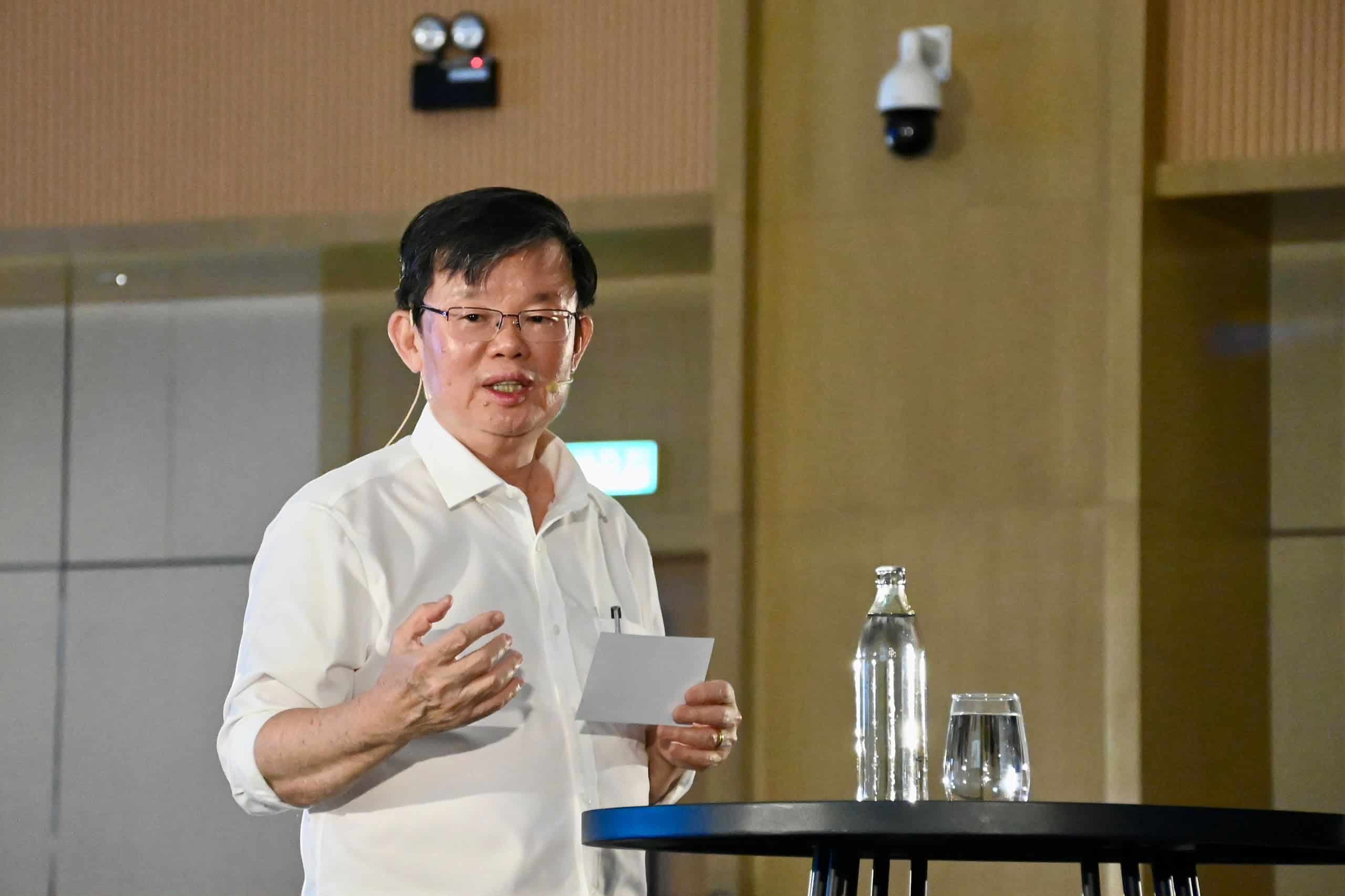

CHIEF Minister Chow Kon Yeow has given his administration a 70 per cent rating, while stressing that the state government must continue strengthening the foundations laid over the past eight years and move forward with the Penang2030 vision.
Chow said the assessment reflected the collective efforts of the state government, private sector, non-governmental organisations (NGOs), communities and various stakeholders in driving Penang’s development and turning the Penang2030 vision into reality.
“70 per cent is my standard answer,” Chow said when asked to rate himself and his administration over the past eight years.
He said the Penang2030 vision, introduced following an early engagement exercise in 2019, was anchored by four foundational themes and 16 strategic initiatives aimed at making Penang a more competitive, liveable and sustainable state.
Chow stressed that the vision should not be viewed as a collection of targets to be completed by 2030, as several major projects will continue beyond that timeframe.
“Today is not a celebration. Today is for us to look back so we can orientate ourselves forward more precisely,” he said during his remarks at the launch of the Penang2030 Achievement Report Card.
“The final four years that are left of the 2020s and how we continue the journey is key. Daring and readiness to take ‘quantum leaps’ are also necessary attitudes for us to maintain,” he further added.
Among the key foundations laid under Penang2030 are major infrastructure, digitalisation, environmental resilience, heritage and economic development initiatives.
Chow highlighted the ongoing expansion of Penang International Airport, which is expected to increase its capacity to about 12 million passengers annually, as well as the Mutiara Line Light Rail Transit (LRT), Penang’s first rail system, which is currently under construction.
The Juru-Sungai Dua elevated highway, Penang Hill Cable Car Project and Silicon Island development were also cited as major projects aimed at strengthening the state’s connectivity, tourism appeal and economic capacity.
Chow said these projects were not merely about infrastructure, but about laying the groundwork for Penang’s future prosperity.
“Sometimes with a change in leadership, even with planned succession, initiatives and programmes may go through an overhaul. To me, if the project is important and good for Penang, we should see it through,” he said.
He also pointed to the state’s efforts in digital transformation, noting that Penang had expanded cashless services, digital skills programmes and smart governance initiatives, while leveraging data and artificial intelligence (AI) to improve planning and public services.
At the same time, environmental resilience remained a key priority, particularly in addressing the effects of climate change, flooding and water security.
Chow said the state government was also looking beyond physical infrastructure by strengthening Penang’s semiconductor and technology ecosystem, attracting high-value investments and developing the Penang International Financial Centre (PIFC).
“We want to be at the forefront in the semiconductor industry and technology innovation, with strong fundamentals that generate economic growth for the benefit of the people in Penang,” he said.
However, Chow acknowledged that not all Penang2030 targets had progressed at the same pace.
He said he had instructed every state executive councillor to identify initiatives that remained incomplete or had yet to make sufficient progress, to ensure that work intending to ensure completed.
“I gave an order a few weeks ago for every exco to list down things that they have not completed, and I hope that they will take action to complete it. Start it, if not, complete it,” he said.
Chow said accountability was also strengthened through the Penang2030 Dashboard, which allows the public to monitor the progress of the state’s strategic initiatives.
He said each initiative has a designated “champion exco” and “champion officer”, ensuring that responsibility for progress is clearly assigned.
“A government that puts the scoreboard online, updated continuously, for any resident, any journalist, any opposition politician to check on any day of the year, that is a government that has made itself accountable by design, not just by promise. That is Penang government,” he said.
Chow also acknowledged the contribution of Penang’s civil society, private sector and communities, saying the state’s progress could not have been achieved by the government alone.
“I have said, thank you for working with me, not working for me,” he said, stressing that various groups could contribute in their respective areas while aligning their efforts with the broader vision for Penang.
Looking beyond 2030, Chow said the next administration would ultimately determine which initiatives should be continued, completed or replaced with new priorities.
“That depends on the Chief Minister who comes next. In any case, particularly these foundation projects, they will take time beyond 2030,” he said.
He added that some projects could be continued if their objectives had not yet been achieved, while completed initiatives could make way for new areas of focus to take Penang to a higher level.
With the eventual transition of leadership in mind, Chow said he wanted to leave behind strong foundations for his successor to build upon.
“I also want to hand over Penang in a proper manner to the successor,” he said.
Ultimately, Chow said the Penang2030 journey remained centred on building a Family-Focused, Green and Smart State that Inspires the Nation, with development measured not only by major projects but also by improvements to the daily lives of Penangites.
“This is a promise we intend to keep, project by project, household by household, until Penang is not just a place we are proud to call home, but a place that inspires the rest of the nation for being green, for being smart, and most importantly, for being family-focused,” he said.
Among those present earlier were Deputy Chief Minister I Prof Datuk Dr Mohamad Abdul Hamid, state Tourism and Creative Economy Committee chairman Wong Hon Wai, state Social Development, Welfare and Non-Islamic Religious Affairs Committee chairman Lim Siew Khim, state Housing and Environment Committee chairman Datuk Seri Sundarajoo Somu, state Trade and National Unity Committee chairman Goh Choon Aik, state assemblymen, Penang Island City Council (MBPP) mayor Datuk A. Rajendran, Seberang Perai City Council (MBSP) mayor Datuk Baderul Amin Abdul Hamid, and others.
Story by Kevin Vimal
Pix by Alissala Thian
Video by Siti Nuratikah Rahmat