


THE global energy crisis triggered by the United States–Iran war took centre stage at the Penang State Legislative Assembly today, as lawmakers debated its impact on the state’s economy and utilities.
Lee Boon Heng (PH – Kebun Bunga) raised concerns that the crisis, compounded by rising logistics and insurance costs, would intensify by June.
He pressed the government on whether Penang would introduce an economic stimulus package to support small and medium enterprises (SMEs), reduce industrial taxes, and help utilities like the Penang Water Supply Corporation (PBAPP), manage escalating project costs.
He also asked whether water tariffs would be raised to offset PBAPP’s higher operating expenses.
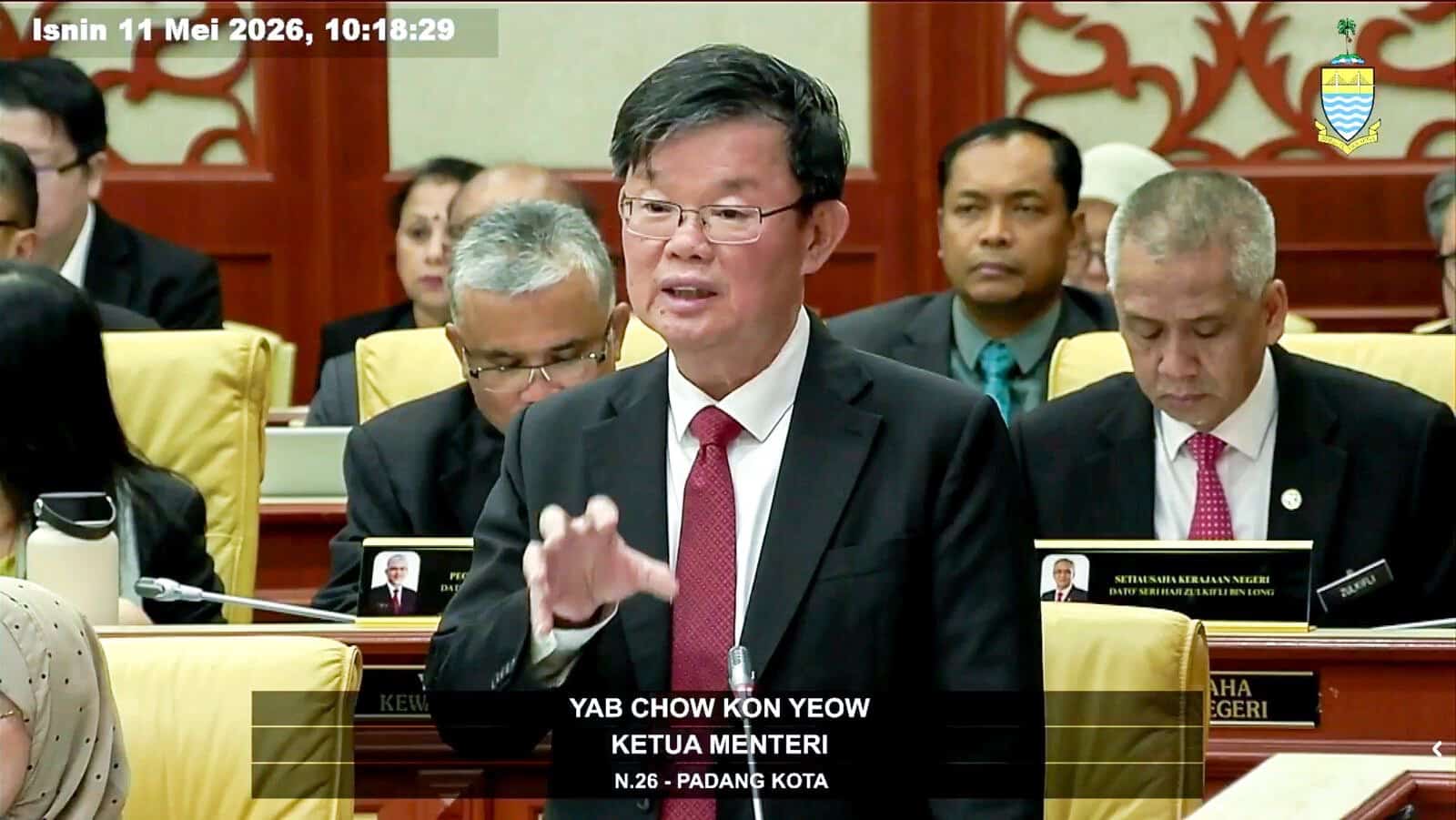
In reply, Chief Minister Chow Kon Yeow acknowledged the challenges but stressed that Penang would not impose additional burdens on its people and industries.
“Do not add further pressure. At this point, even if the state wanted to, we are not in a strong position to provide a stimulus package.
“The Federal Government has already taken important steps to assist industries and SMEs, including mobilising bank loans,” he said.
Chow (PH – Padang Kota) revealed that the state itself is grappling with higher diesel costs, with local councils facing millions in additional expenses.
“For example, the Seberang Perai City Council (MBSP) is facing an estimated RM5 million increase in operating costs due to diesel hikes.
“We do not know how much more they will have to bear by year’s end,” he added.
Chow explained that the Penang Development Corporation (PDC) had postponed several projects for at least six months to give contractors certainty amid cost escalations.
“PDC will shoulder the burden together with contractors through cost-sharing arrangements,” he said.
For PBAPP, Chow emphasised that all projects under the Water Contingency Plan 2030 would proceed as planned.
“These are strategic projects to secure Penang’s water supply. We have already secured sufficient loans to finance them. Whether water tariffs will be raised or not, that is for this Assembly to determine,” he added.
Earlier, Chow had outlined the broader impact of the global energy crisis on Penang. Investor sentiment has cooled, with foreign investors adopting a “wait and see” approach, slowing job creation in high-impact sectors.
Rising energy and raw material costs have hit factories hard, while companies face cash flow pressures as they divert reserves to buy raw materials at premium prices.
The semiconductor and electronics sector, a cornerstone of Penang’s economy, is particularly vulnerable to global supply chain disruptions. Surveys conducted during the launch of the Penang Automation, Test & Equipment (ATE) Campus showed that 40 percent of firms reported cost increases of between five and ten percent, while some faced surges above 30 percent.
To mitigate these challenges, the state government has rolled out a series of measures, including continuous engagement with industry groups, the establishment of an integrated early warning system with federal agencies, and efforts to attract high-quality investments in sectors like semiconductors, medical devices, automation, AI, and IC design.
The state is also promoting automation, solar energy adoption, and green manufacturing, supported by the launch of the Penang ATE Campus and a RM100 million Climate Mitigation Fund with Alliance Bank to accelerate low-carbon production. Export diversification, digital trade initiatives, and tariff exemptions under international agreements are also being pursued to keep Penang competitive.
Despite PBAPP’s operating costs being projected to rise by 15 to 30 percent due to higher diesel, electricity tariffs, and imported chemicals for water treatment, Chow assured that domestic and industrial consumers would not be burdened.
“Our priority is to ensure households and industries continue to enjoy a reliable water supply without compromising financial stability,” he said.
Story by Kevin Vimal
Pix by Siew Chia En