

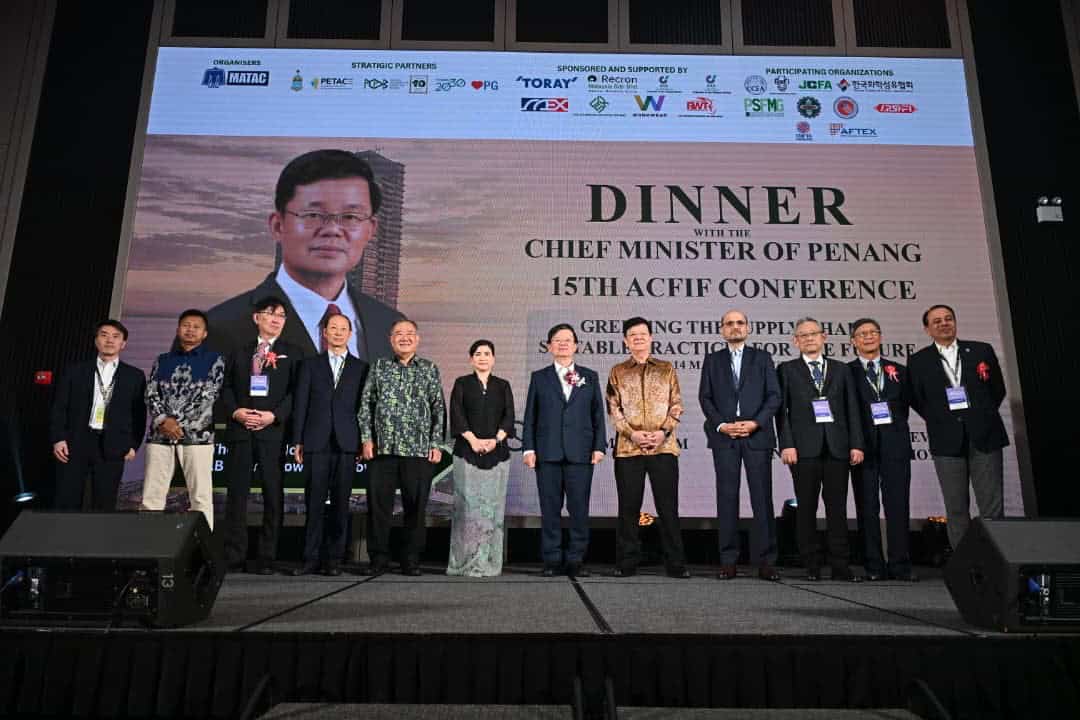

OVER the past five decades, Penang has transformed itself from a labour-intensive manufacturing base into a high-value industrial ecosystem, said Chief Minister Chow Kon Yeow.
Chow said Penang is now home to more than 500 multinational corporations and over 1,000 small and medium enterprises (SMEs), all operating within an ecosystem built on reliability, efficiency and innovation.
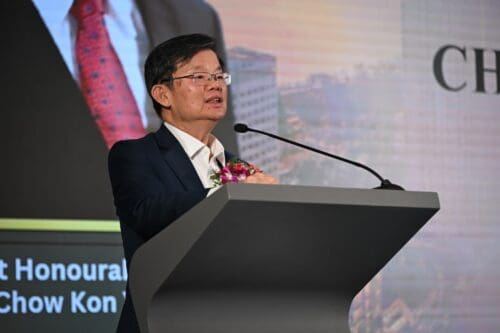
“What makes Penang stand out is not just what we produce, but how we connect by connecting industries, supply chains, talent and markets.
“In a world where supply chains are being restructured for greater resilience and efficiency, that connectivity has become a significant advantage,” he said during a special dinner held in conjunction with the 15th Asian Chemical Fibre Industries Federation (ACFIF) Conference 2026 at the Penang Marriott Hotel in Gurney Drive this evening.
The three-day conference, organised by the Malaysian Textile Manufacturers Association (MTMA), began yesterday and gathered more than 200 delegates comprising industry leaders from eight countries, namely China, Indonesia, India, Japan, South Korea, Pakistan, Taiwan and Thailand.
Also present at the dinner were Entrepreneur Development and Cooperatives Minister Steven Sim Chee Keong, Investment, Trade and Industry Deputy Minister Sim Tze Tzin, Consul-General of Japan in Penang Shinya Machida, MTMA president and ACFIF chairman Regina Leong and Federation of Malaysian Manufacturers Penang (FMM Penang) Datuk Seri Lee Teong Li.
Chow added that Penang’s industrial hubs, from Bayan Lepas to Batu Kawan, have evolved beyond traditional production centres.
“They are now platforms for design, innovation and collaboration. For industries such as chemical fibre and textiles, Penang can serve not only as a manufacturing base, but also as a strategic link within a broader regional supply chain,” he said.
He further stressed that the transition towards greener supply chains is no longer a distant ambition, but a process already underway that will continue to accelerate in the coming years.
“The real question before us is not whether industries should adapt, but how quickly and effectively we can move forward together.
“In this context, gatherings such as ACFIF play an important role in bringing together not just companies, but also perspectives to exchange ideas, strengthen partnerships and shape the future of industry with greater clarity and purpose.
“As you continue your discussions tomorrow and conclude this conference, I hope you will also see Penang not merely as a host destination, but as a trusted long-term partner, a place where industry, innovation, connectivity and opportunity continue to converge,” he added.
Meanwhile, Regina said the ACFIF community is united not only by shared industry interests, but also by genuine friendship and mutual respect cultivated over the past three decades.
“It is gratifying to be surrounded this evening by colleagues who are also friends, individuals with whom we share not only business objectives, but also common values and aspirations for the future of our industry.
“Tomorrow will feature another comprehensive day of theme paper presentations and panel discussions designed to deliver actionable outcomes, address critical industry challenges and create further opportunities for meaningful collaboration.
“I am confident that the momentum established today can be carried forward even more productively,” she said.
Story by Riadz Akmal
Pix by Muhammad Iqbal Hamdan
Video by Adleena Rahayu Ahmad Radzi