


PENANG is considering setting up a dedicated implementation office for the proposed Penang Technology Finance Centre (PTFC), alongside a joint federal-state committee to accelerate the initiative following its recognition under the Federal Budget 2027.
Chief Minister Chow Kon Yeow said the proposed arrangements would help coordinate resources, strengthen cooperation with relevant stakeholders and ensure the initiative could move forward effectively.
He said the state government intended to intensify discussions with the Finance Ministry (MOF) once the Federal Budget 2027 was approved.
“We want to ensure that a joint committee between the state and Federal governments is established as soon as possible because there is much work to be done.
“At the state level, I also see the need to establish a dedicated PTFC implementation office to mobilise our resources and coordinate efforts with other stakeholders,” he said.
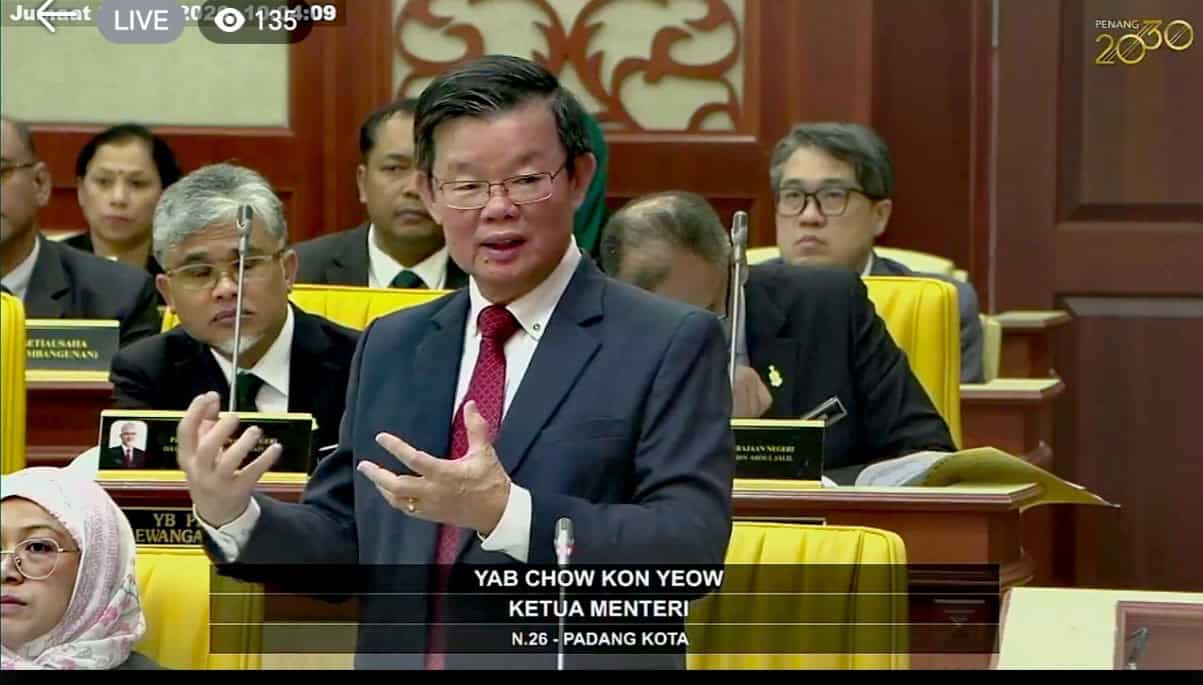
Chow (PH – Padang Kota) was responding to a supplementary question from Gooi Hsiao-Leung (PH – Bukit Tengah) during the State Legislative Assembly sitting at the State Assembly Building today.
He said the state government was encouraged by the Federal Government’s recognition of Penang as a national technology finance centre under Budget 2027, describing it as an opportunity for the state to assume a greater role in Malaysia’s technological and industrial development.
Chow admitted that the announcement had come as somewhat of a surprise, as the state’s original proposal had focused on establishing a regional financial centre.
“I was a little surprised when the Finance Minister, who is also the Prime Minister, announced during the budget presentation that Penang had been identified as the country’s technology finance centre.
“For us, this represents an enhancement of what we initially proposed. What was originally envisioned as a regional centre has now been recognised as having the potential to play a much bigger role at the national level,” he said.
Chow explained that the initiative, originally known as the Penang International Financial Centre (PIFC), had undergone a strategic repositioning following consultations with stakeholders and the Finance Ministry.
The decision to rebrand it as the PTFC was made to better reflect Penang’s strengths as a high-technology hub, particularly in the electrical and electronics (E&E) and semiconductor industries.
He said the state recognised the need to differentiate its proposed centre from existing financial hubs in Kuala Lumpur, Labuan and Johor.
“We agreed that there must be something that distinguishes our centre from conventional financial centres.
“That is why we believe a technology finance centre is a better fit, particularly as we continue to strengthen our semiconductor and E&E sectors amid global geopolitical changes and the ongoing artificial intelligence (AI) supercycle,” he said.
Chow said the PTFC was envisioned as an integrated financial and investment ecosystem capable of mobilising capital, financial services and innovative financing solutions to accelerate technological development.
He said the initiative would complement national policies, including the National Semiconductor Strategy and the New Industrial Master Plan (NIMP), while supporting the growth of high-value industries such as semiconductors, advanced manufacturing, high technology and deep technology.
“The objective is to strengthen our existing ecosystem by integrating financial and investment capabilities so that we can mobilise capital and innovative financing solutions to accelerate technological development, not only in Penang and the northern region but eventually across the country,” he said.
Chow also revealed that the Federal Government’s announcement had already attracted interest from foreign parties seeking opportunities to participate in financing Malaysia’s technology sector.
He said access to capital remained a major challenge for small and medium enterprises (SMEs) and technology startups, particularly those seeking to commercialise innovations and expand their businesses.
“Following the announcement in Parliament, we have already begun seeing interest from parties in other countries who recognise the opportunity to participate in financing the development of our technology sector,” he said.
Chow added that the initiative could also help bridge the gap between research and commercialisation, particularly by unlocking the commercial potential of intellectual property developed at universities.
He said universities possessed substantial intellectual property, but commercialisation remained a weakness.
“With greater access to capital and financial support, technology companies, SMEs and startups can explore opportunities to commercialise intellectual property developed by universities and turn these innovations into viable technology projects.
“This is among the outcomes we hope to achieve, although it is difficult at this stage to predict how significantly the initiative could contribute to broader economic growth,” he said.
Earlier, Gooi welcomed the Federal Government’s recognition of Penang as a national technology finance centre, describing the initiative as a potential catalyst for the state’s economic development over the next two to three decades.
However, he sought clarification on the state’s participation in the proposed national framework, particularly whether Penang could benefit financially through equity ownership or other mechanisms that would generate additional state revenue.
“Beyond economic growth, job creation and attracting new industries, I would like to know whether equity ownership and financial returns to the state are being considered as part of this initiative.
“This is particularly important because it could help expand the state government’s revenue base,” he said.
Gooi also proposed that the PTFC White Paper, Strategic Blueprint and Action Plan be presented to all state assemblymen to allow them to provide feedback and recommendations.
In response, Chow welcomed the suggestion and said the state government would consider inviting assemblymen to a briefing once the relevant documents were completed.
He said PricewaterhouseCoopers (PwC) Malaysia, the appointed consultant, was expected to submit the Strategic Blueprint and Action Plan by November 2026.
The documents would outline the initiative’s strategic direction, implementation strategies and necessary actions.
Chow added that the state government had submitted the PTFC White Paper to the Treasury secretary-general at the Finance Ministry on Sept 23 this year.
He said the Federal Government’s subsequent recognition of Penang under Budget 2027 represented a positive development in efforts to strengthen the state’s technology ecosystem and enhance the value of its local industries.
With the federal budget currently undergoing parliamentary deliberations, Chow said further engagement with the Finance Ministry would be intensified over the next one to two months, following its approval.
Story by Kevin Vimal
Law Suun Ting and Muhammad Iqbal Hamdan