

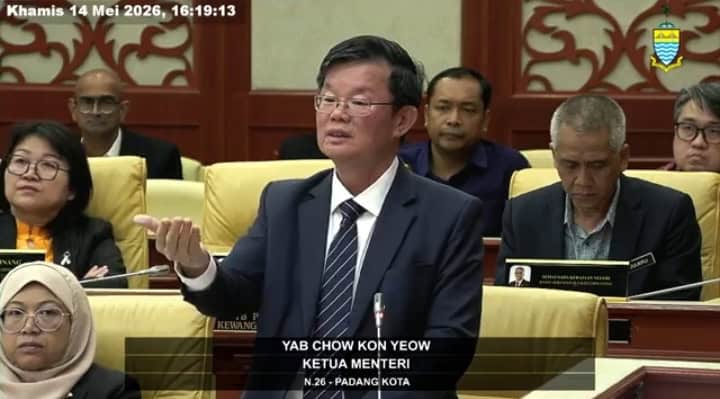

PENANG’S economy is projected to grow between four and five per cent this year, driven by the strong performance of the high-technology manufacturing and electrical and electronics (E&E) sectors despite mounting global economic and energy-related pressures, Chief Minister Chow Kon Yeow (PH-Padang Kota) told the State Legislative Assembly today.
Winding up the debate at the State Legislative Assembly, Chow said the state’s inflation rate is also expected to remain moderate at between 1.5% and 2.5%.
He said the encouraging outlook reflects continued strength in external trade activities, which remain among the key drivers of Penang’s economy.
“Based on the latest economic information, Penang’s Gross Domestic Product (GDP) for 2026 is projected to grow between four per cent and five per cent.
“This reflects the strong performance of the high-technology manufacturing sector, electrical and electronics (E&E), as well as external trade activities, which continue to be the main drivers of the state economy,” he said.
Chow added that Penang has continued to maintain its position as one of the country’s key investment destinations based on official statistics from the Malaysian Investment Development Authority (Mida).
He said the state recorded total approved investments of RM63.96 billion, with the services sector contributing RM41.22 billion, while the manufacturing sector accounted for RM22.38 billion.
“This achievement reflects the high and continuous confidence of investors in the strength of the state’s economic fundamentals, industrial ecosystem stability and progressive, competitive development direction,” he said.
At the same time, Chow said the Penang government would continue adopting a responsible fiscal approach instead of populist measures in ensuring sustainable governance and long-term economic resilience.
“The state must decide whether to adopt a populist or responsible approach in ensuring sustainable governance.
“Amid economic uncertainty and rising expenditures caused by internal and external factors, safeguarding the welfare of the people remains a priority. Therefore, my administration must wisely plan and optimise every available resource,” he said.
Chow said the state government welcomed a proposal by Joseph Ng Soon Siang (PH-Air Itam) to help reduce the people’s cost-of-living burden through discounts and assistance initiatives.
He said the proposal reflects concern for public welfare and aligns with the state government’s aspiration to prioritise the people’s well-being.
“Accordingly, the state will comprehensively study the proposal by taking into account financial implications, implementation effectiveness and long-term benefits to the people and the state,” he added.
On the state’s finances, Chow said Penang recorded total revenue of RM403.39mil as of May 13 this year based on the Consolidated Revenue Account statement.
He said the amount comprised tax revenue, non-tax revenue and non-revenue receipts.
“In terms of operating expenditure, the state government spent RM310.22mil, which remains under control.
“This demonstrates continued fiscal discipline in ensuring prudent expenditure management,” he said.
As a result, Chow said the state recorded a current surplus of RM93.17mil, contributing to an increase in the balance of the Consolidated Revenue Account.
He described the performance as reflecting Penang’s “strong and resilient” financial position driven by efficient revenue management and prudent expenditure control.
Chow said additional revenue obtained by the state would be channelled back to the people through infrastructure development, social empowerment programmes such as i-Sejahtera, disaster management efforts and various development initiatives directly benefiting public well-being.
He added that the additional revenue would not be allocated to one specific initiative but would instead be channelled into the State Consolidated Fund and utilised strategically according to current priorities.
“At the same time, the state remains committed to safeguarding public welfare and economic resilience.
“The additional revenue also has the potential to support targeted initiatives such as energy efficiency and sustainability programmes, support for industry and SMEs, as well as high value-added economic development and investment programmes,” he said.
Chow added that the approach was in line with prudent fiscal management principles to ensure long-term state financial stability without unduly burdening the people.
On the Penang International Financial Centre (PIFC), Chow said the establishment of the PIFC remains a key strategic priority for the Penang government in its efforts to strengthen the state’s position as a future hub for financial services and high-value economic activities.
“After nearly two years of planning, stakeholder engagement and restructuring efforts involving various key parties, including the Ministry of Finance, Bank Negara Malaysia, the Securities Commission Malaysia and the Labuan Financial Services Authority, as well as the Expression of Interest (EOI) process involving potential developers, the state government is now entering a new and more significant phase focused on implementation.
“Guided by the spirit of ‘If the plan doesn’t work, change the plan, but never the goal’, the state government has adopted a new strategy through the establishment of the PIFC Special Task Force Committee, which was approved during the State Executive Council meeting on March 18 this year, to accelerate the development of the policy framework, strategic plan and early implementation of the PIFC in a more comprehensive and structured manner through a whole-of-state approach.
“The committee comprises various key state and federal agencies, including the State Finance Department, State Economic Planning Division, InvestPenang, the Northern Corridor Implementation Authority (NCIA) and Mida.
“It is also supported by three major strategic partners, namely Eastern & Oriental Berhad, IJM Corporation Berhad and Ideal Property Group through the Queens Island Financial District (QIFD).
“Through the appointment of an international consultant, the committee is responsible for preparing a comprehensive white paper, strategic plan, and action plan to be submitted to the Federal Government as part of efforts to realise the establishment of the PIFC in a more organised and sustainable manner.
“As such, the Penang government is confident that this new, more structured, inclusive and implementation-oriented approach will strengthen efforts to realise the PIFC as a catalyst for the state’s next phase of economic growth,” he said.
Chow stressed that the PIFC is a long-term strategy aimed at transforming Penang into a hub for financial services, financial technology and high-value economic activities that complements the national financial ecosystem.
“This will, in turn, create more investment opportunities, high-income jobs and local talent development for a more sustainable and competitive economic future for Penang,” he added.
Meanwhile, on the Jelutong Landfill Rehabilitation project, Chow said the Penang government is also taking seriously the fact that approval for the Environmental Impact Assessment (EIA) has yet to be obtained.
“The state government will review the report from the Penang Development Corporation (PDC) before making any decision on the direction of the project.
“The state government is also of the view that the project is crucial in addressing existing safety and environmental concerns at the Jelutong landfill site, including fire risks, gas emissions, leachate discharge and structural instability at the landfill area.
“The extension of time (EOT) being considered by the state government takes into account factors beyond the developer’s control, allowing the developer to complete the necessary technical requirements and fulfil additional conditions related to the EIA report as stipulated by the Department of Environment (DoE),” Chow explained.
On governance issues involving InvestPenang, Chow said the Penang government views the matter seriously.
“Improvement measures have been and are being implemented, including the development of a Board Charter aligned at the state level through Chief Minister Incorporated (CMI), the standardisation of reporting formats for overseas investment missions, as well as improvements to internal organisational procedures.
“It has also been clarified that the state government’s allocation of RM18.5 million to InvestPenang and expenditure amounting to RM0.5 million for 16 overseas investment missions covered four years from 2021 to 2024, and not a single financial year.
“Of the total amount, approximately RM14.46 million was utilised for the organisation’s operational expenditure, equivalent to an average of about RM3.6 million annually, while the remaining RM4.1 million was channelled towards various strategic industrial and talent development initiatives such as the Penang Future Foundation, Penang Internship Subsidy Programme and the Penang i4.0 Seed Fund, all of which directly benefit Penang’s human capital development and industrial ecosystem,” he said.
Story by Edmund Lee and Riadz Akmal