



CHIEF Minister Chow Kon Yeow has called for aggressive adoption of water-management technologies and stronger federal support for securing raw water sources, describing both as “urgent priorities” for Malaysia as the country battles rising demand, ageing infrastructure and growing climate pressures.
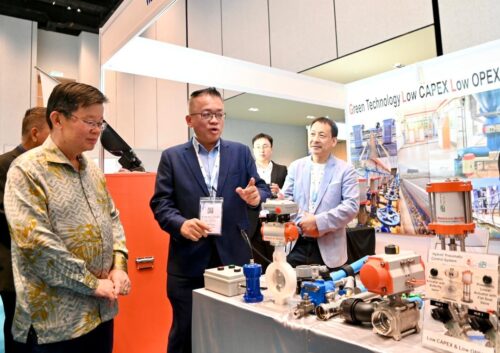
Chow made the remarks after visiting Water Tech Asia 2025 – International Water Management Industry and Technology Exhibition and Forum at the Penang Waterfront Convention Centre (PWCC), where he engaged with innovators offering cutting-edge water solutions.
Chow said while the industry is rapidly innovating, from advanced leak-detection systems to smart metering, Malaysia risks losing the gains if raw water sources remain politically or environmentally vulnerable.
“It doesn’t matter how much technology we deploy if we don’t have a guaranteed raw water catchment,” he warned.
“Without a secured catchment area to generate raw water, then whatever technology we have becomes useless because we simply do not have the source to treat,” he added.
He stressed that Penang continues to support the push by Pengurusan Aset Air Bhd (PAAB) chairman Datuk Seri Jaseni Maidinsa for federal recognition of the Ulu Muda Basin as a national water scheme, a long-standing proposal that has not yet materialised.
“Datuk Seri Jaseni has pushed this idea before. We fully support him.
“But these efforts have not succeeded. This is a very important matter because without protected catchment areas, there is no raw water to sustain our future needs,” Chow told reporters earlier.
In a related development, he also welcomed Water Tech Asia’s focus on solutions for non-revenue water (NRW), a problem that continues to affect states nationwide.
He said Malaysia must avoid a scenario where states continue building new plants but leakages in distribution networks undermine efficiency and financial sustainability.
“Non-revenue water is very close to our hearts.
“There is no point building more treatment plants if the reticulation system keeps leaking and wasting water, while also losing revenue that water companies desperately need,” he said.
Meanwhile, he noted that the exhibition showcased promising solutions, including smart meters, stronger pipes, and leak-detection systems, which water operators across Malaysia should consider adopting.
“I hope these solutions can be implemented by all water operators in Malaysia, not only in the northern region.
“With the right technology, we can achieve more efficient water management — for both suppliers and users,” he said.
Chow also highlighted Penang’s interest in deepening cooperation with Anhui Province, describing it as an economy “growing rapidly” due to its focus on high-technology sectors.
“Anhui is developing strongly in semiconductors, electric vehicles, and renewable energy.
“We have brought several companies from these sectors, and we hope they can explore opportunities for investment and collaboration. We hope these efforts will succeed,” he said.
Chow led a state delegation to Anhui recently to explore new ties between Penang and the province.
Separately, when asked if he would be open to a public forum with the Kedah Menteri Besar following recent remarks about historical ties and water matters, Chow said Penang remains willing to engage.
“We do meet irregularly at national meetings.
“In fact, yesterday there was a National Water Council, but I didn’t see him there,” he said.
Chow emphasised that platforms like the National Water Council are critical and should be fully utilised.
“Every time you attend the National Water Council, every topic is important, not only for the industry but for mankind.
“We are open to any discussion. The National Water Council is the platform to address issues of common interest for the country,” he emphasised.
Also present earlier was Penang Water Supply Corporation (PBAPP) chief executive officer Datuk K. Pathmanathan.
Story by Kevin Vimal
Pix by Alissala Thian
Video by Muhammad Iqbal Hamdan