

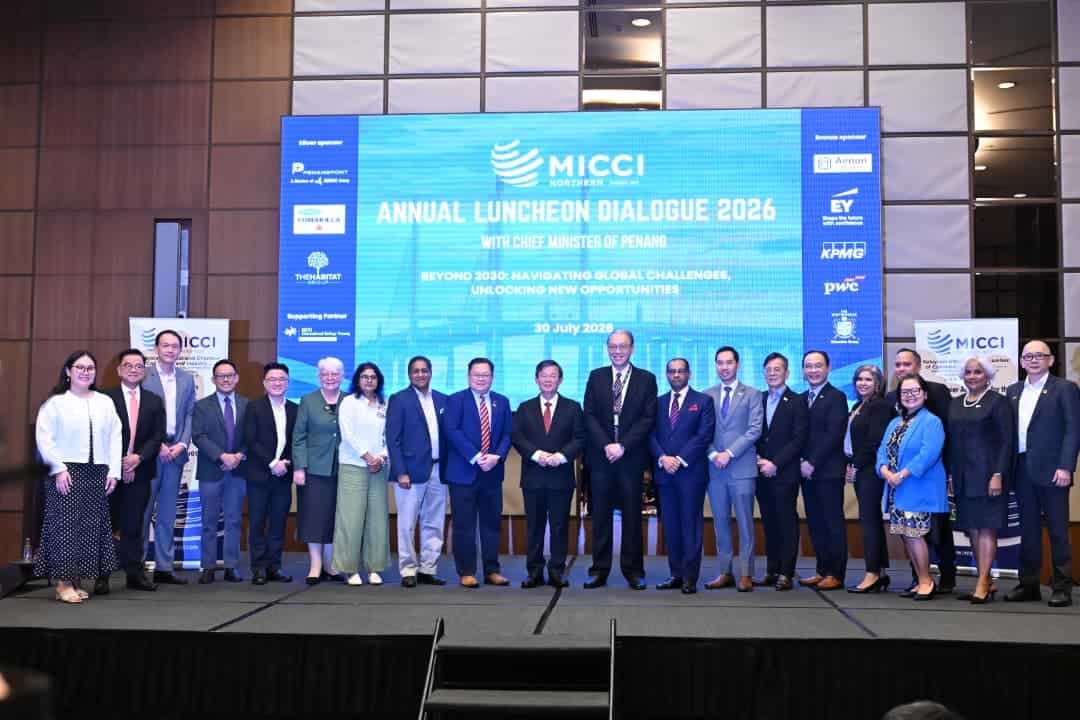

PENANG must remain committed to realistic governance, policy continuity and close collaboration with industry if it is to remain one of Asia’s most competitive investment destinations beyond 2030, Chief Minister Chow Kon Yeow said today.
Speaking at the Malaysian International Chamber of Commerce and Industry (MICCI) Northern Annual Luncheon Dialogue 2026 at St Giles Wembley Hotel, Chow said the state government would continue to prioritise transparency and practical solutions over making unrealistic promises, particularly amid an increasingly uncertain global economic landscape.
“The global economy has become increasingly unpredictable. Geopolitical tensions, shifting supply chains, tariffs, inflationary pressures, rapid technological change, and climate commitments are reshaping how businesses operate. None of us can afford to stand still,” he said.
While noting that Penang continues to attract quality investments because of its mature industrial ecosystem, skilled workforce and reliable supply chain, Chow acknowledged that the state’s success has also brought new challenges.
“Land is becoming increasingly scarce. Infrastructure is under strain. Traffic congestion affects productivity. Talent shortages remain a concern. Housing affordability, logistics efficiency, utility capacity, and ESG compliance are becoming increasingly important considerations for businesses.
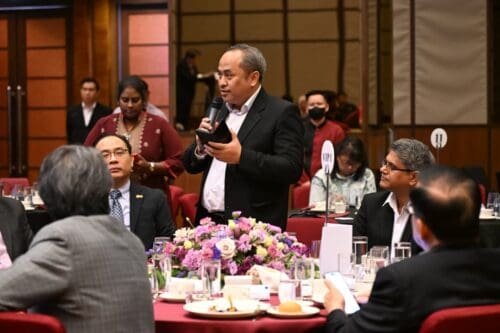
“These are genuine issues, and pretending otherwise serves no one,” he said.
Chow stressed that the state government welcomes constructive feedback from industry players and remains committed to addressing issues within its capacity while working closely with the Federal Government on larger, long-term infrastructure projects.
“We would rather tell you honestly what can be done, what will take time, and what simply cannot be achieved under the present circumstances.
“It may not always be the answer people want to hear, but it is the responsible answer. Good governance is not about making the loudest promises. It is about making realistic commitments and delivering on them,” he said.
He added that the state would continue expanding industrial space through strategic planning, strengthen talent development with universities and TVET institutions, improve digital government services, and create a more efficient business environment.
Looking beyond the Penang2030 vision, Chow said the state’s future should not depend on changes in political leadership but on the continuity of sound policies and institutions.
“Development should not begin and end with political terms. Good policies should have continuity. Sound institutions should outlast politicians.
“Businesses make investment decisions over decades, not election cycles, and government must provide that same consistency and certainty,” he said.
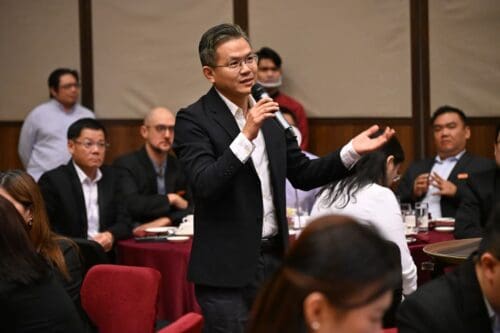
During the dialogue session, Chow highlighted the importance of ensuring local small and medium enterprises (SMEs) remain competitive alongside multinational corporations (MNCs), particularly in embracing digitalisation, innovation and sustainability.
“Our concern is, of course, for our local SMEs: how they can also embrace a similar agenda that makes corporations and investments successful.
“We are taking various actions through state agencies in talent development, providing incubation space, creating conducive platforms for startups to scale up and become suppliers to MNCs,” he said.
Addressing concerns over rising industrial land prices, Chow explained that current market conditions and higher land acquisition costs have inevitably driven up development costs, but stressed that the state’s priority is not to maximise profits from industrial land sales.
“Our primary mission in providing land is to attract investment, create employment opportunities and build a supply chain ecosystem so that SMEs and industries can grow together with foreign investments.
“We are not out here to make big money out of industrial land sales. It is sufficient for us to cover land acquisition and infrastructure costs because our purpose is to generate investment and create opportunities for SMEs,” he said.
On infrastructure, Chow said Penang adopts a multi-source funding approach involving the state government, Federal Government and private developers, noting that major projects require substantial federal support.
He cited the ongoing RM3 billion Juru-Sungai Dua Elevated Highway project as an example of strategic infrastructure that would not have been possible through state funding alone, while revealing that several traffic improvement projects are also being planned around the Bukit Tambun, Bukit Minyak and Batu Kawan industrial corridor.
Touching on talent development, Chow said the state has urged the Federal Government to facilitate work visas for expatriates and international graduates from Malaysian universities to help ease talent shortages faced by industries.
He also reaffirmed the state’s support for the establishment of more international schools and private hospitals, saying Penang remains open to such investments to enhance its attractiveness for expatriate families and high-value investments.
Meanwhile, Chow said tourism and hospitality will continue to play an important complementary role in Penang’s economy despite the dominance of the electrical and electronics (E&E) sector.
He said the state aims to attract higher-value tourism by increasing visitors’ length of stay, expanding business events and medical tourism, while improving connectivity through more international flights.
“Although tourism’s contribution to GDP may not be comparable to the E&E sector, its spillover effect on local businesses is very significant.
“From food and beverage outlets to small businesses and communities, more tourism activities bring broader economic benefits that people on the ground can directly experience,” he said.
Also present earlier were state Trade and National Unity Committee chairman Goh Choon Aik, MICCI Northern Branch chairman Datuk Brian Tan Guan Hooi, consul-general of Thailand in Penang Machida Shinya, Penang Development Corporation (PDC) chief executive officer Datuk Abdul Latiff Abd Aziz, InvestPenang chief executive officer Datuk Seri Loo Lee Lian, and others.
Story by Kevin Vimal
Pix by Muhammad Iqbal Hamdan
Video by Siti Nuratikah Rahmat