

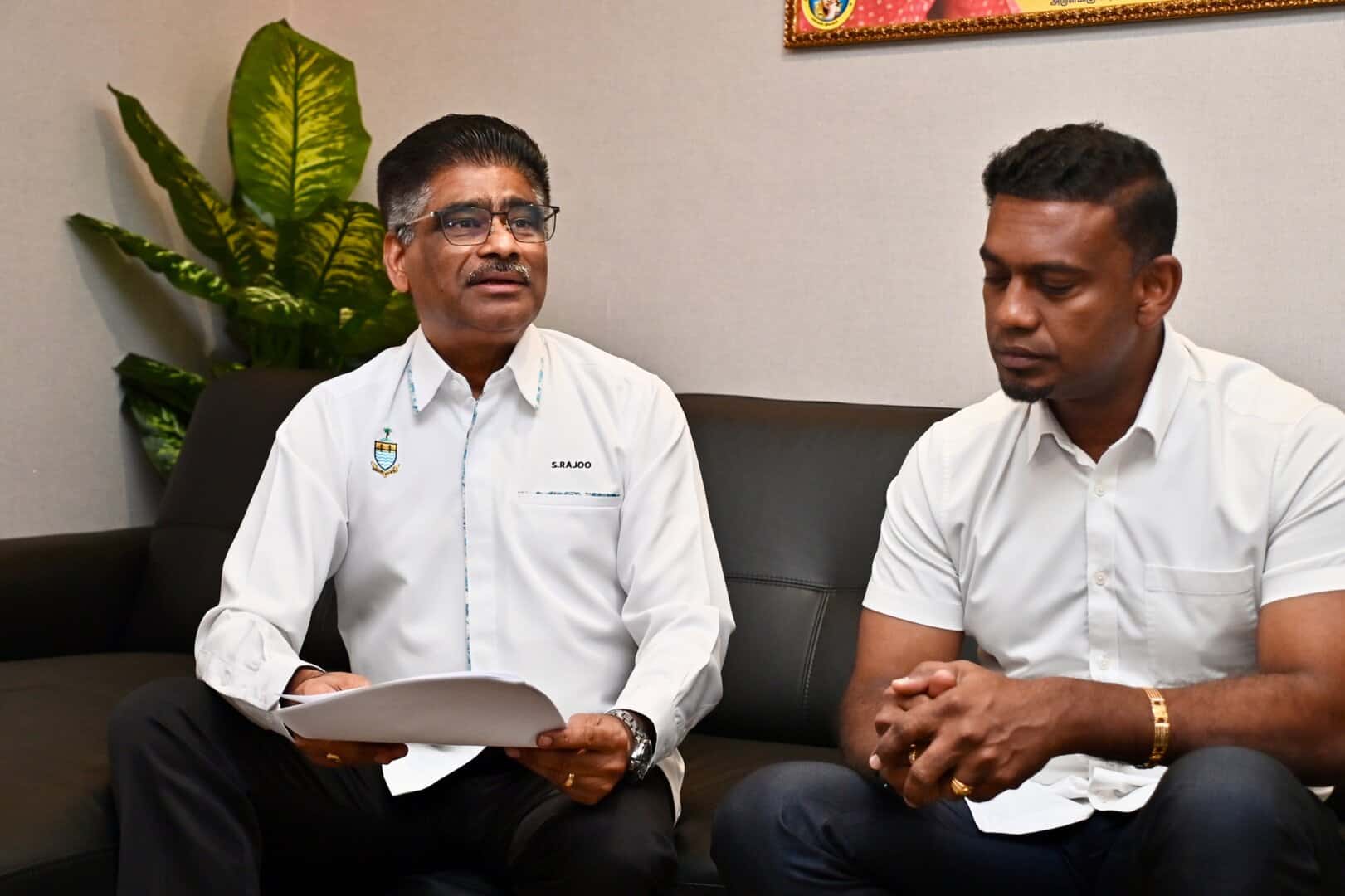

THE Penang government continues to strengthen Tamil education in the state through a comprehensive approach that combines infrastructure upgrades, governance reforms, student development programmes and long-term pathway planning, said state Housing and Environment Committee chairman Datuk Seri Sundarajoo Somu.
Speaking in an exclusive interview with Buletin Mutiara in Komtar on Jan 7, Sundarajoo, who also heads the Penang Special Committee for Tamil Schools Initiatives, said all initiatives are guided by strict governance, accountability, and on-the-ground verification to ensure funds are used effectively.
“Every Tamil school submits a detailed list of its needs, whether for infrastructure, digital facilities, or equipment. These requests are compiled and followed up with site visits before any allocation is approved,” he said.
He stressed that procurement and financial procedures adhere to strict controls, including the requirement for at least three quotations and multiple levels of approval.
“Funds are not handed over casually. Payments are made directly through the banking system, and we personally verify that the work has been completed before final clearance. These checks and balances are crucial to prevent misuse,” Sundarajoo added.
Penang currently supports 28 Sekolah Jenis Kebangsaan Tamil (SJKT), many of which have undergone significant upgrades in recent years. According to Sundarajoo, most schools are now equipped with smart boards or smart TVs, digital libraries, and laptops, reflecting the state’s push towards modernised learning environments.
“This year, we are replacing tables and chairs for Standards One to Three, and next year we will extend this to Standards Four to Six. Tablets are also being distributed to support digital learning,” he said.
Upgrading school halls is another priority, with open halls being enclosed or redesigned with proper ventilation to function as multipurpose assembly and activity spaces.
A key pillar of Penang’s support for Tamil schools is its emphasis on Science, Technology, Engineering and Mathematics (STEM), with between 10% and 15% of allocations channelled towards STEM-related initiatives.
“This focus has produced results. Our students have achieved national recognition in robotics competitions, which shows that given the right exposure and training, they can excel alongside their peers,” Sundarajoo said.
He noted that STEM programmes are being expanded progressively from robotics to drone technology and artificial intelligence, with training provided not only to students but also to teachers, headmasters (GBs) and senior assistants (PKM).
“Capacity building is important. We work with long-term partners like Syscore to ensure teachers are confident and capable of delivering these programmes,” he added.
Bagan Dalam assemblyman Kumaran Krishnan, who is also involved in the committee’s work, said the initiatives go beyond academics to address confidence, participation, and inclusivity.
“We organise ‘recharge’ sessions for teachers and the community, sports carnivals at the state stadium and even food carnivals to bring parents and students together. These activities help strengthen the school ecosystem and encourage enrolment,” he said.
Kumaran also highlighted plans to introduce special education (Pendidikan Khas) classes across the 28 Tamil schools to support students with special needs.
“No child should be left behind. These classes will ensure that students with different abilities receive the support they deserve,” he said.
Both leaders acknowledged a longstanding challenge faced by Tamil school students, the absence of a Tamil-medium secondary school, which has led to dropouts and limited pathways to subjects such as SPM Tamil and Tamil literature.
“This is a serious gap. We are actively engaging the state and federal education ministries on the proposal to establish a Tamil secondary school. It would be the first of its kind in the country,” Sundarajoo said.
In the meantime, the state is prioritising Bahasa Malaysia proficiency to help students transition smoothly into secondary schools.
“We are strengthening Bahasa Malaysia programmes, especially for Standards Five and Six, so students are better prepared academically and emotionally when they move on,” he added.
Cultural needs are also being addressed, with plans to reinstate and standardise small altars in schools to support Hindu religious practices. Each altar is budgeted at between RM5,000 and RM10,000, with bulk procurement planned to ensure uniformity.
“These elements are part of the schools’ identity and heritage. We want to support them respectfully and systematically,” Sundarajoo said.
Penang’s Tamil school initiatives have attracted attention from other states, with delegations visiting to learn from its model.
“We are proud that Penang is seen as a reference point. Our goal now is to sustain these programmes, complete ongoing upgrades and, in the medium term, realise the establishment of a Tamil secondary school,” Kumaran said.
Both leaders reaffirmed that the state will continue to seek increased allocations to keep pace with rising costs, while maintaining strong governance to ensure lasting impact for future generations.
Story by Kevin Vimal
Pix by Law Suun Ting