

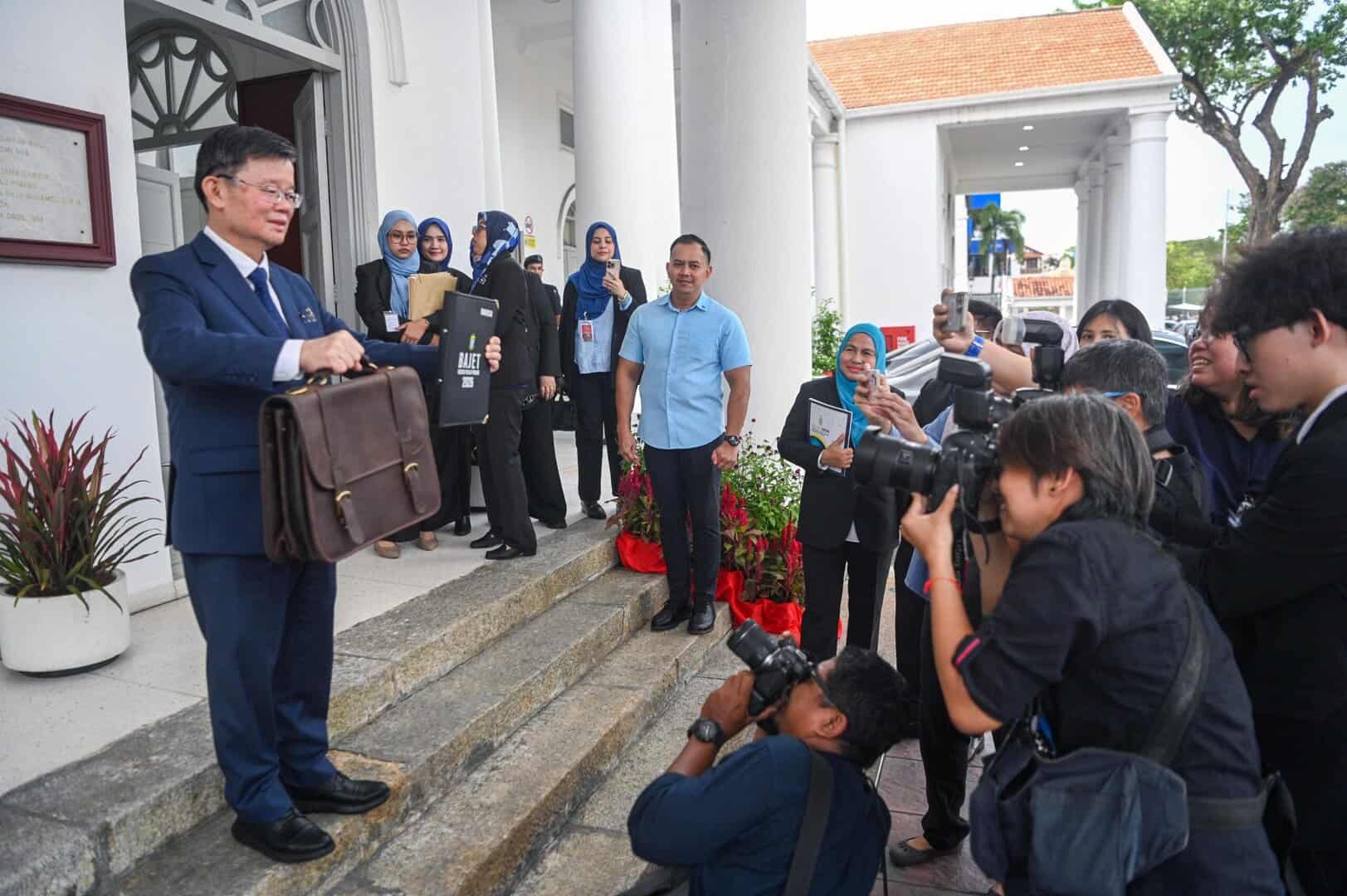

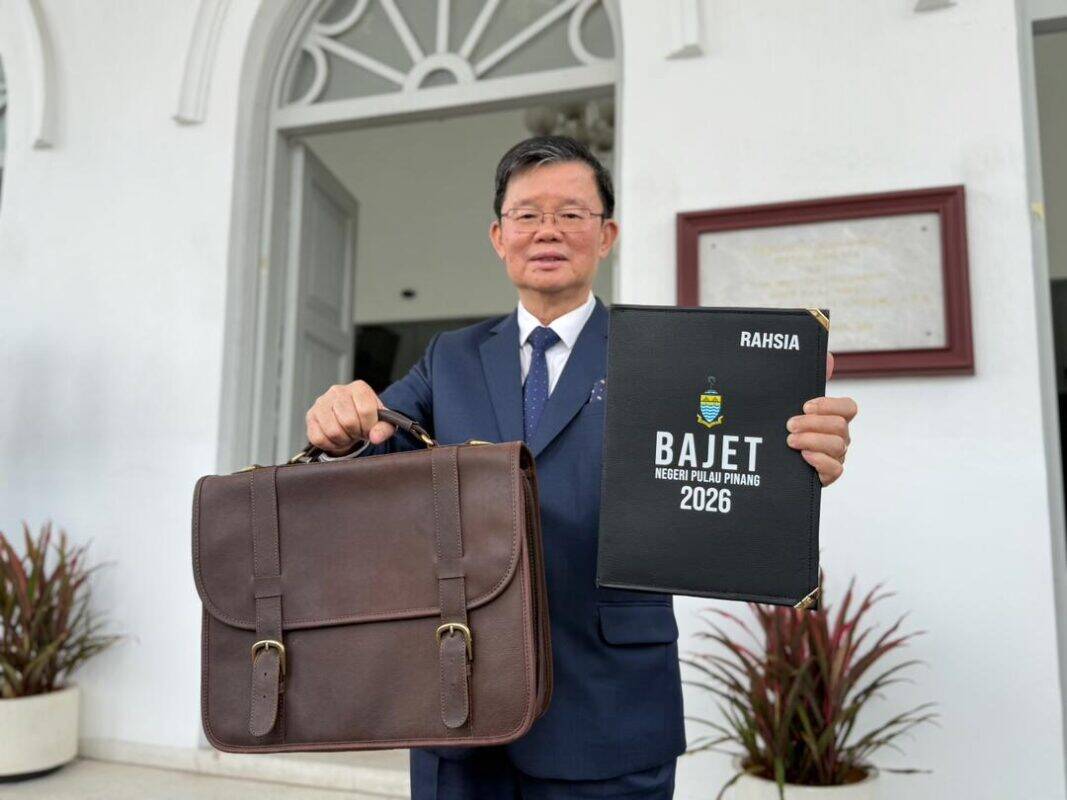
THE Penang government has tabled its 2026 Budget with the lowest projected deficit in the state’s history, underscoring its prudent financial management, strong revenue performance, and continued commitment to people-centric development.
Chief Minister Chow Kon Yeow said the 2026 Budget projects a modest deficit of RM19.92 million, a significant improvement from the RM33.63 million recorded in 2025.
“Taking into account the estimated revenue of RM1.068 billion against the projected expenditure of RM1.088 billion, the 2026 Budget records the lowest projected deficit in the history of Penang State Budgets,” Chow said when tabling the Supply Bill 2026 at the Penang State Legislative Assembly today.
He emphasised that this achievement reflects the state government’s disciplined approach in balancing fiscal responsibility with continued investment in infrastructure, housing, and the people’s well-being.
Prudent fiscal governance and accountability
Chow said Penang’s financial statements for 2024 received an Unqualified Certificate from the Auditor-General, further validating the principles of efficiency, accountability, and transparency embedded in the state administration.
Between 2020 and 2024, the state government recorded an average annual expenditure of RM831.37 million and annual revenue of RM631.6 million, while continuously striving to reduce fiscal deficits and safeguard the state’s Consolidated Revenue Account.
“The Penang State Budget 2026 has been formulated systematically, focusing on generating revenue that brings direct benefits to the people without compromising essential expenditure needs.
“It is not merely a presentation of figures, but a reflection of fiscal decisions grounded in noble values, accountability, and social justice — the very principles that underpin the Penang State Government,” Chow said.
Reflecting on the state’s performance, he noted that Penang’s economy grew by 4.8 per cent in 2024, compared to 3.3 per cent in 2023, with the state’s Gross Domestic Product (GDP) reaching RM121.5 billion, driven mainly by the services and manufacturing sectors.
According to the Department of Statistics Malaysia (DOSM), Penang contributed 7 per cent to Malaysia’s total GDP in 2024.
Chow added that the services and manufacturing sectors remained the largest components of the state’s GDP, accounting for a cumulative 94.3 per cent, followed by Construction (3.2 per cent), Agriculture (1.8 per cent) and Mining & Quarrying (0.1 per cent).
For 2025, the state government is confident that the GDP can expand by up to 5.4 per cent, supported by the growth of the electrical and electronics (E&E) sector and rising global demand for semiconductors.
Higher allocation for development and growth
For 2026, the state government has proposed a total expenditure of RM1.088 billion, comprising RM1.051 billion in Operating Expenditure and RM37.07 million in Charged Expenditure.
Of this amount, RM265 million will be channelled to the State Development Fund to support development expenditure totalling RM318.62 million — a 44.83 per cent increase compared to 2025.
The components of the Operating Expenditure are as follows: Emoluments – RM226,733,229 (20.84%), Services and Supplies – RM200,509,235 (18.43%), Assets – RM3,593,203 (0.33%), Grants and Fixed Payments – RM645,731,927 (59.35%), and Other Expenditures – RM11,381,040 (1.05%).
Comparatively, the Estimated Operating Expenditure for 2026 shows an increase of RM147.72 million or 15.71% compared to 2025. All major expenditure objects for 2026 are projected to rise, except for Assets.
Key high-impact projects earmarked for 2026 include land acquisition for the Light Rail Transit (LRT) Mutiara Line, Phase 2 of the Gurney Bay project, the Penang Silicon Island development, and continuation projects under the Penang Transport Master Plan (PTMP).
A total of 122 continuation projects have also been listed for 2026, covering areas such as public infrastructure, community facilities, and special economic projects.
Among them are the Museum and Art Gallery Expansion Project, Penang Hill Development Project, State Sports Council Dormitory, and the new Northeast Syariah Subordinate Court building, as well as several community halls in Batu Maung, Kampung Baru Alma, and Taman Senangin.
“The state government remains committed to ensuring that every development initiative contributes to Penang’s transformation into a more liveable, sustainable, and resilient state,” Chow said.
Federal support and major approvals
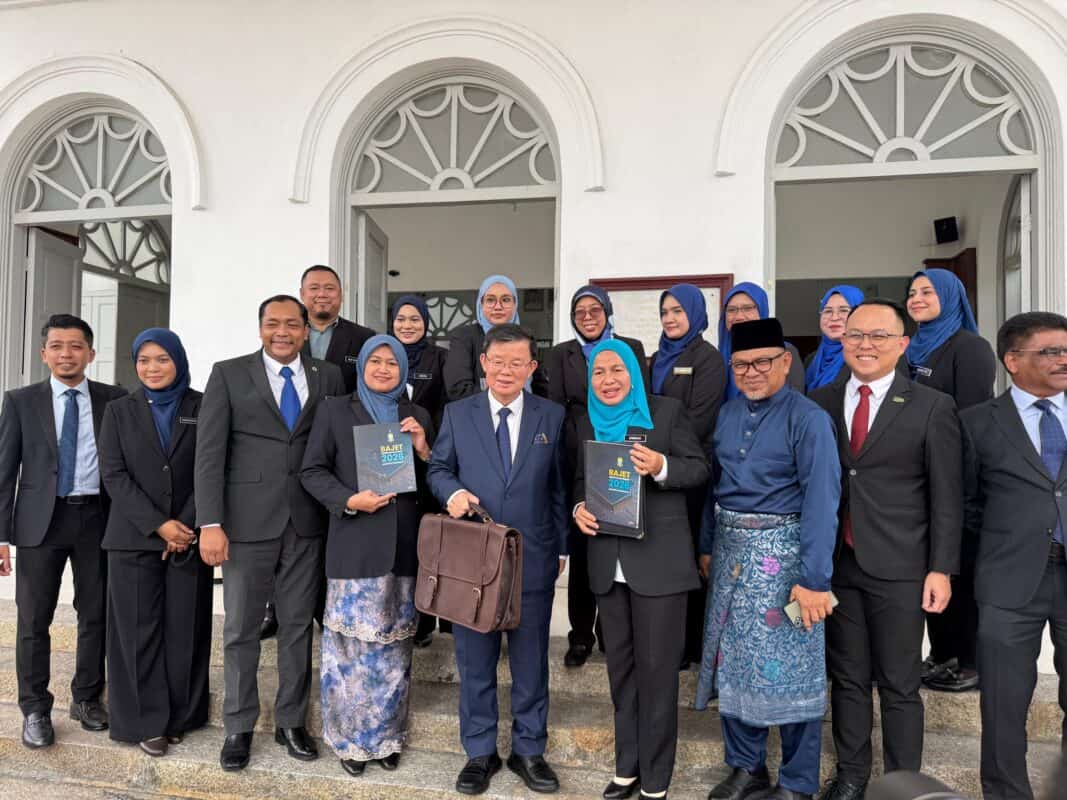
Chow expressed appreciation to the Federal Government for approving all 10 high-impact projects under the First Rolling Plan of the 13th Malaysia Plan (RMKe-13) worth RM283 million, with an allocation of RM55 million for 2026.
These include:
i. Traffic and Land Use Study for the proposed Pan Island Link (PIL) project
ii. Preliminary works for the upgrading of Federal Route FT006 from Bayan Lepas to Teluk Kumbar
iii. Upgrading of water intake facilities at Titi Kerawang and Teluk Awak, and installation of raw water pipes from the intake points to the Teluk Bahang Dam
iv. Construction of a Type 2 Health Clinic in Kubang Semang and Integrated Health Complex in Seberang Perai Tengah, Penang (Replacement Project)
v. Preliminary works for the construction of a Multi-Storey Block at Kepala Batas Hospital
vi. Upgrading of the Bertam Sports Complex, Kepala Batas, Seberang Perai Utara (SPU)
vii. Construction of a new Sekolah Menengah Kebangsaan (SMK) Juru in Seberang Perai Tengah (SPT)
viii. Preliminary works for the construction of an underpass connecting Jalan Mount Erskine to Jalan Burma at the Mount Erskine / Jalan Gottlieb / Jalan Burma / Jalan Bagan Jermal intersection (Section A: Underpass)
ix. Feasibility study for the development of a Tuna Port in Penang to enhance the nation’s food security
x. Empowerment of Fishermen’s Markets in Penang.
The state government also welcomes the Federal Government’s plan to develop the Kota Giam People’s Residency Programme (PRR), which has been approved under Rolling Plan 3 (RP3) of the 12th Malaysia Plan with an allocation of RM55 million, as well as the Seberang Perai Tengah PRR project, which has been approved under RP5 of the 12th Malaysia Plan with an allocation of RM30 million.
“These approvals demonstrate the Federal Government’s strong support and shared commitment to ensure that Penang’s development remains aligned with the national Malaysia Madani agenda,” he said.
The estimated state revenue for 2026 amounts to RM1,068,032,417 (RM1.068 billion), representing an increase of RM161.44 million or 17.81 per cent compared to 2025.
Of this, RM269,783,213 is projected as Tax Revenue, RM699,686,750 as Non-Tax Revenue, and RM98,562,454 as Non-Revenue Receipts.
Non-Tax Revenue is expected to remain the largest contributor through projected premium payments and special fees, in addition to investment returns that provide consistent yields.
The state government also anticipates an increase in Tax Revenue, particularly Direct Taxes, due to the introduction of a new Land Tax rate starting in 2026. However, land tax rebates will be provided to ensure that property owners are not adversely affected by the new rates.
Strengthening industry and sustainable growth
The 2026 Budget also reinforces Penang’s position as a leading investment destination through initiatives such as Penang Silicon Design @5km+, which has seen the number of integrated circuit (IC) design companies in the state grow from 20 in 2024 to over 45 in 2025.
From January to June 2025 alone, Penang recorded RM12.5 billion in approved manufacturing investments, expected to generate more than 11,000 new jobs.
Chow said the state continues to ensure that economic progress goes hand in hand with environmental stewardship, citing ongoing programmes under the Penang Green Council to promote green industry, clean energy, and sustainability practices.
People-focused vision
Guided by the Penang2030 Vision, now in its eighth year, the 2026 Budget focuses on four key themes — enhancing liveability, upgrading the economy, empowering the people, and investing in the built environment.
“The Penang government remains steadfast in delivering growth that is not only sustainable but inclusive, ensuring that prosperity and opportunities reach all corners of society,” Chow said.
Story by K.H. Ong
Pix by Darwina Mohd Daud & Siew Chia En
Video by Noor Siti Nabilah Noorazis