

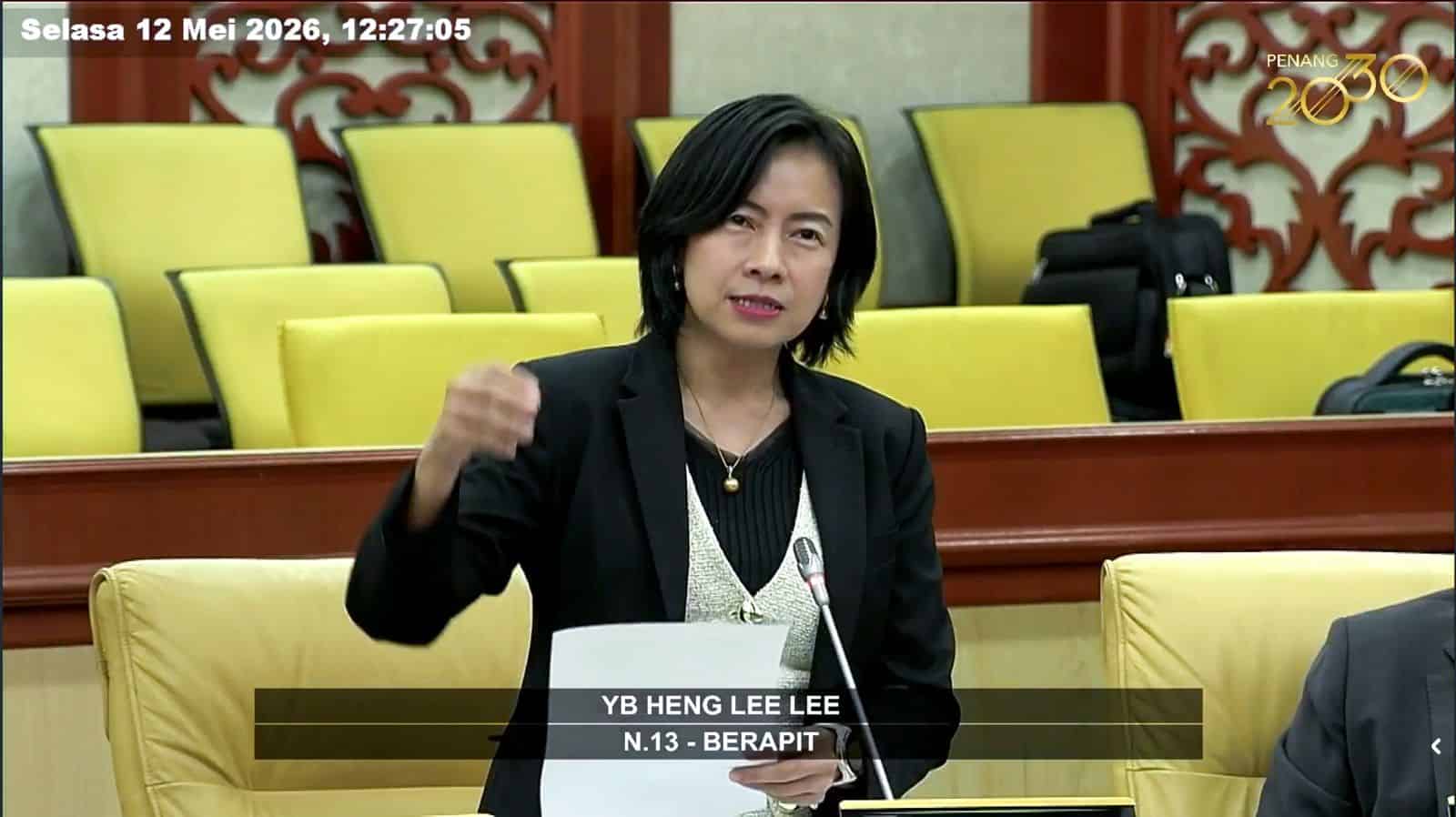

THE Penang government should further strengthen efforts to safeguard food security and fertiliser supply in the state.
While debating the motion of thanks to the Yang di-Pertua Negeri of Penang Tuan Yang Terutama Tun Ramli Ngah Talib’s address at the Penang State Legislative Assembly sitting today, Heng Lee Lee (PH-Berapit) said that amid today’s uncertain global environment, wars and geopolitical conflicts are not only triggering energy crises, but are also affecting food supplies and fertiliser supply chains.
“As such, we need to start asking an important question, can urban areas also become part of our food supply source? In my view, the answer is yes.
“We can look at examples from Singapore, where spaces such as flat rooftops, open land and community areas are transformed into community gardens.
“Residents there collectively manage these gardens. Each individual or family takes care of a small plot of land, planting vegetables, herbs or simple crops for their own use or for small-scale sharing.
“At the same time, the government provides basic facilities, technical support and a clear management system. As a result, these community gardens are not merely temporary activities, but can function as a sustainable and continuous community system,” she said.
Heng added that this demonstrates urban farming is not merely a slogan, but something that can be successfully implemented, provided there are three key elements namely space, systems and community participation.
“If we look at Penang, we are actually not starting from zero. Today, several communities, schools and local organisations are already carrying out small-scale planting activities.
“We also have examples such as Juru Auto-City, which has implemented food waste composting efforts that are later reused for planting and greening purposes.
“These are all strong foundations. They show that the people of this state already have the awareness and interest to move in this direction.
“The issue now is that these efforts are still rather fragmented. Many are being carried out independently by certain communities, schools or organisations, and have yet to be coordinated and expanded in a more systematic manner,” she said.
As such, Heng said the Penang government could strengthen these initiatives through several measures.
“First, open up more suitable spaces for community farming purposes. These could include rooftops of public buildings, vacant land, community corners or small areas under the supervision of local councils that are safe and suitable for use.
“Second, simplify the application process and provide basic support. This includes basic equipment, introductory training, technical guidance and perhaps small-scale assistance so that interested communities can get started more easily.
“Third, establish a clear community management system. For example, each participant or family could manage a small plot, with simple rules on maintenance, water usage, cleanliness and produce-sharing. This is important to ensure the programme remains fair, organised and sustainable.
“Fourth, integrate urban farming with community composting systems. If food waste can be converted into compost and reused in community gardens, school gardens or green spaces, we can create a cycle of ‘grow — recycle — reuse’.
“This would not only reduce food waste, but also help lessen dependence on imported fertilisers,” Heng said.
She added that Penang already has the necessary foundations in place.
“What matters now is how we organise these small-scale efforts into a more systematic, sustainable and people-centric direction,” she said.
Story by Riadz Akmal