

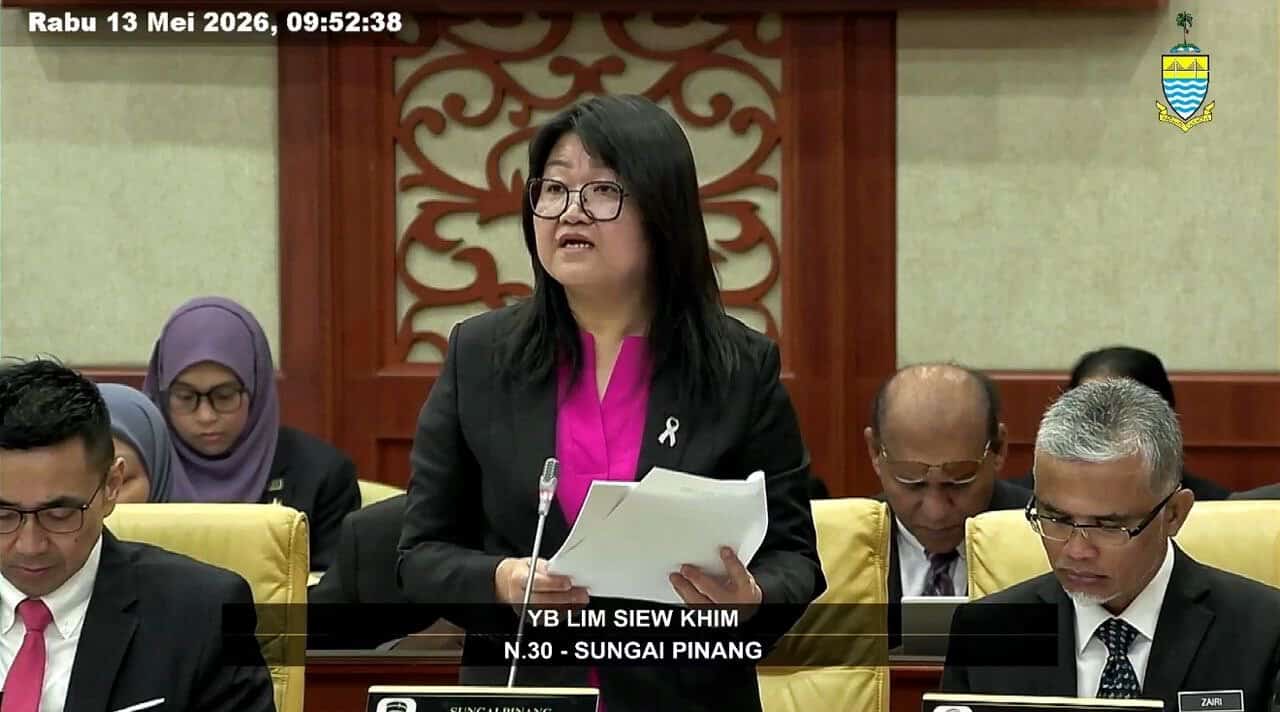

THE Penang government has reaffirmed a firm, principled and balanced stance in addressing the issue of unapproved non-Islamic houses of worship (RIBI), emphasising law compliance, structured solutions and long-term social harmony.
State executive councillor Lim Siew Khim said the state’s approach focuses on resolving existing cases prudently while ensuring future developments strictly follow legal requirements.
“The state government takes a firm, clear and principled stand in handling unapproved non-Islamic houses of worship.
“Any new construction without approval will face enforcement action in accordance with existing policies and laws,” she said during the State Legislative Assembly sitting today.
At the same time, Lim stressed that existing structures built without approval are being addressed through a tolerant and practical approach.
“For existing structures, the state adopts a tolerance-based approach through regularisation, relocation or provision of suitable alternative sites, subject to technical suitability and land availability,” she explained.
She added that solutions would be implemented in stages to ensure more sustainable and orderly outcomes while preventing similar issues from recurring.
To coordinate the process, the state has established the Penang Non-Islamic Houses of Worship Coordination Committee under the state Town and Country Planning Department.
The requirement to allocate RIBI sites has also been made mandatory in new development schemes by local authorities, ensuring religious facilities are planned in a lawful and systematic manner.
“This approach is expected to reduce the issue of unauthorised placement while safeguarding overall social harmony,” Lim said.
In response to questions by Kumaran Krishnan (PH – Bagan Dalam), Lim said the state relies on the Town and Country Planning Act 1976 and local authority guidelines.
All RIBI developments must apply for planning permission and building plans approval from local councils, which are empowered to act against unauthorised construction.
The state is also supporting federal efforts to review national guidelines through the National Council for Local Government.
“The state continues to ensure planning and implementation related to RIBI are carried out in an orderly and integrated manner in line with existing laws and guidelines,” she said.
As of January 2026, the state Town and Country Planning Department identified 136 RIBI structures without building plan approval, 115 in the Penang Island City Council (MBPP) area and 21 in Seberang Perai.
These cases will be brought to the state coordination committee to determine the appropriate course of action.
Lim stressed that the state’s long-term strategy extends beyond governance to include community empowerment and interfaith understanding.
Financial assistance for maintenance and safety upgrades continues through the RIBI Special Allocation Fund, while the eRIBI digital system is being strengthened to improve coordination and service delivery.
Programmes under Harmonico, including the Jelajah Harmoni initiative targeting youth, and interfaith dialogue sessions are also being expanded.
“The synergy between efficient RIBI governance and proactive awareness programmes forms the foundation of the state government’s efforts to sustain harmony among Penang’s diverse communities,” she said.
Earlier, Kumaran reminded lawmakers that religious matters must be handled responsibly and based on facts.
“Statements made hastily without complete facts will only worsen the situation and open space for manipulation by irresponsible parties,” he said.
He urged the state to ensure solutions are based on “justice, humanity, interfaith respect and social harmony rather than political pressure or temporary public sentiment.”
Responding, Lim reiterated that a multi-agency mechanism involving local authorities, land offices, relevant agencies and community representatives is already in place.
“The state is committed to continuous communication and ensuring this issue is not politicised or manipulated in ways that could trigger racial or religious tension,” she said.
Story by Kevin Vimal
Pix by Darwina Mohd Daud