


PENANG is positioning itself to become a national hub for the drone industry and Low-Altitude Economy (LAE), leveraging its strong electrical and electronics (E&E) ecosystem, technical expertise and growing pool of STEM talent.
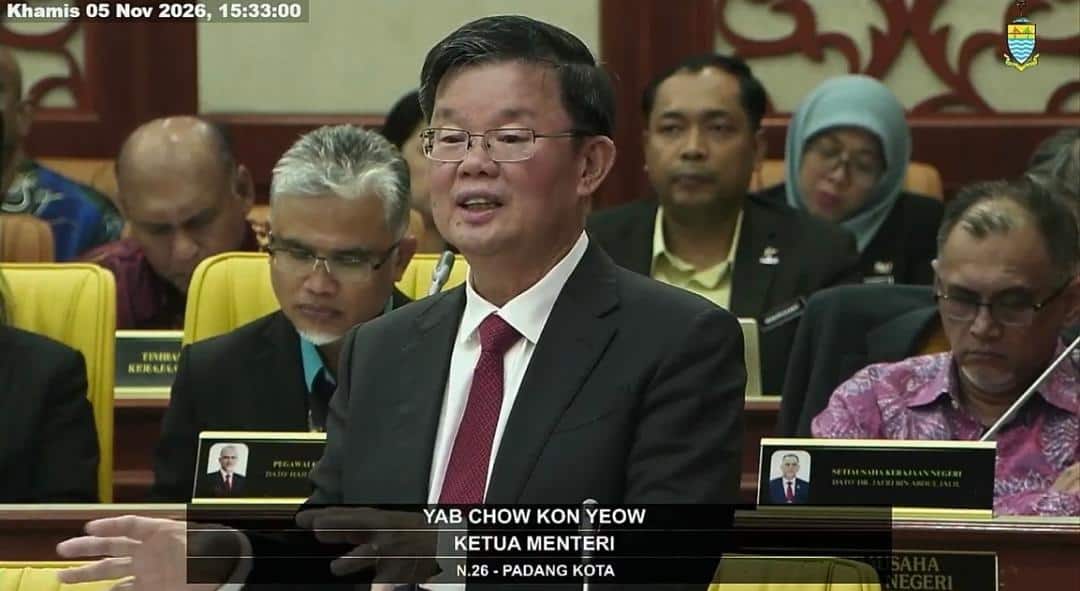
Chief Minister Chow Kon Yeow (PH – Padang Kota) said the state government welcomed a proposal by Komtar assemblyman to seek Federal Government approval for Penang to be selected as the country’s pilot location for a drone and LAE ecosystem.
He said Penang already had the technical capabilities and industrial ecosystem to support the initiative, with FILPAL (M) Sdn Bhd, a company with relevant expertise, currently operating at GBS TechSpace, Silicon Research & Incubation Space in Bayan Lepas.
“Penang has the technical capabilities and industrial ecosystem to support this aspiration,” he said during his winding-up speech at the State Legislative Assembly sitting today.
Chow said InvestPenang was actively promoting the state’s E&E strengths, particularly in integrated circuit (IC) design, embedded software, sensors and precision engineering, to attract global drone manufacturers and high-technology avionics component companies.
The state was also strengthening its talent pipeline through autonomous STEM development, supported by a RM12.3 million allocation for the STEM Talent Pilot Project in collaboration with the Ministry of Economy.
He said Penang STEM, Tech Dome Penang and Penang Science Cluster (PSC) had begun introducing artificial intelligence (AI) training modules for autonomous systems, supported by the expertise of Universiti Sains Malaysia’s (USM) School of Aerospace Engineering in avionics and remote sensing.
Under the Penang Digital Economy Master Plan (DEMP) 2025-2030, Digital Penang was also driving pilot programmes to develop agricultural drone operators while helping local small and medium enterprises (SMEs) participate in the Drone-as-a-Service (DaaS) model.
Meanwhile, Chow said the state government was strengthening its data-driven financial governance through the development of the State Financial Dashboard, which consolidates real-time financial information to improve revenue monitoring and identify areas requiring intervention.
He said the integrated platform enabled the state to monitor revenue collection against targets, identify efficiency gaps across departments and take prompt corrective action when revenue sources underperformed.
“This data infrastructure provides a strong foundation for implementing AI analytics modules.
“Through AI modelling, we can analyse revenue collection and expenditure patterns, while establishing an early warning system to detect potential fiscal risks,” he said.
On the proposal to introduce Zero-Based Budgeting (ZBB), Chow said the state government was open to the approach but would adopt a realistic and measured implementation strategy.
He explained that ZBB required every programme to be assessed from scratch rather than relying on allocations approved in the previous year.
The state was studying the possibility of conducting targeted pilot programmes for selected activities, while ensuring existing contractual obligations and essential public services were not disrupted.
On procurement reforms, Chow said efforts to strengthen the state’s e-Procurement system were ongoing, with the government prepared to consider extending the centralised electronic tendering procedures to all 18 state-owned companies.
He said the move would help minimise the risk of financial leakage while strengthening transparency and competition in the procurement process.
Story by Kevin Vimal
Adleena Rahayu Ahmad Radzi