

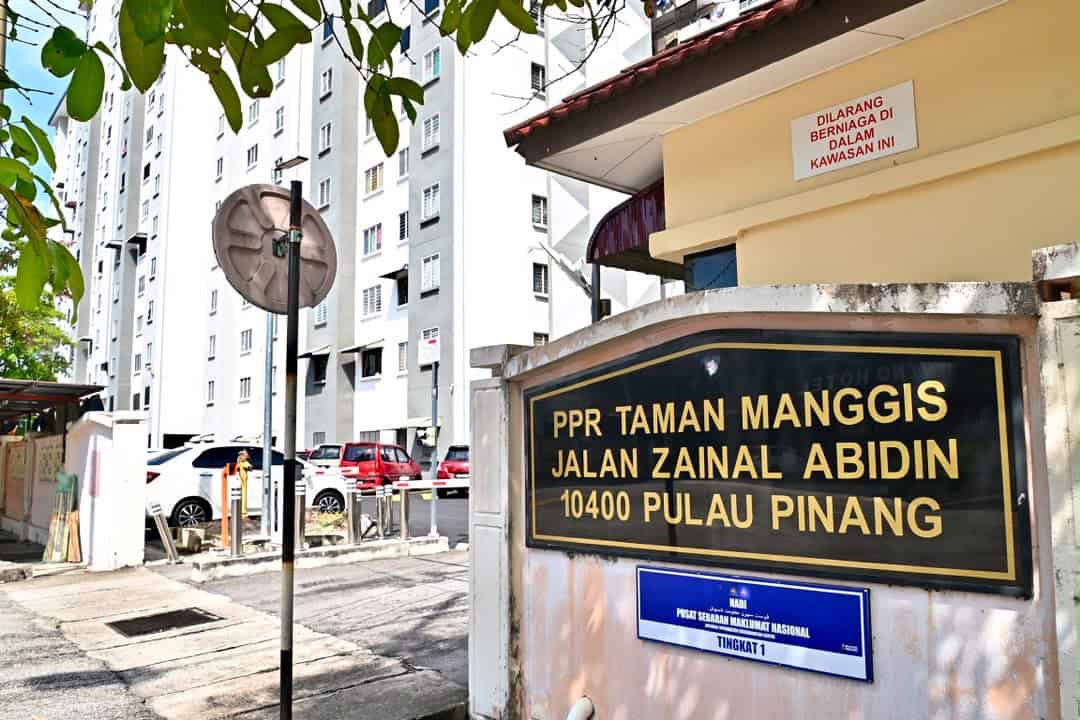

CHIEF Minister Chow Kon Yeow has defended the recent sealing of five People’s Housing Project (PPR) units at Taman Manggis, stressing that enforcement action was taken only after the occupants had lost their eligibility and failed to cooperate with the relocation process.
Chow said PPR housing was intended as transit accommodation for eligible applicants, with occupants generally given five years to improve their circumstances and move on to other housing.
However, he acknowledged that some residents had been allowed extensions following appeals and on humanitarian grounds, with some even receiving an additional three years.
“This project started in 2007. Until today, some have been staying here for 19 years, beyond the intended period,” he said.
He explained that the limited number of PPR units meant the state also had a responsibility towards applicants who had been waiting for years to secure a home.
“We have applicants who have been waiting for eight or 10 years asking, ‘Where are our houses?’ So there is a need to ensure that those who have waited many years also get the opportunity to be offered units that become vacant,” Chow said.
According to Chow, some residents who had lost their eligibility had cooperated with the authorities, while others had appealed for extensions, which would be considered by the relevant committee.
However, those who refused to cooperate could eventually face enforcement action.
“When there is no cooperation, enforcement action has to follow. That is the normal process,” he said.
Chow stressed that the objective was not to penalise residents, but to ensure fairness to all parties given the shortage of PPR units.
“If people are fighting for the interests of those who have lost their eligibility, we also have to ask who is fighting for the people who have been waiting. We have to be fair to all parties,” he said.
He added that enforcement was not carried out suddenly, pointing out that occupants would have gone through a process involving repeated notices and opportunities to resolve their status.
“If they are eventually removed, it would have gone through a process, possibly over several years. It is the last resort,” he said, adding that vacant units must eventually be made available to new eligible applicants.
Chow also clarified that PPR is a Federal housing programme and said Penang currently has four PPR schemes, namely PPR Taman Manggis in George Town, PPR Taman Bagan Jaya and PPR Mak Mandin in Butterworth, and PPR Permatang Tok Suboh in Bukit Mertajam. The limited supply of units, he said, continues to make demand significantly higher than availability.
The five families involved were among more than 20 occupants facing eligibility or relocation issues, with some cooperating and others appealing for extensions.
Chow said further details on whether the five families had submitted appeals should be obtained from the Penang Housing Board.
“Enforcement is not something we immediately resort to. There have been many opportunities and a process to follow. But if units are not vacated, how can new applicants be given the opportunity to move in?” Chow said.