

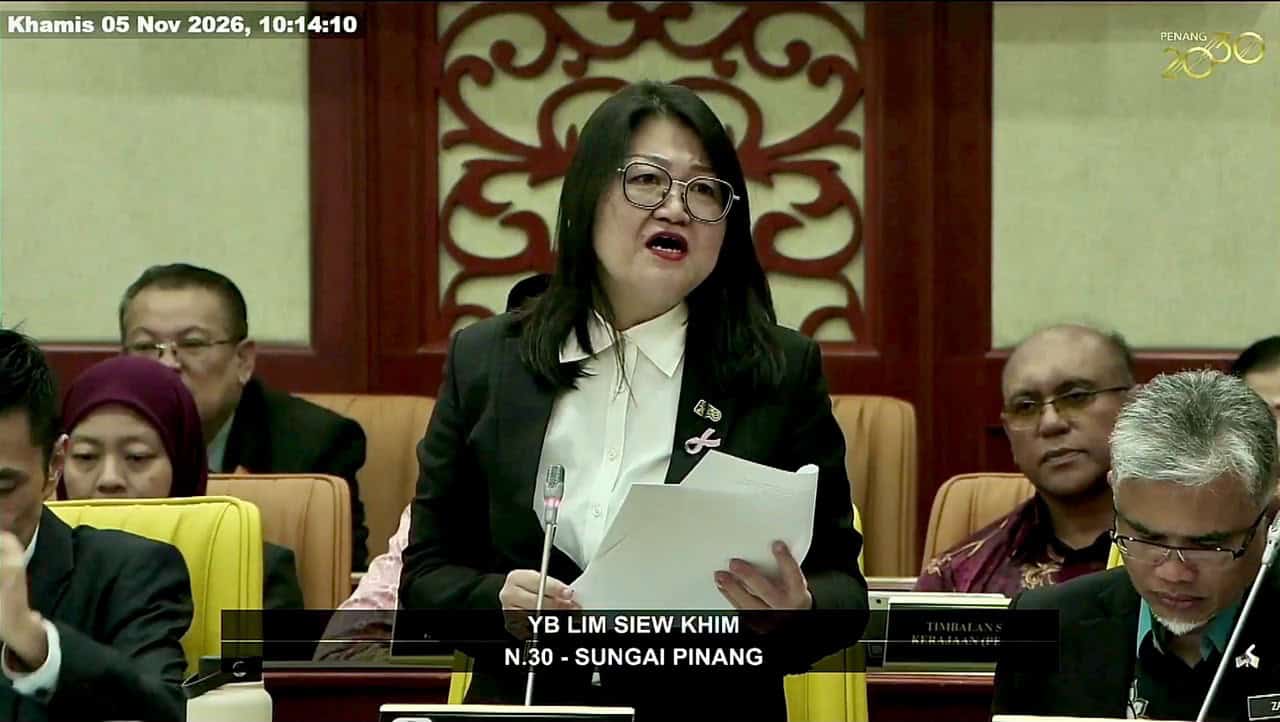

STATE Social Development, Welfare and Non-Islamic Religious Affairs Committee chairman Lim Siew Khim has urged Heng Lee Lee (PH – Berapit) to ensure that statements raised in the State Legislative Assembly are based on accurate and verified facts, following claims concerning a child abuse-related case.
Lim (PH – Sungai Pinang) clarified that the Social Welfare Department (JKM) and Health Department had coordinated their actions from the day the child was admitted to hospital in October 2025.
She explained that the child’s biological mother had subsequently returned to Penang, and the child was handed over to her after being discharged from hospital.
“There was no issue of the child being instructed to return to the father’s home, as claimed earlier. I would like to urge all assemblymen to ensure that the facts presented in this House are accurate and correct,” she said.
Lim added that the state Health Department would also issue an official statement to clarify the matter, stressing that inaccurate claims could create the wrong perception of departments working to protect victims of violence.
She was responding to a supplementary question from Sungai Puyu assemblyman Phee Syn Tze, who raised concerns over inter-agency coordination in handling cases involving child safety.
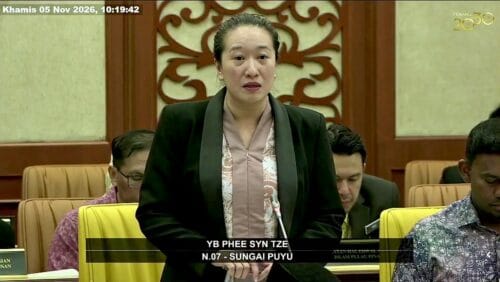
Phee stressed that the registration of childcare and care centres should go beyond merely obtaining licences, as the priority must be to safeguard the welfare of children.
She also sought clarification on the coordination mechanisms involving JKM, the Health Department, police and other relevant agencies to ensure cases concerning child safety were identified, reported and acted upon promptly.
“We do not want a situation where, despite efforts to ensure all care centres are registered, communication gaps between agencies still exist, potentially causing certain cases to go unnoticed by the relevant authorities,” she said.
Phee also asked whether CCTV installation was compulsory at care centres.
In response, Lim confirmed that CCTV installation was among the compliance requirements for care centres, adding that the relevant agencies maintained close working relationships and communication channels.
She acknowledged that shortcomings in information dissemination could occur but maintained that the standard operating procedures and inter-agency coordination mechanisms were clearly established.
Separately, Lim said Penang had recorded 1,012 childcare centres, kindergartens and care centres (TTPJ) as of Sept 30, 2026, comprising 790 registered and 222 unregistered premises.
Of the total, 153 Taska (childcare centres) were registered while 63 remained unregistered. For kindergartens, 472 were registered and 119 unregistered, while 165 care centres were registered and 40 unregistered.
She said the State Executive Council Meeting No. 6 of 2026 had approved incentives to assist operators in obtaining valid registration certificates, alongside efforts to facilitate the regularisation of premises that had yet to comply with the requirements.
The initiative involves cooperation with the Penang state Education Department, Social Welfare Department, local authorities and relevant technical agencies to help operators complete their registration applications.
Among the incentives are exemptions from planning permission requirements, a fixed RM1,000 change-of-use charge, a 50% discount on development charges for new applications, exemption from certain penalties and contributions in lieu of parking facilities.
Operators will also be exempted from contributions towards tree planting and landscaping requirements within the Penang Island City Council’s administrative area.
Lim said the regularisation programme would run from March 1, 2026, until Feb 28, 2027, giving operators time to fulfil the necessary legal requirements.
“After the regularisation period ends, enforcement action will be taken from March 1, 2027, against operators who continue to fail to comply with the stipulated registration and approval requirements,” she said.
Meanwhile, Fahmi Zainol (PH – Pantai Jerejak) raised concerns over the growing number of childcare centres and kindergartens operating within residential neighbourhoods, saying the situation had caused unease among residents.
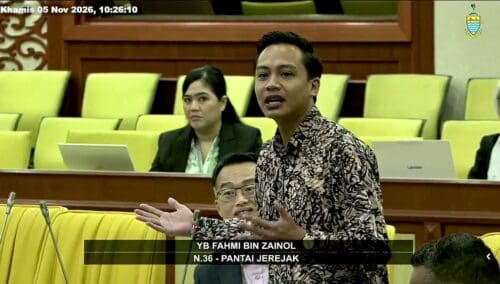
He said some homeowners, particularly retirees, had complained about the noise and disruption caused by the concentration of such establishments in their neighbourhoods.
Fahmi also questioned the approval of licences for certain operators despite their earlier applications being rejected, and called for greater scrutiny of the relevant zoning and distance requirements.
Responding to the concerns, Lim said she would identify the residential neighbourhood involved and review the matter with the local authority to determine the appropriate number of establishments permitted in the area.
Lee Khai Loon (PH – Machang Bubok), meanwhile, called for the state to assess whether the existing number of childcare centres and kindergartens was sufficient to meet demand from working parents.
He said having adequate childcare facilities was important to enable parents to participate in the workforce, while stressing the need for proper planning in determining where new centres should be established.

Lim said the state was reviewing its existing guidelines, which she described as outdated, particularly in view of major developments taking place across Penang.
“We must have sufficient policies to support parents and enable them to participate in the workforce. Studies are currently being conducted because demand for childcare services varies from one location to another,” she said.
State Local Government, Town and Country Planning Committee chairman Jason H’ng Mooi Lye (PH – Jawi) said applications to establish childcare and care centres were subject to supply-and-demand considerations, as well as zoning and buffer zone requirements.
He said the existing guidelines, to the best of his understanding, allowed for three care centres and three childcare centres within a 250m radius.
“In Penang, there are three zones where childcare centres, kindergartens and care centres are not permitted to operate. In other areas, such establishments are allowed, subject to the relevant zoning and buffer zone requirements,” he said.
H’ng also said the local authorities would review the neighbourhood highlighted by Fahmi to determine whether the existing establishments complied with the relevant planning requirements.
Story by Kevin Vimal
Pix by Noor Siti Nabilah Noorazis