

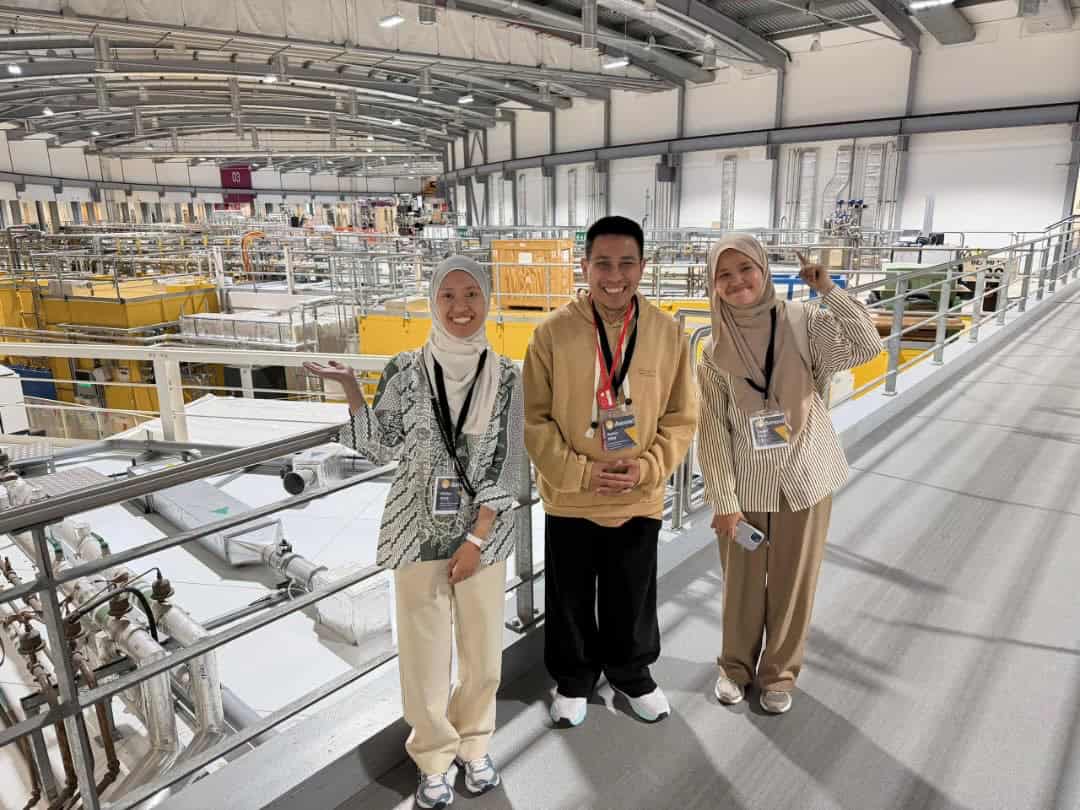

TWO Doctor of Philosophy (PhD) candidates from Universiti Teknologi MARA (UiTM), Anis Syuhada Saufi and Nur Lina Syahira Mustapa, have recently earned a prestigious opportunity to conduct research abroad alongside internationally renowned scientists, Dr Steven Parnell and Dr Dirk Honecker, in the field of Small-Angle Neutron Scattering (SANS).
The two promising young researchers are also part of a UiTM team that has become one of the earliest Malaysian groups to conduct experiments using one of the world’s most advanced neutron scattering instruments in the United Kingdom (UK).
The research team is led by Mohamed Syazwan Osman, a senior lecturer at the Faculty of Chemical Engineering, UiTM Cawangan Pulau Pinang, who also heads the EMZI-UiTM Nanoparticles, Colloids and Interface Industrial Research Laboratory.
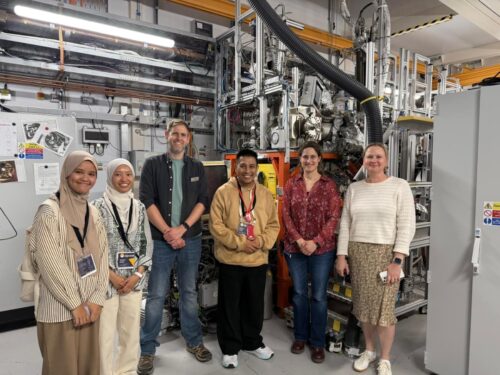
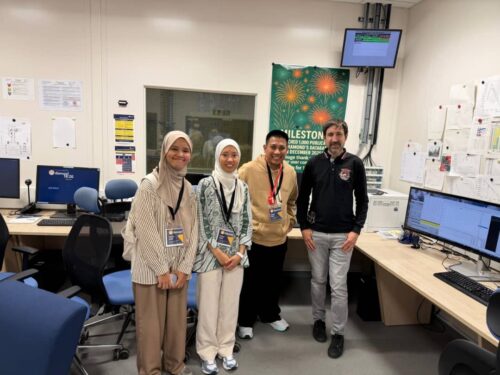
Together with Anis Syuhada and Nur Lina, Mohamed Syazwan spent two weeks at the prestigious ISIS Neutron and Muon Source, a leading UK national research facility located at the Rutherford Appleton Laboratory in Oxfordshire.
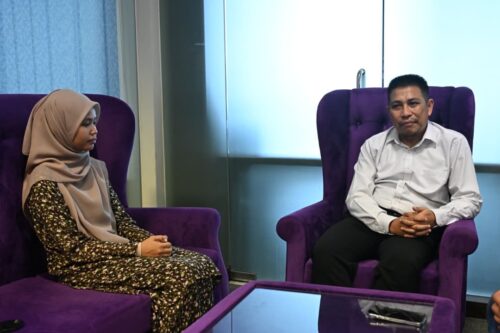
Speaking to Buletin Mutiara recently, Mohamed Syazwan described the experience as a significant milestone not only for UiTM but also for Malaysia’s scientific and research landscape.
“We are among the earliest Malaysian research groups to be granted access to the SANS instrument at the facility. ISIS is one of the world’s most respected neutron research centres, and access to its instruments is highly competitive,” he said.
The opportunity enabled the team to collaborate directly with world-class scientists while gaining hands-on experience with cutting-edge research infrastructure that is rarely accessible to researchers from developing nations.
Unlike conventional laboratory equipment, the SANS instrument allows scientists to probe the internal structure of advanced materials at the nanoscale. This capability provides crucial insights into how materials behave and interact, enabling researchers to improve the design and performance of catalysts used in environmental and industrial applications.
The research conducted by the UiTM team focuses on developing advanced catalyst materials that can contribute to cleaner and more sustainable technologies. Through neutron scattering techniques, researchers are able to observe structural characteristics that are otherwise impossible to detect using traditional analytical methods.
For Anis Syuhada and Nur Lina, the overseas research attachment offered invaluable exposure to the international scientific community, allowing them to expand their expertise, build professional networks, and contribute to high-impact research alongside some of the world’s leading experts in neutron science.
The achievement underscores UiTM’s growing reputation in advanced materials research and demonstrates the increasing capability of Malaysian researchers to participate in globally significant scientific projects.
It also reflects the university’s commitment to nurturing future scientific talent and strengthening Malaysia’s presence in frontier research fields that have the potential to drive innovation, sustainability, and technological advancement.
A rigorous selection process
Earning access to the world-class facility was no easy feat.
The UiTM team had to submit a comprehensive research proposal, which underwent a stringent international peer-review process before being selected.
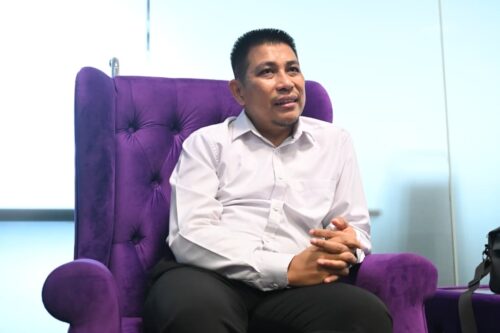
“Our proposal was accepted after a competitive evaluation, making us one of the earliest Malaysian team chosen to carry out the experiment,” Mohamed Syazwan said.
As part of the programme, the researchers also received partial travel funding, enabling them to collaborate directly with leading international scientists while conducting hands-on experiments using technology unavailable in Malaysia.
According to Mohamed Syazwan, the SANS instrument is exceptionally rare, with only a handful of similar facilities operating worldwide. The UK facility is widely regarded as one of the finest in terms of capability, prestige and scientific output.
Developing catalysts to combat plastic pollution
The team’s research focuses on one of today’s most pressing environmental challenges namely plastic waste and microplastic pollution.
Since last year, the researchers have been developing advanced photocatalysts that use light energy to activate chemical reactions capable of breaking down microplastics while simultaneously converting plastic waste into valuable chemical products.
“The study has two major objectives. First, we want to degrade microplastics into harmless substances such as carbon dioxide and water. Secondly, we want to upcycle plastic waste into higher-value chemicals that can eventually be commercialised,” Mohamed Syazwan explained.
Unlike conventional recycling, which simply reprocesses used plastic into similar products, upcycling transforms waste into materials with greater economic value.
“For example, instead of merely recycling plastic bottles into another plastic product, we aim to convert them into specialty chemicals with much higher commercial value,” he said.
The research utilises photocatalytic technology, which harnesses light to activate specially designed catalysts that accelerate the breakdown and transformation of plastic materials through environmentally friendly processes.
Addressing an urgent environmental issue
Mohamed Syazwan said the research is particularly relevant for Malaysia and Penang, where plastic waste management has become an increasingly important environmental concern.
While plastic pollution has long been recognised as a global issue, scientists are now paying even closer attention to microplastics (plastic particles measuring less than five millimetres) which pose significantly greater risks because of their ability to enter ecosystems and living organisms.
According to Mohamed Syazwan, recent international studies have detected microplastics in human blood and, more recently, even in unborn babies, highlighting growing concerns over their potential health implications.
“These findings show that microplastics have already entered the human body. It underlines why research like ours is so important in finding practical solutions to reduce this pollution,” he said.
He hopes the technology being developed by his team will eventually contribute to cleaner water resources while creating sustainable methods to convert waste into useful products.
Building world-class research from humble beginnings
Remarkably, the project began without a major government research grant.
“We started with whatever resources we had. After conducting our initial research in Malaysia, we prepared a proposal to use neutron technology for advanced catalyst characterisation, something that is not available in our country.”
Their perseverance eventually paid off when the proposal was accepted by the UK facility.
The SANS instrument itself represents a major international scientific investment, valued at approximately €4.5 million and jointly funded by the governments of the United Kingdom and the Netherlands about a decade ago.
The facility welcomes researchers from around the world, but only after they pass a highly selective review process designed to ensure that only high-quality scientific research is conducted.
Strengthening Malaysia-UK scientific collaboration
Mohamed Syazwan also noted that the opportunity reflects the growing scientific collaboration between Malaysia and the United Kingdom.
Under an agreement between the Malaysian Government and the UK’s Science and Technology Facilities Council (STFC), Malaysian researchers have been given access to several internationally recognised research facilities for a two-year period.
The collaboration enables local scientists to utilise cutting-edge equipment that is currently unavailable in Malaysia, while fostering international partnerships and accelerating scientific innovation.
For Mohamed Syazwan and his team, the experience represents more than just an academic achievement.
“It may be a small step, but we hope our research will contribute towards reducing microplastic pollution and creating greener technologies that benefit both society and the environment,” he concluded.
Story by Riadz Akmal
Pix by Muhammad Iqbal Hamdan and courtesy of Mohamed Syazwan Osman