

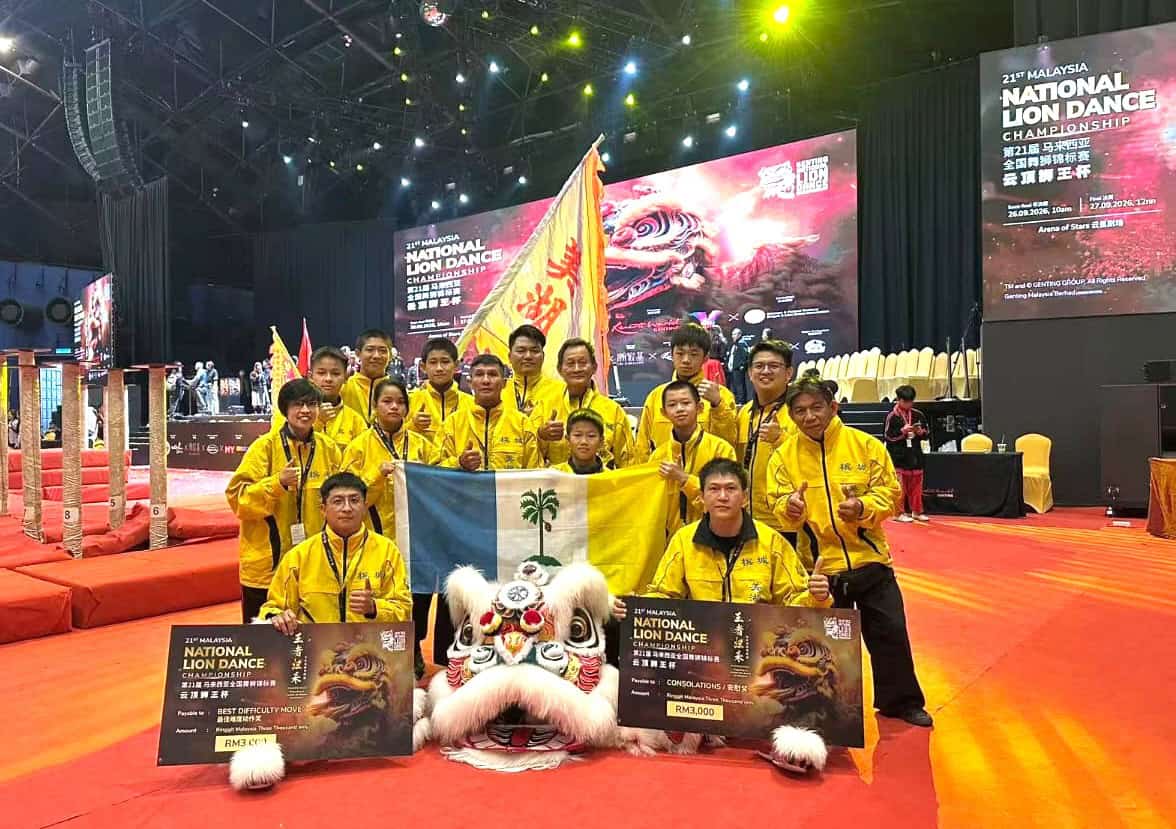

THE Penang Meihu Culture and Sports Association high pole lion dance team finished fourth in the 21st Malaysia National Lion Dance Championship 2026 “Genting Cup” Finals, after progressing through the Northern Region qualifiers and earning a place among 88 teams nationwide.
The team also won the Best Difficult Movement Award, bringing home RM3,000 for fourth place and another RM3,000 for the special award.
Assistant coach Loh Chin Hoong told Buletin Mutiara that the team’s journey began with the regional qualifiers in June and continued through the semi-finals and finals in September, spanning about four months of preparation.
He said the competition, regarded as one of the country’s premier lion dance championships, presented the team with various challenges, including financial constraints, prop-making, athletes’ age and physical fitness, as well as adapting to the different pole formations used in Genting.
“From the Northern Region qualifiers in Kuala Lumpur to the semi-finals and finals in Genting, the team spent a five-figure amount on transportation, accommodation, meals, registration fees and competition equipment.
“For a team that is primarily driven by cultural preservation, this was certainly a considerable financial commitment,” he said.
Loh said the team also arrived in Genting three days ahead of the semi-finals and finals to allow the athletes to acclimatise to the high-altitude environment and colder weather, with the accommodation and meals funded by the team.
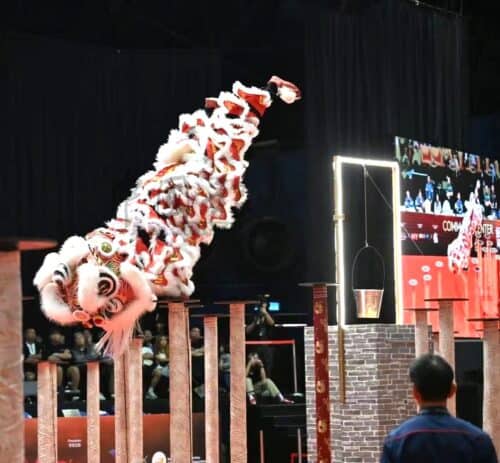
He added that prop-making was another challenge, as the team sought to enhance its storytelling through the use of props.
“Since we do not have specialists in prop-making, our coaches and members had to conduct their own research and take part in the entire process.
“We faced many challenges along the way, but eventually managed to produce what the audience saw during the competition,” he said.
Experience and adaptability are key to performance.
Loh said the team’s lion head and lion tail performers, Loh Chin Hee and Lai Choon Aun, are both 33 years old, making them one of the older pairings in this year’s national finals.
He said high-pole lion dance athletes generally reach their competitive peak between the ages of 17 and 25.
“As such, we had to find ways to manage their physical demands, especially when competing against younger athletes.
“We adjusted the choreography to allow better energy distribution throughout the performance and also introduced training methods to help them adapt to Genting’s high-altitude conditions, including training while wearing masks,” he said.
Another challenge was the pole formations used at Genting.
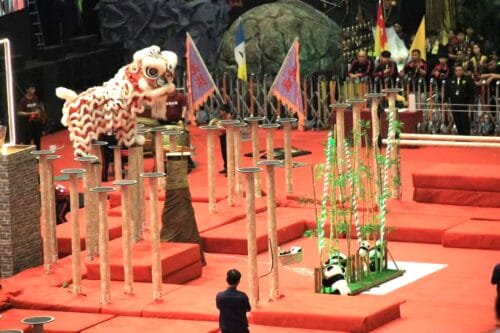
Loh said the “Wang” formation differed significantly from the standard pole formation used in the team’s other competitions.
“This meant that the athletes had to adjust the choreography, transitions, rhythm and energy distribution according to the pole formation.
“After completing the Penang state-level competition in June, we returned to our training hall that same night and immediately began working on the routine for the Genting competition,” he said.
The team subsequently won the Northern Region qualifiers and secured a place in the Genting semi-finals.
However, with other competitions scheduled in July, the athletes had to continuously adjust their routines according to different pole formations and competition requirements.
Loh said preparations for the September Genting semi-finals officially began around mid-July and lasted about two months.
“During this period, we constantly refined the routine and worked on finding the most suitable movements and energy distribution for the Genting pole formation,” he said.
High-difficulty movement earns special award.
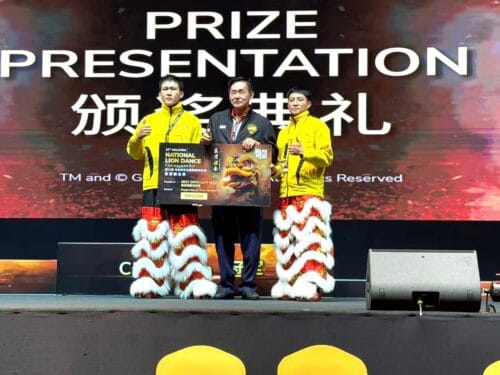
The team’s winning entry for the Best Difficult Movement Award involved the lion head performer executing a 180-degree backward turn while jumping 2.5 metres, followed by the lion tail performer dropping through the air to execute the next part of the sequence before returning to the pole.
Loh said the team was the only one in this year’s competition to perform the particular sequence.
“The movement carries a high degree of difficulty and has strong visual appeal.
“When we performed it during the competition, we received enthusiastic applause from the audience, while the judges also recognised the difficulty of the movement,” he said.
However, he stressed that the team’s overall performance was not built solely around difficult movements.
The team performed under the theme “Flying Over Dangerous Peaks, Rescuing the Panda”, featuring a story about a lion encountering a panda cub that had fallen into a well.
The lion eventually uses the principle of leverage to rescue the cub and reunite it with its parents.
Loh said the team also experimented with new musical arrangements, including a double-drum technique accompanied by qilin cymbals.
“Although some of these combinations were new to us, they worked well with the lion’s movements and jumps on the high poles,” he said.
He added that the team had always been keen to challenge itself with high-difficulty movements.
“When we learned that the Genting competition had introduced the Best Difficult Movement Award, we did aim for the honour.
“We therefore incorporated several challenging movements into our routine, and we are pleased that the effort paid off,” he said.
Scores improve throughout competition
Loh said the team’s score improved progressively, from 9.26 in the Northern Region qualifiers to 9.35 before reaching 9.40 in the national finals.
He attributed the improvement to the overall choreography, musical coordination, movement execution and the incorporation of high-difficulty elements.
“It was not simply about performing difficult movements.
“The overall arrangement of the routine, the coordination between the lion dance and music, and the athletes’ ability to manage their energy all contributed to the final performance,” he said.
The team has participated in four competitions so far this year, securing both first and second places at the Penang-wide championship, winning the Northern Region championship and finishing fourth at the national level.
Loh said the team has not set any specific target for its next competition.
“Our coaches always remind the athletes to maintain high-intensity training after every competition.
“Once we step off the podium, everything starts from zero. Training must continue,” he said.
He also expressed appreciation to the coaches, athletes and their parents, as well as committee members and members of the public who had supported and assisted the team throughout its journey.
Story by Ammar Mikhail Aamer
Pix courtesy of Penang Meihu Culture and Sports Association