

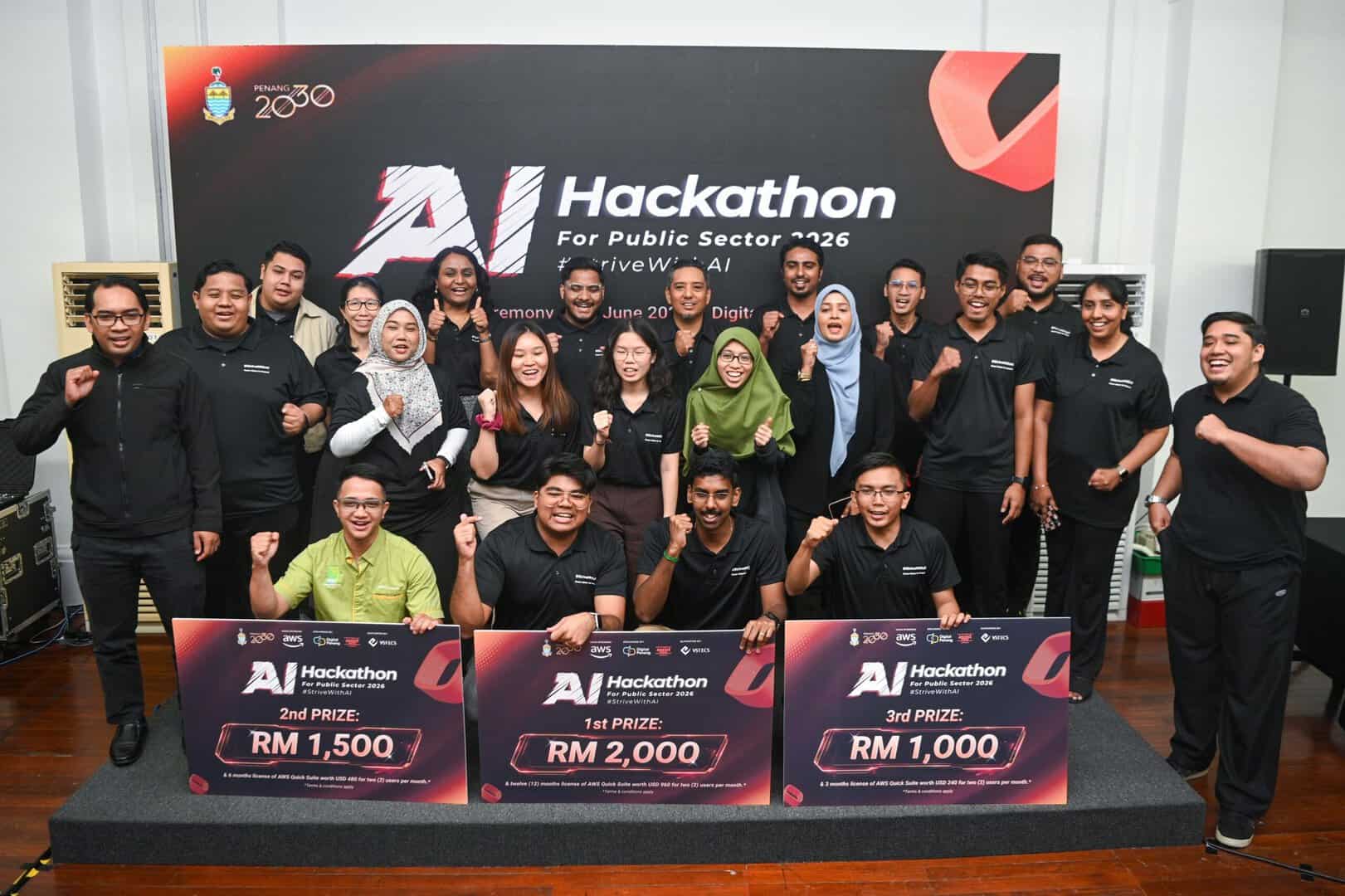

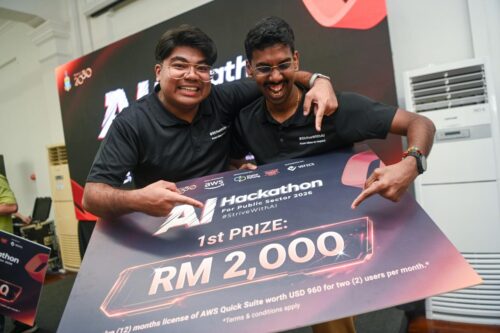
THE Penang Convention and Exhibition Bureau (PCEB) emerged champion of the AI Hackathon for Public Sector 2026 after impressing judges with an artificial intelligence-powered solution designed to strengthen the enforcement and monitoring of short-term rental accommodation (STRA) across Penang.
Representing PCEB to receive the champion’s mock cheque worth RM2,000 were researcher J. Revin Samuel, 28, and senior executive for marketing and communications Arvind S. Santhaselvan, 25.
Named GovtSTRA Penang, the winning project is a real-time digital ecosystem that enables local councils to monitor whether STRA operators comply with existing regulations while enhancing the management of condominium developments.
According to the team, the application provides local authorities with real-time updates and supports proactive enforcement efforts involving short-term rental accommodation.
The project also addresses Penang’s existing STRA guidelines introduced in 2023, which stipulate that Airbnb operators are allowed to rent out their premises for only 180 days annually.
Through the proposed system, guests are required to scan a QR code upon checking in, while security personnel at condominium guardhouses can scan the same code to monitor occupancy and ensure the permitted duration is not exceeded.
The team described GovtSTRA Penang as a real-time proactive enforcement platform for short-term rental accommodation, aimed at improving compliance while providing better oversight for local councils and property management bodies.
The first runner-up was Penang Hill Corporation, which received RM1,500, followed by the Penang State Legislative Assembly, Penang State Secretariat Office (PSUKPP) as second runner-up, taking home RM1,000.
Meanwhile, the Penang Green Council (PGC) finished in fourth place, while Chief Minister Incorporated (CMI) received the consolation prize.
Earlier, Digital Penang chief executive officer Ng Kwang Ming expressed his appreciation to Ashisuto Global Technologies and Amazon Web Services (AWS) for serving as the strategic partner and main sponsor of the AI Hackathon for Public Sector 2026.
“The programme would not have been possible without the support, expertise and commitment of all parties involved,” he said.
Ng said the hackathon aligns with the Penang2030 vision of strengthening digital transformation within the public sector while building a smarter, more resilient and competitive state.
He added that the programme also supports the implementation of the Penang Digital Economy Master Plan (DEMP), particularly Initiative DG-2.2, which focuses on expanding technology adoption among state government agencies and government-linked companies (GLCs), while nurturing a culture of innovation across the public sector.
Describing the hackathon as more than just a competition, Ng said it served as a learning platform that allowed civil servants to explore the potential of artificial intelligence, identify actual workplace challenges and develop practical digital solutions.
He explained that participants began their journey through hands-on workshops using the Amazon Quick platform, where they were introduced to low-code and no-code approaches that enabled them to build functional prototypes without requiring extensive technical or programming knowledge.
“The main objective of this hackathon is not to produce a perfect product, but to build confidence and capability.
“Every prototype can still be improved, but the experience of developing these solutions proves that digital innovation can be realised by those who best understand the challenges on the ground.
“This is the programme’s greatest achievement, a shift in mindset. When public officers have the confidence to experiment, innovate and build their own solutions, the culture of digital transformation within the public service will continue to grow,” he said.
Ng also thanked the panel of judges for contributing their time, expertise and valuable feedback throughout the competition.
Congratulating all 14 participating teams, he said every team had demonstrated a willingness to learn, the courage to innovate and a strong spirit of collaboration.
“Regardless of today’s results, every team has shown that innovation can begin with public servants who understand the real challenges faced in public service,” he added.
Ng stressed that the closing ceremony marked not the end of the programme, but the beginning of more digital transformation initiatives within the public sector.
He expressed hope that the ideas, prototypes and experience gained throughout the hackathon would continue to be refined and eventually implemented by participating agencies.
“Digital Penang remains committed to working closely with the state government, public agencies and industry partners to strengthen innovation and accelerate digitalisation across Penang’s public sector,” he said.
Meanwhile, state Infrastructure, Transport and Digital Committee chairman Zairil Khir Johari, who delivered his address virtually after being unable to attend the event in person, said digital technology is fundamentally reshaping how people live, work, govern and interact.
He noted that technologies such as cloud computing, data analytics, intelligent chat agents, and artificial intelligence are no longer emerging innovations but have become key drivers of global transformation.
“As such, the public sector must continue strengthening its capabilities and readiness to adopt digital technologies to improve governance efficiency and service delivery to the people.
“AI is not intended to replace humans, but to enhance our capabilities. It can automate routine tasks, support more accurate data-driven decision-making and reduce repetitive workloads that consume significant time and resources,” he said.
Zairil said the hackathon had provided valuable exposure for public sector officers and employees of Penang’s government-linked companies by enabling them to build real AI-powered solutions using no-code and low-code approaches without requiring coding expertise.
He urged participants to continue refining, testing and implementing the ideas developed during the programme within their respective organisations.
“This is how we will ensure that the true impact of digital transformation is ultimately experienced by the people,” he said.
Zairil also recorded his appreciation to Ashisuto Global Technologies and AWS for their expertise, commitment and confidence in supporting the state’s public sector digital transformation agenda.
Also present during the closing ceremony were CMI general manager Datin S. Bharathi, Collaborative Research in Engineering, Science, and Technology (Crest) advisor Datuk Seri Abdul Halim Hussain, Ashisuto chief executive officer Cefinny Teh, and others.
Story by Kevin Vimal
Pix by Siew Chia En