

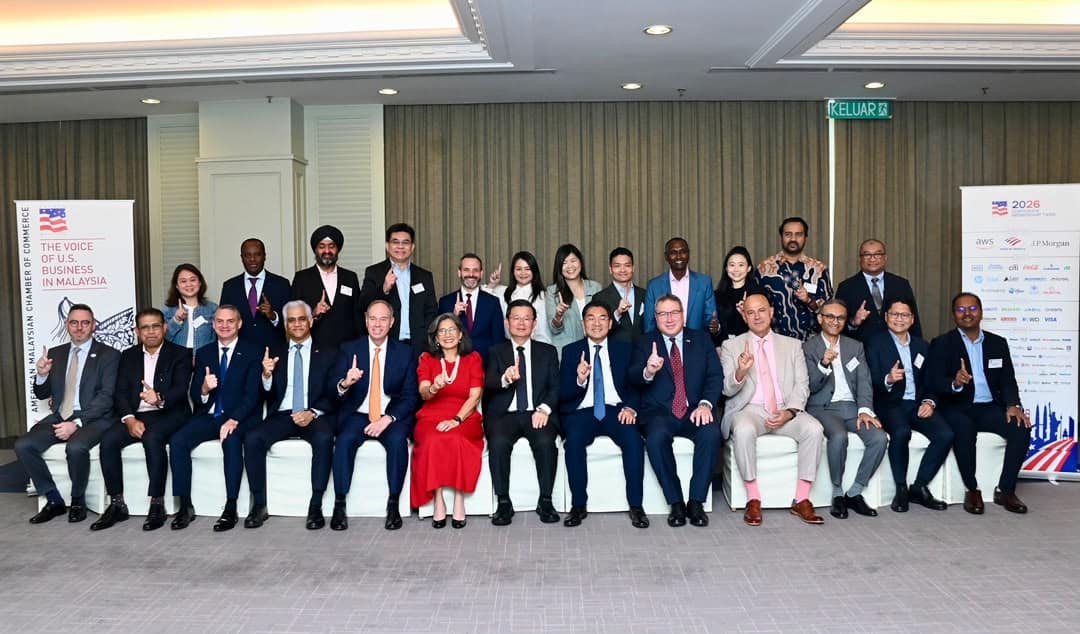

PENANG has warmly invited American companies to work with local companies and grow together, says Chief Minister Chow Kon Yeow.
Speaking at the eighth AMCHAM Penang Dialogue at the E&O Hotel today, Chow encouraged American companies to partner with local ATE players in technology development, supplier localisation and supply chain strengthening.
Themed “The US-Malaysia Advantage”, the dialogue brought together industry and government representatives to discuss opportunities for deeper collaboration between Malaysia and the United States.
Chow said that in the 1970s, the Eight Samurai set up operations in Penang, comprising four American companies — Intel, Hewlett-Packard (HP), Texas Instruments and Advanced Micro Devices (AMD) — as well as two from Japan and two from Germany.
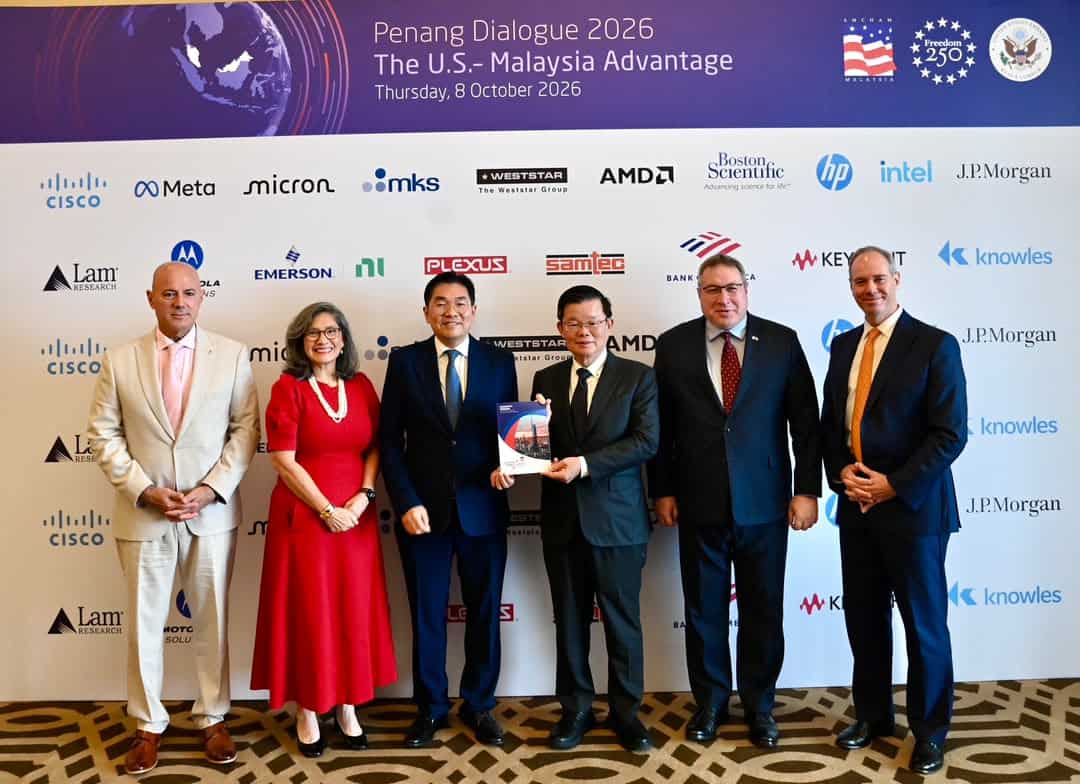
“They took a bet on a small island with big ambitions, and that bet has paid off, for them and us,” Chow said in his speech.
“More than fifty years ago, a handful of American companies believed in Penang. Today, let us give the next generation of companies, on both sides of the Pacific, the same reason to believe.”
Among those present were Deputy Minister of Investment, Trade and Industry (Miti) Sim Tze Tzin, US Ambassador to the Republic of Tunisia Bill Bazzi, Charge d’ Affaires of US Embassy in Kuala Lumpur David ‘Chip’ Gamble, AMCHAM chairman Datuk Timothy Garland and AMCHAM chief executive officer Datuk Siobhan Das.
Moving forward, Chow said the state’s strategy rested on three priorities — attracting strategic investments that strengthen its ecosystem, enabling local companies to join the global value chain, and developing AI-ready talent to drive innovation.
The task ahead, he added, is to build on more than 50 years of partnership by creating the conditions for US companies to stay, expand and take on higher-value activities in Penang.
“This is not a journey we take alone. Working hand in hand with our investors, with AMCHAM and with our government partners, I am confident the best chapters of the US-Malaysia story are still ahead of us,” he said.
Chow said companies today asked harder questions than cost alone when deciding where to invest, including whether they could find trustworthy partners and a reliable, long-term ecosystem.
Penang, he highlighted, had been answering these questions for more than half a century.
Chow recently returned from a trade mission to the US with the InvestPenang team, where they engaged with 13 stakeholders, including AMD, Bank of America, Intel, Lam Research and Micron Technology.
It was also a special moment for him and the delegation to visit Intel, one of the state’s original Eight Samurai, now led by Malaysian-born chief executive officer Lip-Bu Tan.
“Their confidence in Penang remains strong,” he said.
From 2020 to the first half of 2026, Penang attracted RM18.2 billion in approved US manufacturing foreign direct investment (FDI), accounting for 38% of the national total. More than 100 American companies call Penang home.
In terms of trade, of the RM177.7 billion worth of electrical and electronics (E&E) products Malaysia exported to the United States, RM155.4 billion, or 87%, came from Penang.
In December 2024, Chow launched Penang Silicon Design @5km+, or PSD@5KM+, an accelerator programme for IC design companies.
“In less than two years, our incubates are already moving from technology development towards commercialisation. That proves Penang does not only have semiconductor capabilities. We now have homegrown semiconductor companies with the potential to scale globally, moving from ‘Made in Malaysia’ to ‘Made by Malaysia’,” he said.
Penang has also launched the Malaysia ATE Campus in Penang, backed by RM25 million from the Ministry of Economy under the 13th Malaysian Plan.
It will build an integrated ecosystem for Automated Test Equipment (ATE), helping local solutions move from co-development all the way to their first customer deployment.
Meanwhile, Sim said the United States has remained one of Malaysia’s vital trading partners.
He said Malaysia is fully committed to keeping its relationship with the US strong, predictable, and open, and will do everything to get the best outcomes for both nations.
He recalled that among the visionary companies that built factories in the Bayan Lepas Free Trade Zone in the 70s were iconic American companies like Intel, Advanced Micro Devices (AMD), Hewlett-Packard, and National Semiconductor, which later became Fairchild Semiconductor.
“Malaysia has never forgotten that gesture. You trusted us when we were just getting started. That early trust planted the seeds for what Malaysia is today — a nation that supplies over 13% of the world’s microchip testing and packaging. For that, we are deeply grateful,” he said.
Sim said the United States stands out as one of Malaysia’s premier export destinations.
In 2025 alone, Malaysia’s exports to the US surged by 17.2% to reach over RM 233 billion, making the American market its second-largest export destination globally.
He noted that over the past three years, US direct investment stock in Malaysia stood above USD 10 to USD 12 billion.
Every year, he added, those investments generate billions of dollars in net profits that flow back to parent companies in the United States, supporting American shareholders and R&D.
On top of that, while Malaysia exports hardware and microchips to the US, Malaysia is a major consumer of American digital services and technology.
According to the Department of Statistics Malaysia (DOSM), Malaysia imported over RM 81 billion (USD 18+ billion) worth of services from the United States in 2025, making the US its largest source of services imports.
“Looking ahead, we want our bond with American companies to grow even deeper. We don’t want you to view Malaysia merely as an assembly line, or a market. We want you to treat us as a true strategic partner.
“Help us build local industries. Connect deeper with our local small and medium suppliers. Bring your advanced design and R&D activities to our shores. Help us train our young engineers in artificial intelligence and green technology.
“When you help local industries grow, you build a stronger, more reliable supply chain for yourselves. Let us continue to work together, innovate together, and grow together,” Sim said.
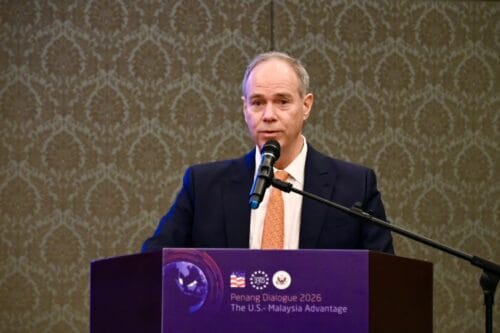
AMCHAM chairman Datuk Timothy Garland highlighted that the Penang-US partnership has grown from strength to strength, adding that US companies are firmly committed to Malaysia.
He said the dialogue was to explore how to build a stronger and more durable relationship to advance both Malaysia’s and US businesses.
Story by K.H. Ong
Pix by Alissala Thian
Video by Siew Chia En