

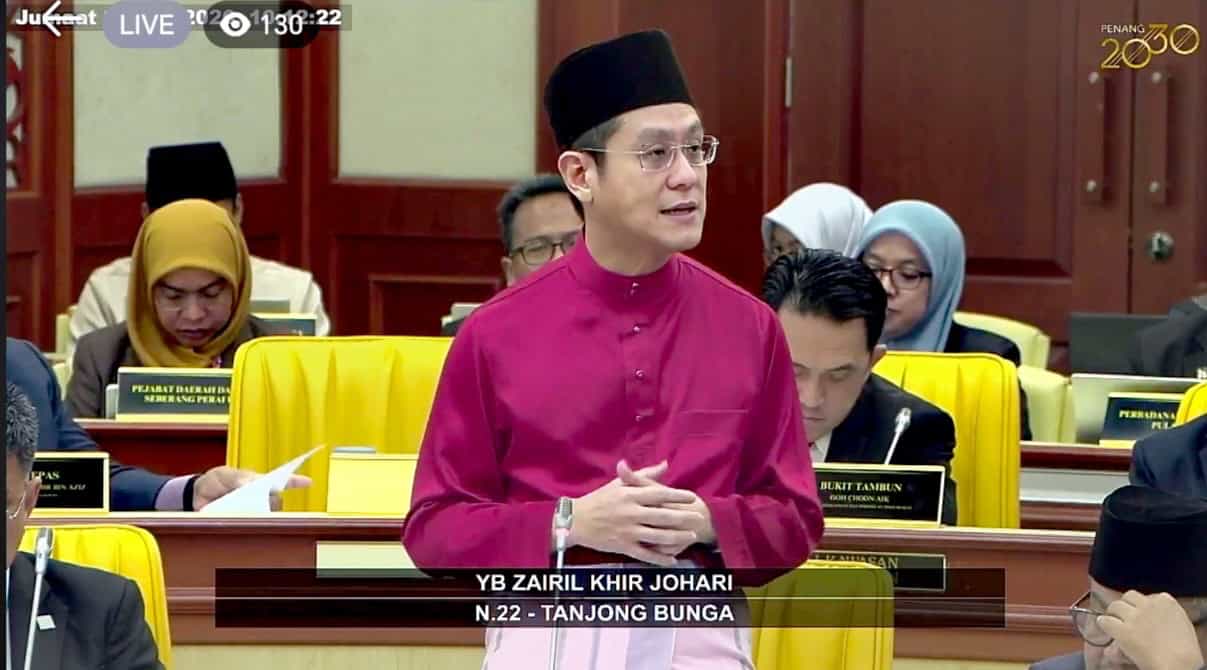

PENANG will not have to bear the estimated RM8.4 billion cost of developing infrastructure for the Perak-Penang Water Project, as the expenses will be covered by Prasarana Air dan Irigasi Perak Sdn Bhd (PAIP), says state Infrastructure, Transport and Digital Committee chairman Zairil Khir Johari.
He explained that PAIP would be responsible for the costs associated with infrastructure construction, operation, maintenance and land acquisition, ensuring that the Penang Water Supply Corporation (PBAPP) would not have to shoulder the substantial upfront financial burden.
Zairil said PBAPP signed a Conditional Bulk Water Supply Agreement (BWSA) with PAIP on July 15 this year to purchase at least 300 million litres of treated water per day (MLD) over a 40-year period, from 2032 to 2072.
“The main objective of this agreement is to strengthen Penang’s long-term water supply security through a second water source.
“This strategy will not only reduce Penang’s dependence on water from Sungai Muda but also help meet the state’s projected water demand, which is expected to exceed 1,162 MLD by 2032,” he said.
He was responding to an oral question from Lee Khai Loon (PH–Machang Bubuk) at the Penang State Legislative Assembly in Light Street today.
Zairil said due diligence assessments had been conducted on various aspects of the project, including technical, operational, commercial and financial considerations.
“The primary consideration is to ensure that Penang has a sustainable second water source to meet the future needs of its people and industries, particularly as the options for developing new raw water sources within the state are limited after 2030,” he said.
On the financial risks associated with the project, Zairil reiterated that PAIP would finance and implement the development of the main infrastructure.
Meanwhile, any matters concerning water tariffs would remain subject to the consideration, approval and regulation of the National Water Services Commission (SPAN).
He stressed that the agreement signed between PBAPP and PAIP was conditional and would only come into full effect once all the stipulated conditions precedent had been fulfilled, including obtaining approval from SPAN and PBA Holdings Bhd’s shareholders.
“If these conditions are not met, the agreement will not be fully implemented,” he said.
In response to a supplementary question from Muhamad Kasim (PN–Teluk Bahang) on whether the project could lead to future water tariff adjustments, given the estimated RM24.6 billion in water purchase costs over the agreement’s 40-year duration, Zairil said any proposed tariff adjustments would require approval from SPAN and the Federal Government.
“Under this project, the agreement that has been signed is conditional.
“Therefore, any proposed water tariff increase must first obtain SPAN’s approval and advice,” he said.
Addressing concerns over the RM24.6 billion figure, Zairil acknowledged that the amount might appear substantial but emphasised that it represented the total projected cost of purchasing water over four decades, rather than an immediate financial commitment.
“The RM24.6 billion figure may sound large, but it covers a period of 40 years.
“The water purchased from Perak is not intended to be stored. Instead, it will be sold to industries in Penang at higher commercial rates, which are above domestic water tariffs,” he explained.
He added that the state government would do its utmost to minimise the impact on Penang residents should any water tariff adjustments be introduced in the future.
On a separate matter, Zairil said a proposed pedestrian bridge along Jalan Telok Air Tawar had been incorporated into the preliminary design for a road upgrading project in North Seberang Perai.
He was responding to an oral question from Azmi Alang (PN–Telok Ayer Tawar), who urged the state government to reconsider the need for a pedestrian bridge along the busy road, citing frequent accidents and the high concentration of schools, mosques and commercial establishments in the area.
Zairil said the need for the facility had been taken into account under the preliminary road upgrading works from the BORR junction (Section 765) to Permatang Pak Elong (Section 773) along Federal Route FT001 in North Seberang Perai.
“The scope for constructing the pedestrian bridge has been incorporated into the road-widening design phase, based on the Social Impact Assessment (SIA), which takes into account the concentration of schools, mosques and commercial establishments along the route,” he said.
However, he noted that the construction of the pedestrian bridge would be subject to Federal Government approval and the availability of funding for the construction phase of the project.
Story by Riadz Akmal