

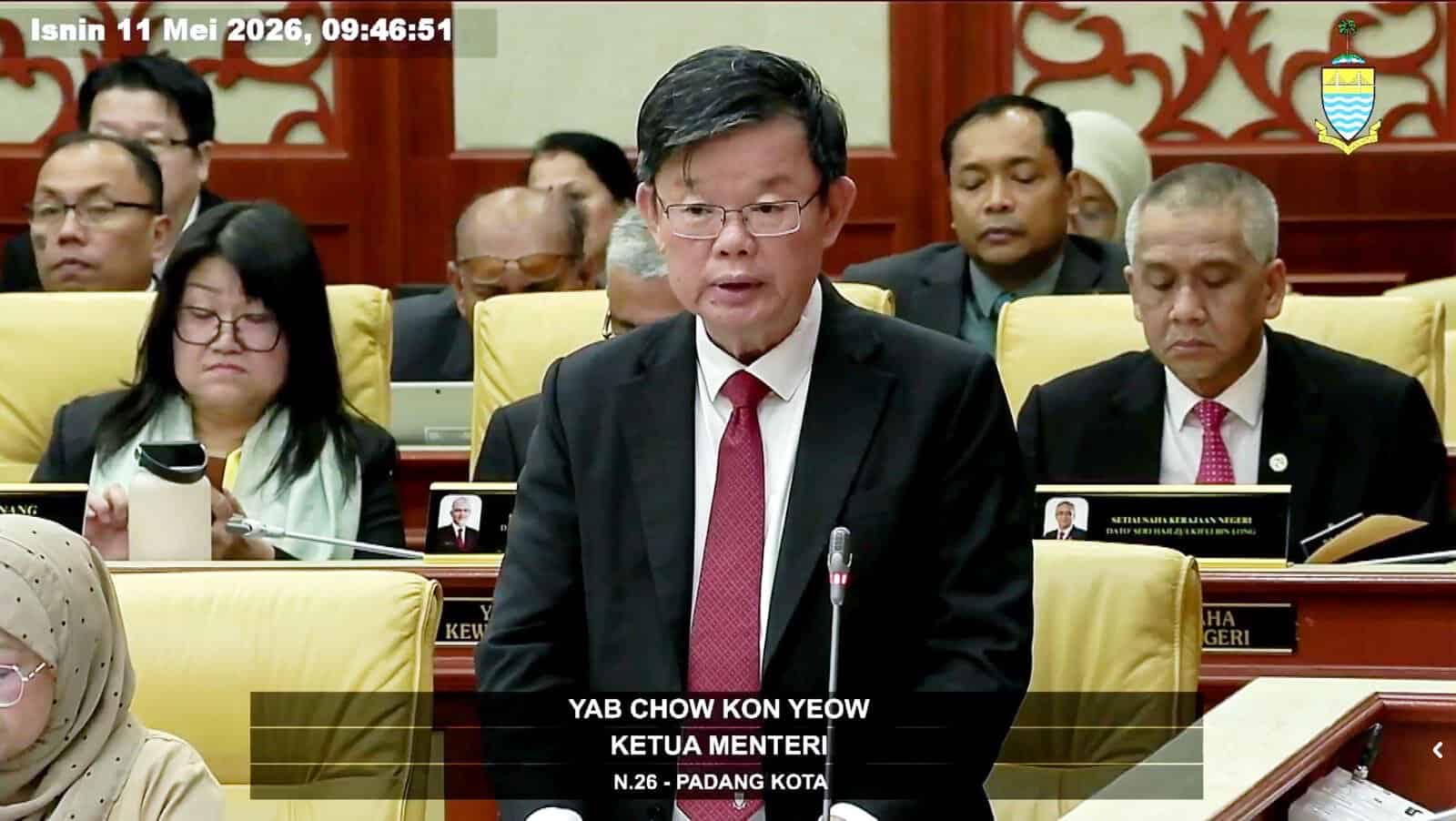

THE Penang government will maintain the existing two-term limit for the chief minister for now, while keeping an open mind on possible future alignment with federal developments, the State Legislative Assembly was told.
Chief Minister Chow Kon Yeow said the state currently has no plans to amend the constitutional provision defining the tenure of the chief minister from “two terms” to a fixed “10 years”.
The clarification came during an oral question by Lee Khai Loon (PH – Machang Bubuk), followed by supplementary questions from Lee and Gooi Hsiao-Leung (PH – Bukit Tengah).
Lee had asked whether the state would consider redefining the two-term limit to an aggregate 10-year cap to mirror proposed federal changes.
Responding, Chow explained that the current interpretation of “two terms” is based on the constitutional definition of a term of the State Legislative Assembly.
“The definition of a term begins from the first sitting until the Assembly is dissolved. The second term likewise begins from the first sitting after an election until dissolution,” he said.
He noted that because the Assembly can be dissolved earlier than five years, a chief minister’s total tenure across two terms may be less than 10 years.
“In this situation, the total years for the first and second terms may be less than 10 years but cannot exceed 10 years,” he said.
Chow also confirmed that there is no plan at this time to amend the provision.
“For now, the state government has no plan to amend the definition from ‘two terms’ to ‘10 years’.”
In response to Lee’s supplementary question, Chow said the Penang amendment in 2018 was based on the political stability at the time.
He recalled that discussions began in 2018 through the Federal-State Coordination Meeting (FMK), which he chaired.
“Based on the 2008–2013 and 2013–2018 terms, both were full five-year terms. On that basis, we felt it was appropriate to use the term system rather than a fixed 10 years,” he said.
He added that the state would have considered aligning with the federal constitution if amendments at the parliamentary level had been passed.
“If the constitutional amendment in Parliament had been approved, perhaps we could consider aligning the state constitution to 10 years instead of two terms. We will wait to see whether Parliament can pass the amendment when it is tabled again,” he further explained.
Chow acknowledged that political developments since 2018 have altered the landscape and raised new considerations.
“The political situation in the country changed after 2018 and 2022, and early dissolutions have become more common.
“This was not something we could have anticipated in 2018 when political stability was stronger,” he said.
Chow also emphasised that legally, there is no requirement for Penang to dissolve its assembly early to follow federal elections.
“From a legal standpoint, there is no obstacle for Penang to complete a full five-year term if we choose not to follow an early parliamentary dissolution,” he added.
However, he noted that political considerations may come into play.
“Today, besides legal considerations, we also need to consider political factors. If Parliament is dissolved early, should the state follow?
“In such circumstances, the state government may end up serving three or four years instead of a full five,” Chow said.
Meanwhile, Gooi highlighted that Penang was the first state to amend its constitution in 2018 to limit the chief minister’s tenure.
He questioned whether the current system is fair if early dissolutions reduce the actual length of service.
“Is it fair that the chief minister may not be able to serve a full term, especially since the constitution does not account for the caretaker period?” he asked, suggesting the state consider adopting the federal proposal in future.
Chow reiterated that the state has taken note of the suggestion and would monitor developments at the federal level before considering any changes.
Story by Kevin Vimal
Pix by Siew Chia En