

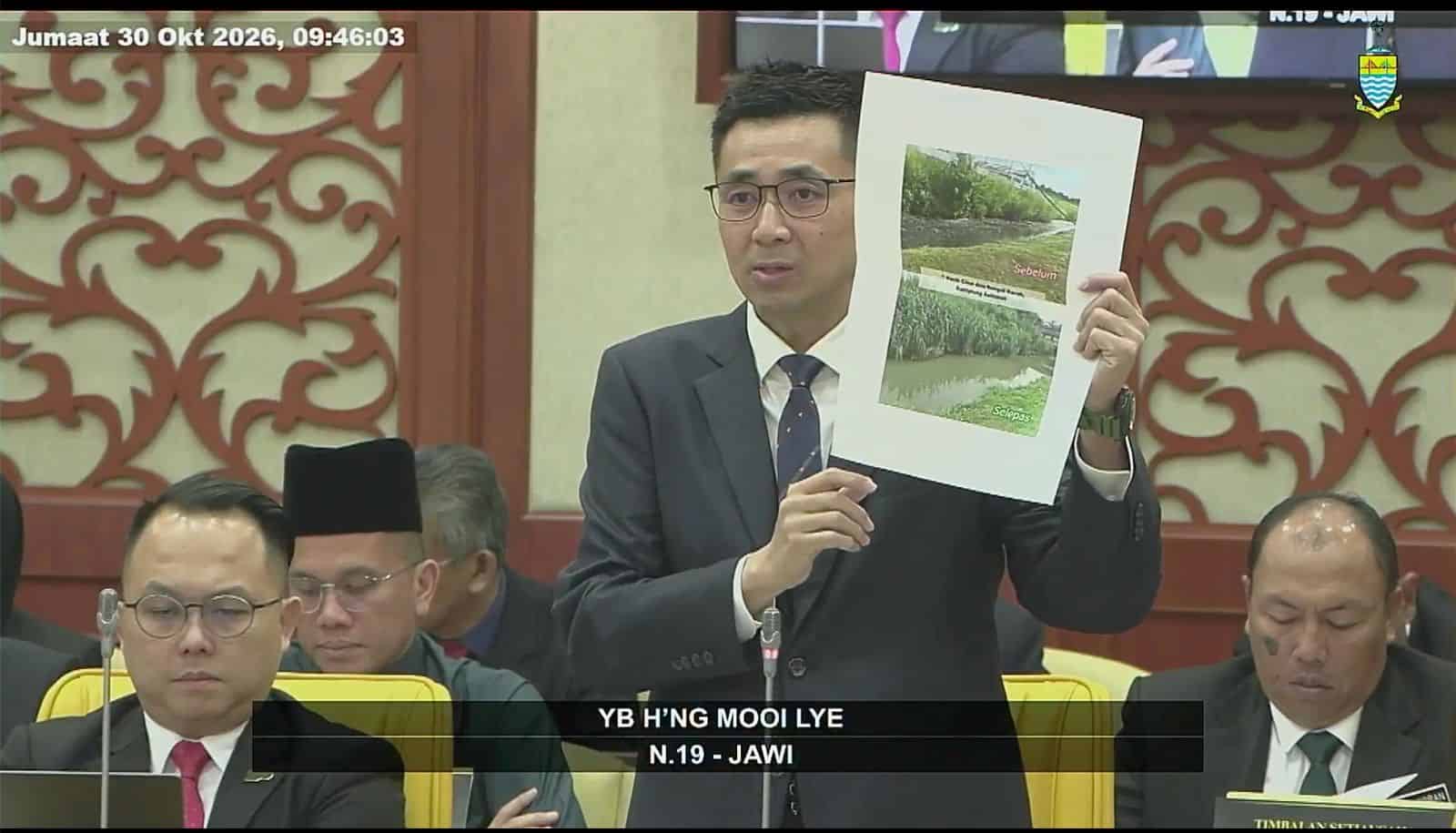

PIG farms in Kampung Selamat have started sending their waste to a biogas plant in Ampang Jajar for processing as part of efforts to address the pollution and foul smell affecting Sungai Kereh.
State Local Government, Town and Country Planning Committee chairman H’ng Mooi Lye (PH-Jawi) said the initiative began on May 4 this year and was aimed at preventing livestock waste from entering the drainage system that flows into the river.
He said the move was expected to help reduce pollution and minimise the odour problem in the surrounding area.
“All pig farms in Kampung Selamat have started sending their pig waste to the biogas plant in Ampang Jajar for processing,” he said in reply to a question from Bukhori Ghazali (PN-Pinang Tunggal) during the question-and-answer session at the State Legislative Assembly sitting today.
H’ng said the Penang Veterinary Services Department (JPVPP) also carried out weekly applications of Useful Microbes Activated Solution (UMAS) into public drains in Kampung Selamat to help control pollution and reduce the foul smell.
He said inspections and enforcement actions were also carried out to ensure pig farmers complied with the stipulated livestock waste management requirements.
“Moving forward, the department will continue monitoring the transportation of pig waste to the biogas plant, carry out weekly UMAS applications and step up enforcement against farmers who fail to comply with the regulations,” he said.
On the standards used to assess the effectiveness of the measures, H’ng said Regulation 25(2) of the Pig Farming Licensing Regulations (Penang) 2020 required ammonia gas concentrations in enclosed pig pens to remain below 20 parts per million (ppm), while hydrogen sulphide levels must be below 5ppm.
He said gas readings taken inside the enclosed pens were within the permitted limits.
However, he clarified that these readings reflected gas concentrations inside the pig pens and did not directly represent the water quality index or odour levels in Sungai Kereh.
On the financial allocation, H’ng said JPVPP had set aside RM6,000 annually for the weekly application of UMAS into public drains in Kampung Selamat.
He added that the state government would also undertake cleaning works at Parit Cina and Sungai Kereh, which were expected to begin in the first quarter of 2027.
The works would involve removing accumulated sediment to improve water flow and help reduce pollution in the affected areas.
In a supplementary question, Bukhori acknowledged the state government’s efforts but questioned their effectiveness.
He also asked what other measures could be introduced to address the pollution, particularly the ammonia levels and pig waste entering the drainage system.
In response, H’ng said the condition of the water in Sungai Kereh could be affected by rainfall.
He said JPVPP officers visited the area every week to conduct monitoring and collect data.
“We will continue taking the necessary initiatives and monitoring the situation to find a lasting solution to the long-standing pollution problem,” he said.
Story by Edmund Lee