

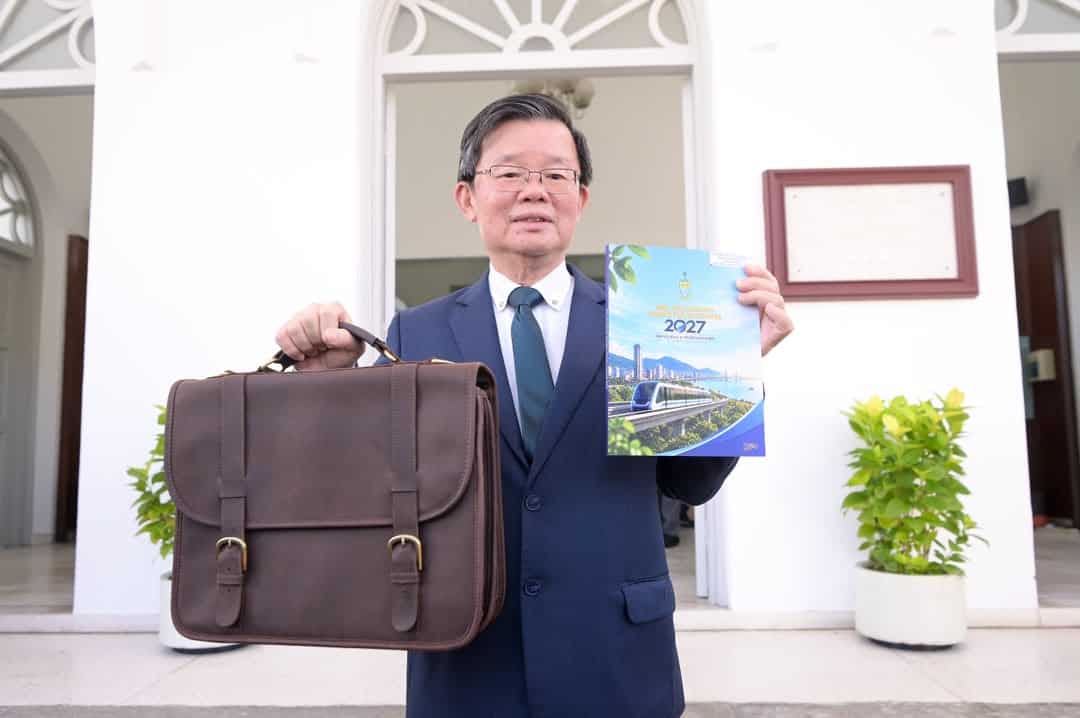

PENANG has projected a record-low budget deficit of RM5.62 million for 2027, down from RM19.92 million in 2026, as the state continues to strengthen its economic competitiveness while prioritising public well-being and strategic development.
Chief Minister Chow Kon Yeow said the state’s estimated revenue for 2027 stood at RM1.069 billion, against total estimated expenditure of RM1.074 billion.
Tabling the Penang Budget 2027 at the State Legislative Assembly today, he said the budget, themed “Making the Vision People-Centred, Forging a Legacy”, reflects the state government’s commitment to translating development aspirations into tangible benefits for the people while laying a strong foundation for future generations.
“Anchored in the aspirations of Penang2030, the budget emphasises sustainable economic growth, improved public well-being and the development of a more resilient, inclusive and harmonious Penang for all,” he said.
Its five main pillars are driving high-value economic growth; strengthening infrastructure and state resilience; developing talent and the potential of future generations; safeguarding public well-being and harmony; and strengthening governance and fulfilling responsibilities.
Chow said progress should not be measured solely by economic growth figures, but also by improvements in people’s lives through quality jobs, better incomes, affordable housing, efficient connectivity, a safe environment, access to education and healthcare, and equal opportunities.
“The state government will continue to drive quality investments, strengthen economic competitiveness and create more high-value employment opportunities so that the benefits of development can be enjoyed comprehensively and equitably,” he said.
Strong economic performance
Penang is poised to enter 2027 on the back of a strong economic foundation, with its gross domestic product (GDP) reaching RM130.3 billion in 2025, compared with RM121.4 billion in 2024.
Chow said the 7.3% growth recorded last year exceeded both the 4.7% achieved in 2024 and the national economic growth rate of 5.2%.
The manufacturing sector remained the main pillar of the state’s economy, contributing 47.3% of GDP, while the services sector accounted for 46.7%.
Penang also maintained its position as the country’s leading exporting state, recording RM113.2 billion in exports in September 2026, an increase of 96.2% from the same period a year earlier. This represented about 52.6% of Malaysia’s total exports.
During the same period, the state recorded RM64 billion in imports, up 139%, accounting for approximately 35.3% of national imports.
From January to June 2026, Penang secured approval for 177 manufacturing projects under the supervision of the Malaysian Investment Development Authority (Mida) with investments totalling RM17.32 billion.
These comprised RM12.83 billion in approved foreign direct investment and RM4.49 billion in domestic investment, with the potential to create 19,337 jobs.
InvestPenang has set a target for the state’s manufacturing investment to reach RM10 billion in 2027.
Revenue rises, expenditure trimmed
The state’s financial position also improved significantly in 2025, with revenue increasing to RM1.26 billion from RM810.46 million in 2024.
Chow said this represented an increase of RM449.52 million, or 55.46%, with the state receiving positive feedback from the Auditor-General on its fiscal performance.
The state’s financial statements for the year ended Dec 31, 2025, received an unqualified audit certificate on June 29, 2026.
Penang recorded a budget surplus of RM366.93 million in 2025, reversing the deficit of RM174.09 million in 2024.
Consequently, the Consolidated Revenue Account balance rose from RM155.94 million at the end of 2024 to RM522.87 million at the end of 2025. As at Oct 30, 2026, the balance stood at RM651.28 million.
For 2027, operating expenditure is estimated at RM1.042 billion, while another RM31.92 million is allocated for charged expenditure, bringing total estimated expenditure to RM1.074 billion.
Operating expenditure comprises RM231.8 million for emoluments, RM219 million for services and supplies, RM4.32 million for assets, RM607.96 million for grants and fixed charges, and RM11.38 million for other expenditure.
Overall, estimated operating expenditure will decline by RM13.49 million, or 1.24%, compared with 2026.
The increase in emoluments is attributed to annual salary increments for civil servants, while higher spending on services and supplies reflects the minimum wage increase from RM1,700 to RM2,000, which takes effect in June 2027.
The higher minimum wage is expected to increase government contract costs for cleaning, maintenance, security and other existing outsourced services. Rising costs of official state functions and fuel will also contribute to the increase.
Meanwhile, spending on grants and fixed charges is expected to fall by RM36.63 million, or 5.68%, partly due to a reduction in the state’s contribution to the State Development Fund from RM265 million in 2026 to RM240 million in 2027.
Tax revenue for 2027 is estimated at RM224.94 million, while non-tax revenue is projected at RM566.11 million and non-revenue receipts at RM277.79 million.
Non-tax revenue remains the largest source of state revenue, supported by projected receipts from land premiums and special payments, as well as investment interest.
From January to Oct 30, 2026, the state collected RM847.53 million in revenue, equivalent to 79.35% of its annual target of RM1.068 billion.
The state government will continue monitoring collections and working with revenue-collecting departments to achieve the 2026 target.
RM280.17mil for development
Penang has allocated RM280.17 million for development expenditure in 2027, a decrease of RM38.4 million, or 12.1%, from 2026.
“Priority will be given to strategic projects that strengthen the state’s capacity, improve quality of life and deliver tangible benefits to the people,” Chow said.
A total of 514 projects have been listed for implementation, covering public infrastructure, community facilities, sports development and strategic economic initiatives.
Story by K.H. Ong
Pix by Noor Siti Nabilah Noorazis